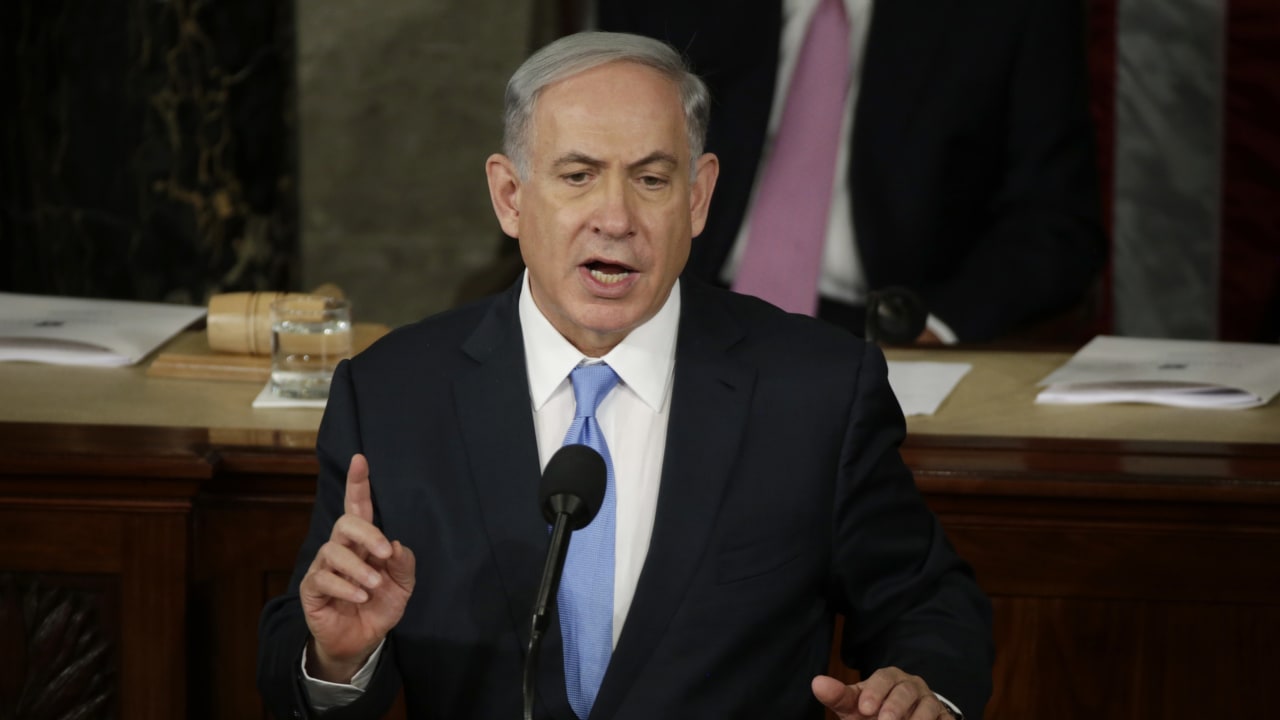
Exactly 11 years ago, on March 3, on the eve of Purim, Prime Minister Benjamin Netanyahu delivered what was arguably the most consequential speech of his career.
Standing before a joint session of Congress, he laid out a full-throated case against the nuclear agreement that then-US president Barack Obama was negotiating with Iran. The speech failed in its immediate objective. The Joint Comprehensive Plan of Action went through. The deal was signed. Netanyahu did not stop it.
But immediate outcomes tell one story. The passage of time often tells another.
Today, as Israel and the United States strike Iran’s nuclear infrastructure together, Netanyahu’s 2015 address reads less like a failed intervention and more like a blueprint for action. Arguments that were fiercely contested at the time now sound less alarmist and harder to dismiss.
In 2015, Netanyahu’s central claim was straightforward: the deal would not prevent Iran from obtaining nuclear weapons but would, once its restrictions expired, all but guarantee that outcome. Had President Donald Trump not withdrawn from the agreement in 2018, most of the sunset clauses in the deal would now be expiring.

Netanyahu warned about breakout time. He warned about centrifuges left spinning. He warned about infrastructure left intact. He warned against “kicking the can down the road.”
Lessons of October 7 massacre
Eleven years later, one of the cardinal lessons of October 7 is that threats deferred do not disappear; they metastasize. Israel was not prepared to take that risk with a nuclear Iran.
At the time, many Democrats dismissed Netanyahu’s argument as exaggerated and needlessly confrontational toward a sitting American president. The administration insisted the deal blocked Iran’s pathways to the bomb. Netanyahu insisted it paved the way.
Today, the debate has shifted.
Trump’s decision to strike Iran rests on an argument very similar to Netanyahu’s in 2015: that Iran’s nuclear ambitions endure, that its infrastructure poses a risk to the world, and that diplomacy has proven insufficient.
Netanyahu framed the Iranian regime not merely as a regional power seeking influence but as a revolutionary actor driven by militant ideology and expansionist ambition. He spoke of Tehran “gobbling up” nations. Critics scoffed.
In the intervening decade, Iran’s footprint across the region – Hezbollah, Hamas, the Houthis, militias in Iraq, and Syria – became undeniable. The question ceased being whether Iran sought regional dominance; it became how that dominance could be constrained.
Some warnings fade with time. This one did not.
If Netanyahu’s strategic analysis aged well, the political consequences of that speech have also endured.
Netanyahu opened his 2015 address by expressing regret that his appearance was perceived as political. He emphasized that the US-Israel alliance had always been above politics and must remain so.
It did not.
Israel did not become a partisan issue because of that speech alone. But the speech accelerated a process already underway.
By accepting an invitation from a Republican House speaker without White House coordination and against its express wishes, Netanyahu stepped directly into America’s partisan crossfire.
Dozens of Democrats, including then–vice president Joe Biden, boycotted. The optics were that this was very much a partisan issue.
Until then, support for Israel had been one of Washington’s most durable bipartisan pillars. Republicans and Democrats disagreed on much, but Israel was rarely one of those disagreements.
That changed – not solely because of Netanyahu and not solely because of Obama – though both contributed to turning Israel policy into a partisan policy fight.
The results are visible today.
A new Gallup poll released last week shows that 41% of Americans now say they sympathize more with the Palestinians, compared with 36% who sympathize more with Israelis, the first time since 2001 that Israel does not hold the edge.
The partisan divide is stark. Among Democrats, sympathy leans 65% toward the Palestinians and 17% toward Israel. Among independents, it tilts 41% to 30% toward the Palestinians. Only among Republicans does Israel hold a commanding advantage, 70% to 13%.
These shifts reflect long-term demographic and generational trends. But the 2015 speech marked a psychological turning point. The image of dozens of Democrats boycotting an Israeli prime minister highlighted that Israel was no longer politically neutral territory.
And that divide has only widened.
Another factor shaping the current landscape is Trump.
Trump's pro-Israel stance
Trump is unapologetically pro-Israel. He is also deeply polarizing.
Like Israel’s numbers in the Gallup poll, his approval ratings, according to a recent CNN poll, have fallen over the past year, dropping from 48% to 36%.
Among independents, it stands at just 26%. Republicans remain overwhelmingly sympathetic to Israel. Democrats overwhelmingly are not. Independents have shifted.
Is there a correlation? The overlap is hard to ignore, even if it is not definitive proof. But polarization has consequences.
In today’s political climate, when a polarizing figure strongly embraces something, opposition to him can spill over into opposition to whatever he embraces. In other words, those who dislike Trump may dislike Israel by extension because Trump likes Israel.
That does not fully explain shifting attitudes toward Israel.
But it likely contributes to it. The polling numbers show overlapping patterns: independents have moved away from Trump while simultaneously expressing greater sympathy for Palestinians. Younger voters show similar trends.
If 2015 marked the moment Israel visibly became a partisan issue, 2026 may mark the moment when that battlefield begins shaping Israel’s public standing in ways Jerusalem cannot easily influence, and that has as much to do with America’s rifts as with Israel.
There is, however, another legacy of the 2015 speech.
By publicly challenging an American president over Iran, Netanyahu signaled to Sunni Arab states that Israel viewed Tehran as the central strategic threat and was prepared to act accordingly. They viewed Iran the same way.
That convergence of interests laid the groundwork for the Abraham Accords. It would be an overstatement to say the speech caused those accords. Covert ties predated the speech, and it was also born of economic pragmatism and fatigue with the Palestinian stalemate.
But the speech crystallized something.
It demonstrated Israel’s resolve. And for Arab leaders weighing whether Israel could be a reliable partner against Iran, that mattered.
Iranian missile attacks of the last three days – not only against Israel but also against the Gulf states – show that the shared threat perception was real, not theoretical.
Much has changed, obviously, between March 2015 and March 2026.
In 2015, Netanyahu confronted an American president pursuing accommodation with Iran. Today, he finds himself aligned with an American president willing to use force against Iran.
Yet the American political environment is far more fractured. The bipartisan consensus Netanyahu praised from the podium in the House chamber has eroded.
Public opinion is divided by party, age, and identity more sharply than at any time in recent memory.
What has not changed is Netanyahu’s worldview.
In 2015, he declared that the days when the Jewish people remained passive in the face of genocidal threats were over. Even if Israel had to stand alone, he said, it would stand.
Eleven years later – notably – it is not standing alone; America is standing with it, but it is an America more divided than ever in its feelings toward Israel.
The speech that once appeared to be a failed gambit now looks more like an inflection point, one that anticipated today’s confrontation with Iran but also helped usher Israel into America’s partisan divide.
The debate, in other words, is no longer only about Iran. It is about where Israel sits in America’s political conversation – and whether that place can ever again be above party politics.