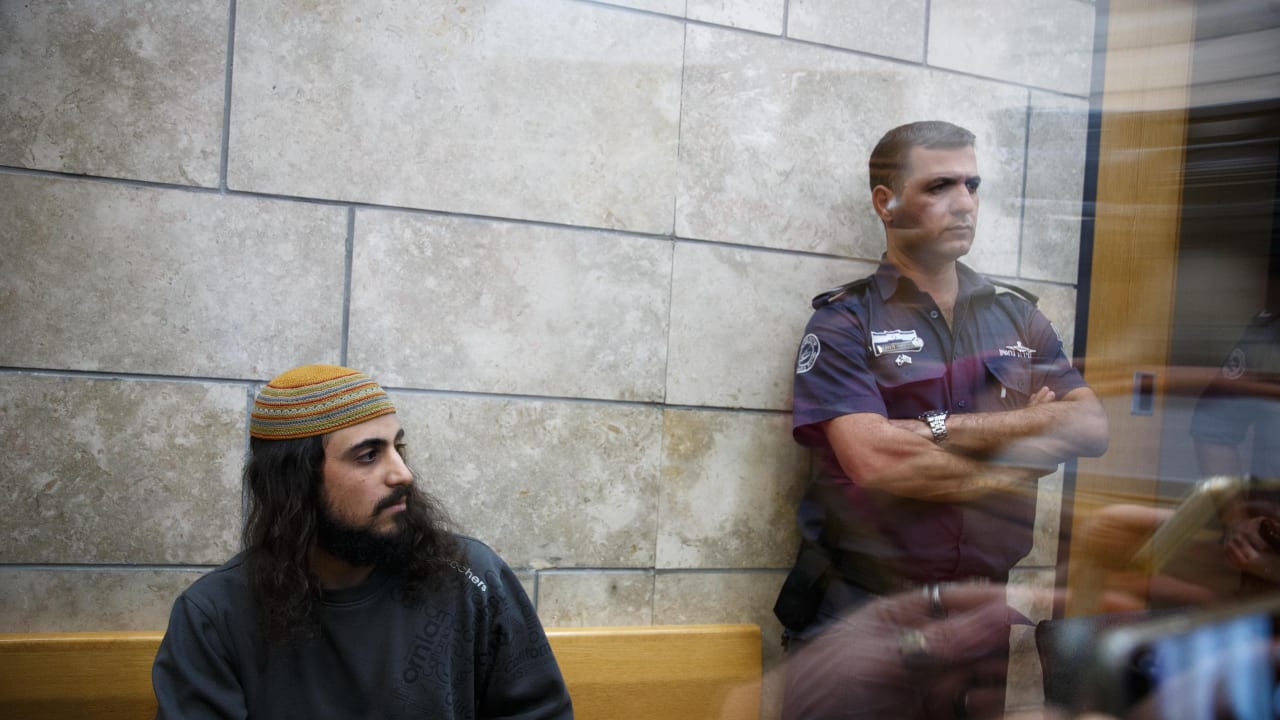
The Beersheba Magistrate’s Court has ordered Yinon Eliya Reuveni, who was convicted over the 2015 arson attack on the Church of the Loaves and Fishes near the Kinneret, to reimburse the state roughly NIS 2.5 million for compensation it paid to the church after the attack, in a ruling that frames the case not only as a question of damages, but as part of the state’s response to ideologically motivated violence against a religious minority.
In the ruling, Deputy President Judge Yaniv Boker accepted the state’s claim in full and held that Reuveni must repay the compensation paid to the church, along with about NIS 70,000 in attorney fees and NIS 5,000 in court costs.
The court rejected Reuveni’s argument that the incident should not have been treated as “war damage” or as harm connected to the broader Israeli-Palestinian conflict, and found that the state had lawfully compensated the church before seeking restitution from the person responsible.
The June 2015 attack on the church, one of Christianity’s most revered sites, drew widespread condemnation in Israel and abroad.

Reuveni was later convicted in the Nazareth District Court of aggravated arson, vandalism motivated by hostility toward a public group, conspiracy, and related offenses.
Israel court enforces church arson repayment
A co-defendant, Yehuda Assaraf, was acquitted. In 2017, Reuveni was sentenced to four years in prison, fined NIS 50,000, and ordered to pay compensation; the Supreme Court later increased the sentence to five-and-a-half years after the state appealed.
Media coverage at the time consistently treated the arson as part of the phenomenon of Jewish extremist “price tag” violence, and the Shin Bet (Israel Security Agency) said when the suspects were arrested that they belonged to a radical group whose activity was driven by an extremist anti-Christian and anti-Arab ideology.
According to the agency, the same circle was also linked to other planned or attempted attacks on religious sites.
What is new in the present case is the civil aftermath. The state told the court that in 2016 and 2017 it paid the church a total of about NIS 2.5 million after then-attorney-general Avichai Mandelblit determined that the arson constituted an act of violence motivated by religious-ideological hostility, directed against Israel’s Christian minority, and could therefore be treated as compensable under the law.
Having paid the church, the state then sought subrogation – effectively stepping into the victim’s shoes and demanding reimbursement from the perpetrator.
Boker accepted that approach and emphasized that a person who intentionally causes ideological damage cannot expect the public treasury to absorb the cost of his actions.
The court also rejected Reuveni's selective-enforcement claim, noting that the state pursues similar reimbursement suits in appropriate cases and that doing so reflects its duty to protect public funds.
The ruling closes a long legal chapter in one of the most symbolically charged Jewish extremist attacks of the past decade. The church was reopened in 2017 after restoration work, in a ceremony attended by then-president Reuven Rivlin, who said the state was committed to freedom of religion and to protecting holy sites.
But while the criminal case had ended years ago, the civil case left open a further question: who ultimately bears the financial burden when ideologically motivated violence damages a site the state has decided it must compensate? This judgment gives a clear answer: not the public, if the perpetrator can be made to pay.