
‘The tension between us was real when Yitzy said he was signing up for his sixth round of reserve duty. For me, it’s my family first, then nation and border. But he believes that by going to the border, he is defending his family here in Jerusalem. It was like that for him in his first round of reserve duty, and it’s still like that with his sixth.”
When Yitzy Friedman received a call-up notice for the reserves on October 7, 2023, his wife, Roni, watched him pack his things and leave within minutes.
Nearly three years later, as Yitzy serves in a sixth round of reserve duty, Roni is preparing to give birth to their fourth child while also wrestling with the cost of her husband’s decision to serve. She spoke to The Jerusalem Post about the tension between family obligations and national service.
Roni grew up in Petah Tikva, one of three siblings in a “religious but open” family. Today, she is a team lead in the Tel Aviv office of an American hi-tech company.
Prior to working in hi-tech, she worked in the public sector for over a decade (with MK Uri Orbach, the Jerusalem Municipality, and the Student Union), but said she is better suited to her current job as she “loves connecting people, whether around a product, or around technology, or around values.”
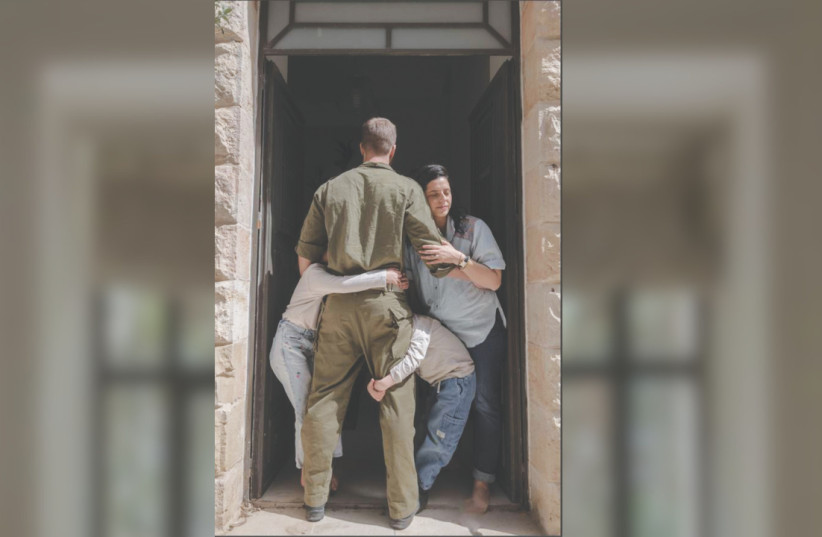
She met her husband, Yitzy, on a blind date while at university in Jerusalem 12 years ago, and they have been together ever since.
On October 6, 2023, the family was in their Jerusalem home, celebrating Simchat Torah with the rest of their community. Roni had just given birth to her third child a few weeks prior and had a tiny baby in tow.
“It was beautiful; I remember it like it was yesterday,” she recalled.
Tension, uncertainty loom as reserve duty call ups begin
However, the next morning, the family awoke to the sirens and went straight down to the building shelter. For the next few hours, Roni said she saw people “called up for miluim [reserve duty] in front of our eyes.”
“We joined our community in the synagogue across from us. I remember one person going to the army and then his wife sitting and crying like crazy,” she said.
“This guy didn’t die that day, but he had such a strong trauma that this was the last time we all saw him acting like himself. He is not functioning three years later. He was one of the first ones in Kfar Aza,” Roni continued.
She said she felt tension and uncertainty about what the situation would mean for the family, but never imagined Yitzy would leave.
“And then the first second he got the phone call that he needed to come up North, he started getting ready to leave. I was completely shocked. I couldn’t stop him, I couldn’t communicate with him,” Roni said.
“It was very surreal. He just started organizing stuff and said, ‘Roni, I’m sorry, everybody has to go.’ He took me outside. He hugged me. And then he just left. And you couldn’t stop him. It was a force stronger than nature,” she continued.
Left alone with two small children (ages three and four) and a newborn, Roni felt overwhelmed.
Then she heard a knock on the door: It was Yitzy’s brother. “He told me: ‘I came to be with you because he’s going to be out for a while. So don’t worry, I’m staying until everything gets clearer.’
“He moved in with us, which was the most surreal situation. He slept in the other room, and the kids slept with me in my bed. And we just passed the time together.”
Yitzy was gone for 40 days. During this time, she didn’t see him once and could barely speak to him on the phone either.
LATER, YITZY recounted what that time was like for him.
“On October 5, we had come back from a trip up North in the Golan with a group of friends and family and kids, and we did apple picking in a beautiful field in the Golan.”
When he left home on October 7, he took a tank and started driving in the Golan, passing through the same apple-picking field.
“Two days before, I was here with my family and friends picking apples; two days after I’m in a tank ready to fight any second, thinking I’m going to meet terrorists, and it was just surreal,” he recalled.
Yitzy fought consistently for the first six months of the war. “I understood completely that October 7 was an SOS, but with the months passing, I felt like I was drawn into this at the cost of putting my family in distress,” he said.
During this time, Roni was worried but at the same time felt a lot of resentment and anger.
She understands that for Yitzy, protecting his family means serving in the army. But she feels differently.
Roni shares conflicting feelings
“For me, it was his way to protect a country, a border, and other people who are not my family. And I felt like he was not seeing the price of what’s happening inside my house,” Roni said.
“With time, this anger unfolded. On the one hand, I’m always admiring him for putting his values in front, and the society and our nation in front, but I cannot pretend that it doesn’t create tension when our house is literally falling apart. We’re not in this good place, and [he] choose to go and defend the border.
“The perspective is just different. I don’t think my perspective is recognizable to him. I think it’s foreign to him in so many ways,” she said.
In those first few months of the war, Roni said that her feelings were not taken into account, and there was no conversation that involved her.
She also said that, as a citizen, a woman who didn’t do the army but did national service, she felt she couldn’t fully comprehend the situation, and therefore it was not her place to say anything.
The first time she says she ever spoke about her feelings was when the two did a recorded interview with KAN 11 about the price that reserve-duty couples were paying during the war.
“It was seven months into the war, and a crew came to our house, and we sat and just talked. I think it was the first time he heard me saying that when he is in miluim, I walk down the street and my state of mind is: ‘One step I take, Yitzy is alive. The next step I will take, he might not be alive.’ This is the anxiety I experience when he’s away.
“I think it was hard for him to hear that, but it’s very hard to bring it into the conversation in the day-to-day life because it really hurts the rhythm of a house, and it creates hard discussions that you don’t usually have time for, as we are either on rounds or in between.”
'Family first, then nation and border and country and values'
THE THINGS Roni said helped her come to terms with the situation at the start of the war have become less powerful over time. She told herself at the start that Yitzy’s leaving to defend the border was necessary, that it was an emergency.
“But by the third round, the fourth round, the sixth round, I really didn’t understand.”
She began to recognize the difference between her and her husband: “For me, it’s my family first, then nation and border and country and values. I think he believes that going to the border defends us in Jerusalem.
“I think a lot of women will recognize that, during rounds, you just need to swallow that feeling to make sure the house will keep on running when he’s coming back. You don’t want a bad environment for your kids to grow up in.
“It’s very, very hard because you feel betrayed, in a way, every single time [he leaves]. I kept thinking that every moment, a rocket could come and drop on the building, and my husband would be somewhere else defending the border.”
This feeling of tension is exacerbated now, since Roni is six months pregnant with their fourth child.
She thought the pregnancy would allow Yitzy to say no to his current round of miluim (he is now serving his sixth round of reserve duty).
“I’m working additional US hours, and my support system is not the same at this point – people are busy. And there is pregnancy, and the kids are growing up and have more demanding activities.
“I wanted him to say ‘no’ just one time. It was such a big trigger for both of us, because I was sure that this was the one time it was okay to say no. But for him, it’s just not an option.”
Roni also said that she feels a lot of guilt about being “this wife who is not happy and is always the one saying ‘no.’”
“I don’t know if they will be honest enough to say it, but a lot of women feel very guilty being the one who’s saying no [to their husbands serving].
“Why do I need to say ‘don’t go’? Look at me; see how I’m extremely scared of you going to Lebanon. Added to that is the lack of support. You should say, ‘This is not good for my family.’”
So much of Roni’s anger is also directed at the government. “I feel almost like they are using me and the status quo.”
She pointed out that the government relies on the fact that reservists will keep on coming to fight, keep on dropping everything. But she said that “at a certain point, you need to very naturally say that you cannot come anymore because life happens.”
Roni wants the government to make a plan, “so my husband will go to the sixth and seventh round [of reserve duty], but someone else will do the eighth one.”
“I never felt so used and hurt and angry at the government as I have since our kidnapped, the living and the dead, came back home,” she added.
Building a 'new normal'
RONI ALSO addressed what it’s like when Yitzy comes home – how her family tries to build a “new normal” that may only last two or three months.
“It can really throw me off. I can be very ‘not myself’ for three months now because I know there will be an end to this. In a way, miluim became the routine, and the in-between became the time that we get allowance for.
“In the first month, I’m on a high. I’ve got my family back. I can sleep at night. I don’t need to be worried about what’s happening.
“And then in the second month, I’m suddenly seeing all the gaps and frustration in our relationship. So many things come to the surface. All the tension that I built up and held when he was away, because I didn’t want to create a bad environment for the kids, and the frustration at home – it suddenly bursts because I need to say this stuff.”
She acknowledged that her experience of Yitzy coming home does not match his experience of coming back home.
“His experience of coming back from reserve duty is shocking, it takes time. His frustration comes up; he’s more agitated. He’s dealing with his work stuff, and he’s been out of the loop. Then, by the third month and fourth month, he’s going to the reserves again.
“So it’s very messy and not a linear kind of relationship. When we get sometimes half a year between rounds, stuff can become a little bit better.”
Roni stressed that Yitzy is an amazing father, and their kids have a very close relationship with him.
“He works really hard to make sure that his relationship with the kids stays the best,” she said. “When he comes back, he’s fully with them, really devoted, doing everything needed, talking to them, communicating with them. I think they have a very close relationship where they can reopen themselves to him and they can count on him.
“It is amazing to see that he really prioritizes the relationship with the kids. When he’s with us, he’s fully with us and takes all the responsibilities. He’s an extremely involved parent in general.”
HOWEVER, RONI, who is with the kids every day, spoke of her sadness that her parenthood is negatively impacted by the situation. “When it’s just you [taking care of them] for so long, the ability to be a patient and nice parent gets harmed. In a way, I hate that I got to this point that also my parenthood gets hurt by this.
“I have one child who is really angry at me when Yitzy’s in a round in the army; he takes all the frustration out on me. And I’m accepting it because I understand the psychology behind it. But it’s another price we pay with miluim – our parenthood is being compromised.”
Nevertheless, Roni said she has no doubt that the family will come out the other end a united unit. “We are a strong family. It takes a lot of therapy, but we will work on it, and we will do our best to come out as strong as possible.”
She said that she hopes the new life she is carrying will create a little bubble for the family. “I’m excited just to have a really good reason to focus on us.”
Roni also spoke of her love and admiration for her husband.
“I admire his values, even if they’re very different from mine. And he’s a very good-hearted person. Anyone who meets him can see it in his eyes; he’s an angel.
“It’s part of his flaws, too, because he will help anyone at any time, anywhere. Part of the scary thing about being his wife is that he will help someone until it can hurt him. So in a war zone, it’s extremely scary.
“He sounds tough, but he’s the most sensitive person. If I’m pretty sensitive, he’s an extremely sensitive person. That sensitivity really leads him in this world, and you can see it in his eyes. His heart is in his eyes.”
She has also learned to really admire herself.
“I think every woman, if they are asked how they have changed in the last three years and how proud they are, the answer will always be very positive. None of us thought we could hold so much for so long. I don’t want to do it for another second, but I’m definitely proud that, no matter what, I held the fort.”