
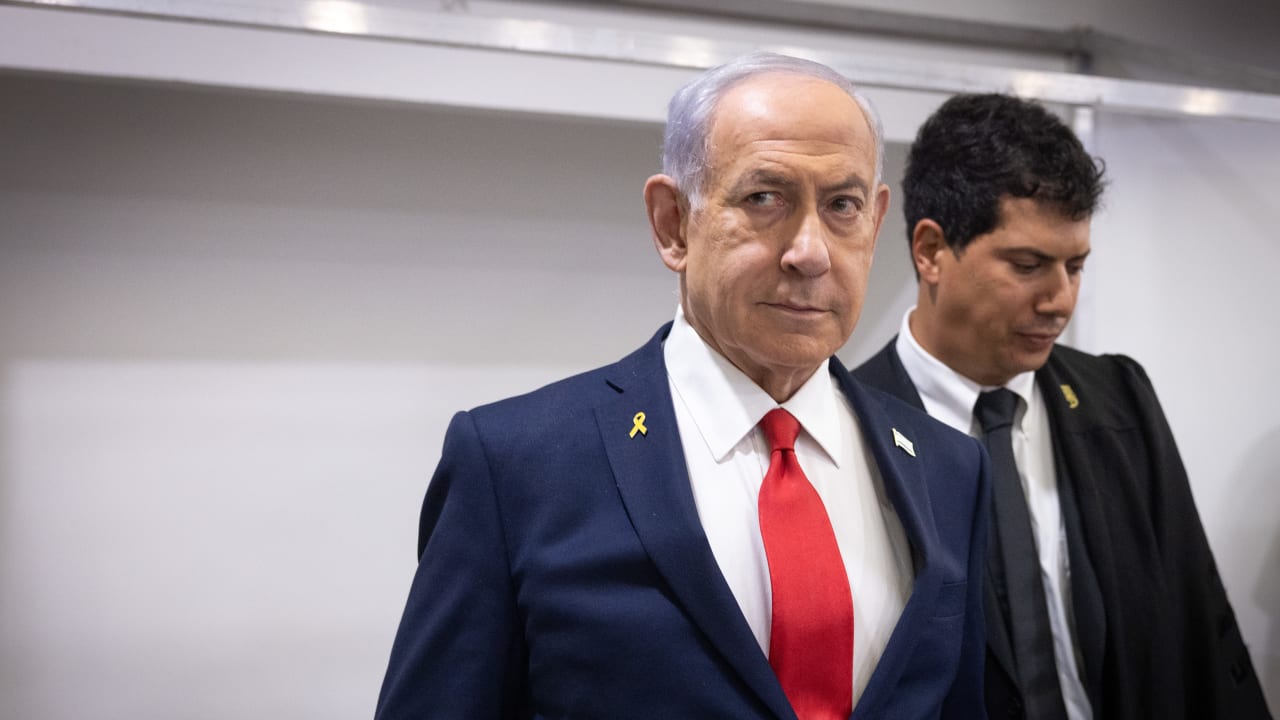
Prime Minister Benjamin Netanyahu’s cross-examination in his criminal trial ended on Tuesday after nearly a year of questioning, moving one of the most politically consequential trials in Israeli history into the final stretch of his testimony before the defense resumes questioning him.
Netanyahu’s testimony is not over. He is expected to return to the Tel Aviv District Court on Wednesday for questioning by his co-defendants’ attorneys, Yediot Aharonot publisher Arnon “Noni” Mozes and former Bezeq controlling shareholder Shaul Elovitch, before his own defense attorneys conduct a short re-examination.
If the coming hearings are not canceled or shortened, his testimony is expected to end by the end of the month or within the next two to three weeks. The cross-examination ended after 94 days of testimony by the prime minister, including 59 hearings of prosecution questioning, which began last June.
Tuesday’s hearing focused largely on Case 2000, the alleged quid pro quo between Netanyahu and Mozes. Netanyahu is charged in the case with fraud and breach of trust, while Mozes is charged with offering and promising a bribe.
Both deny wrongdoing.
Mozes offers to boost Netanyahu’s positive coverage
According to the indictment, Mozes offered to improve Netanyahu’s coverage in Yediot Aharonot and Ynet and to worsen coverage of his political rivals in exchange for the prime minister using his influence to promote restrictions on Israel Hayom, the free daily newspaper that posed a major economic threat to Yediot Aharonot.
Deputy State Attorney Yonatan Tadmor pressed Netanyahu on Tuesday over his December 2014 meetings with Mozes and with the late Sheldon Adelson, then the owner of Israel Hayom.
Tadmor argued that Netanyahu tried to convince Mozes that he would work to advance a softened version of the Israel Hayom bill in order to keep Mozes from launching a full attack against him before the 2015 election.
The prime minister rejected that interpretation. He said the main issue in his discussions with Adelson was the possibility that Adelson would buy Yediot Aharonot and Ynet, and that his talks with Mozes were part of a political fight over Israel Hayom, not a criminal arrangement.
“I wanted to reach an understanding with him on a softened law,” Netanyahu said, adding that such a law could only have been relevant after the election and depending on the next coalition, and he insisted that Mozes could “think whatever he wants.”
Tadmor confronted Netanyahu with his police statement that he had been trying to “buy time” until the election and to maintain a “cold war” rather than a “hot war” with Mozes.
'Keep your friends close, and your enemies closer'
Netanyahu responded in English: “Keep your friends close, and your enemies closer.”
He described Mozes as a political rival with powerful media tools. Yediot Aharonot and Ynet, Netanyahu said, had “crossed the line” in their coverage of him and his family, but that did not mean he was “doing business” with Mozes.
A cold war, he said, meant an effort to keep the fight from breaking boundaries and becoming a “catastrophe.”
The prosecution also questioned the prime minister over his decision to record conversations with Mozes and his later statements to the police.
Netanyahu said he had recorded Mozes to document what he described as the publisher’s methods of “carrots and sticks,” but that he did not view the conduct as a criminal threat or as bribery.
“No one in the world thought that positive or negative coverage was a matter of bribery,” Netanyahu said, arguing that the prosecution had invented a retrospective criminal theory around routine relations between politicians and media figures.
Tadmor argued that Netanyahu could not have publicly released the recordings because they captured what the prosecution views as a clear bribery offer by Mozes and because Netanyahu did not reject it outright.
Netanyahu denied this, saying Mozes was acting in his own interest and had offered him “nothing.” He also said he had not used the recordings because, after winning the 2015 election, the matter “left my memory.”
When Tadmor pressed him on why he initially told police he had not recorded the conversations and then gradually changed his account, Netanyahu said his memory had been refreshed during questioning.
He said he had not remembered the recordings because, from his perspective, the political battle over Israel Hayom had ended.
The hearing also briefly returned to Case 4000, the Bezeq-Walla affair, when prosecutor Yehudit Tirosh argued that Netanyahu’s willingness to discuss Mozes’s business interests undermined his claim that Elovitch never spoke to him about Bezeq.
Netanyahu said the comparison was false, because Mozes was a political rival seeking to limit Israel Hayom through legislation, while Elovitch, he said, never spoke to him about Bezeq.
The trial, which opened in 2020, includes three cases.
In Case 1000, Netanyahu is charged with fraud and breach of trust over gifts allegedly received from wealthy businessmen. In Case 2000, he is charged with fraud and breach of trust over the Mozes talks.
In Case 4000, he is charged with bribery, fraud, and breach of trust over allegations that regulatory benefits were advanced for Bezeq in exchange for favorable coverage on Walla.
Netanyahu denies all charges and has repeatedly described the cases as politically motivated.
The end of cross-examination comes after months of disrupted hearings, many shortened or canceled because of Netanyahu’s security and diplomatic schedule during the war, including the period surrounding the Iran conflict and subsequent diplomatic developments.
On Tuesday, the judges allowed Netanyahu’s testimony to be shortened by an hour and 15 minutes for security-diplomatic reasons and because he also asked for a break to join a government meeting by Zoom.