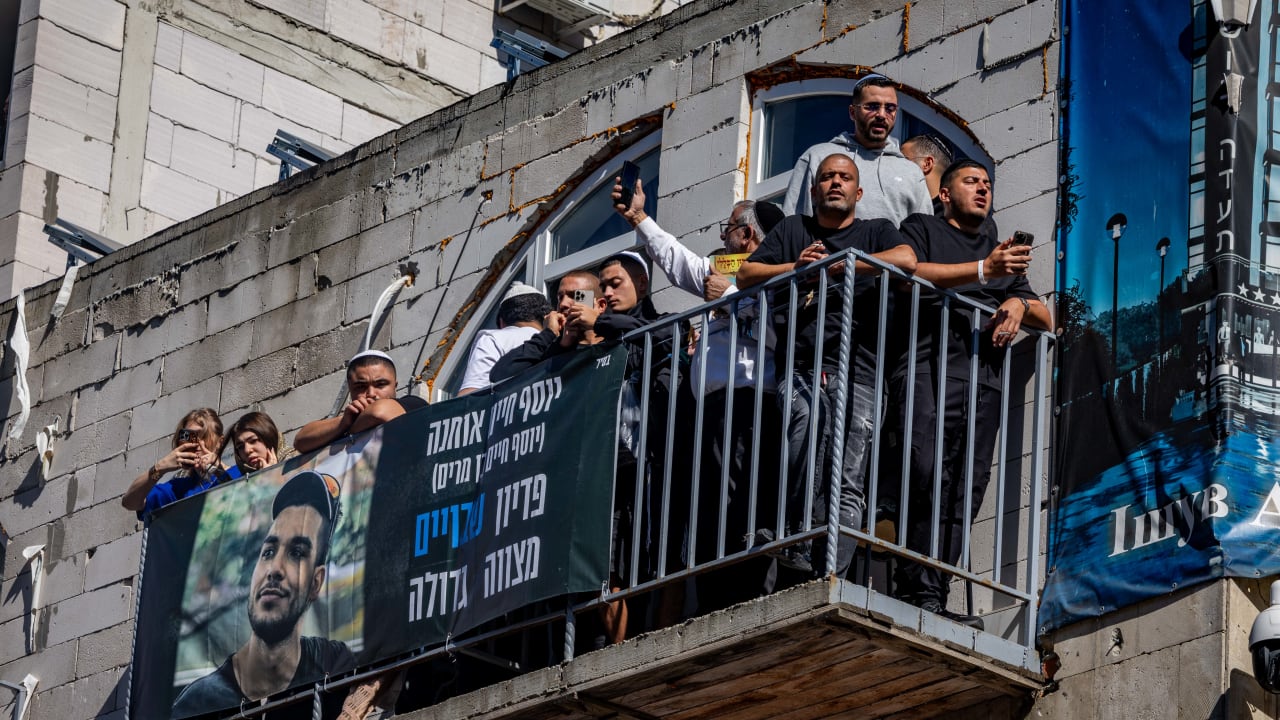
More than 60 draft dodgers have been arrested at border crossings since Sunday, many of them haredi (ultra-Orthodox) men attempting to travel to Uman ahead of Rosh Hashanah. Most of the arrests took place at Ben-Gurion Airport as the men attempted to leave Israel, while additional arrests were recorded at the Taba border crossing.
The IDF confirmed that dozens of draft dodgers were arrested at border crossings over the past two days but did not provide an exact number or details about the detainees. According to the military, enforcement is carried out routinely in coordination with the Population and Immigration Authority, and preparations for arrests of those who have failed to report for enlistment are adjusted based on situation assessments.
The IDF emphasized that those required to enlist can regularize their status and report for service.
The “I Entrusted Guards” hotline has meanwhile issued a warning to haredi youths at risk of arrest, urging them to avoid arriving at border crossings. The hotline warned that the risk is not limited to Ben-Gurion Airport and that attempts to leave Israel through land border crossings could also result in arrest.
The hotline claimed that young men who had already attempted to leave the country were arrested and transferred to military prison, warning that some could remain imprisoned during Rosh Hashanah. The warning comes as police continue preparations for increased activity at border crossings ahead of the annual wave of travel to Uman.

Pilgrimage has become an especially sensitive issue
Every year, tens of thousands of Breslov Hasidim from Israel and around the world travel to Uman, Ukraine, to pray at the grave of Rabbi Nachman of Breslov. This year, amid enforcement against draft dodgers, the pilgrimage has become an especially sensitive issue within the community.
Senior Breslov rabbis called on those who could face arrest not to arrive at Ben-Gurion Airport and not to attempt to resolve their status solely for the purpose of taking the flight. At the same time, an unofficial initiative has emerged within the community to hold Rosh Hashanah prayers in military prison if the trip cannot take place, in an attempt to create public and operational pressure on the IDF.
'I am willing to sacrifice my life for this'
A Breslov Hasid in his 50s who is in Uman with five of his sons told Walla: “There are boys who have been traveling every year since they were five years old. For them, getting to Uman is in their soul.”
He said some young men are following the rabbis’ instructions and will remain in Israel, while others say that they are “willing to sacrifice their lives for this.”
He described attempts to leave through various border crossings, including Egypt and Jordan, based on the assumption that screening there is less predictable. “Everyone has their own ideas. It is a game of cat and mouse,” he said.
One of his sons, 24, remained in Israel due to his military status, while two of his other sons serve in the IDF.
Military Police activity is carried out in cooperation with the Population and Immigration Authority and according to situation assessments. Enforcement takes place routinely, but forces have been reinforced ahead of the holiday.
Those who have been absent from service for a significant period are generally brought before a military court judge, and some are imprisoned. The IDF did not provide a figure for how many of those arrested were transferred to prison.
A Population and Immigration Authority official explained that the authority handles anyone who appears in the system as subject to a travel restriction, without knowing in advance the source of the order.
“If it is a military order, the army is called to the scene, and it decides whether to arrest [the person],” the official said.
According to the official, a technological change implemented during Passover now allows authorities to identify people with travel restrictions during check-in, even when the process is carried out online.
A 19-year-old traveling from Poland to Uman told Walla that the arrests have become the main topic of conversation among travelers.
“Dozens of young men are not a drop in the ocean. It is probably most of the draft dodgers who were supposed to arrive,” he estimated.