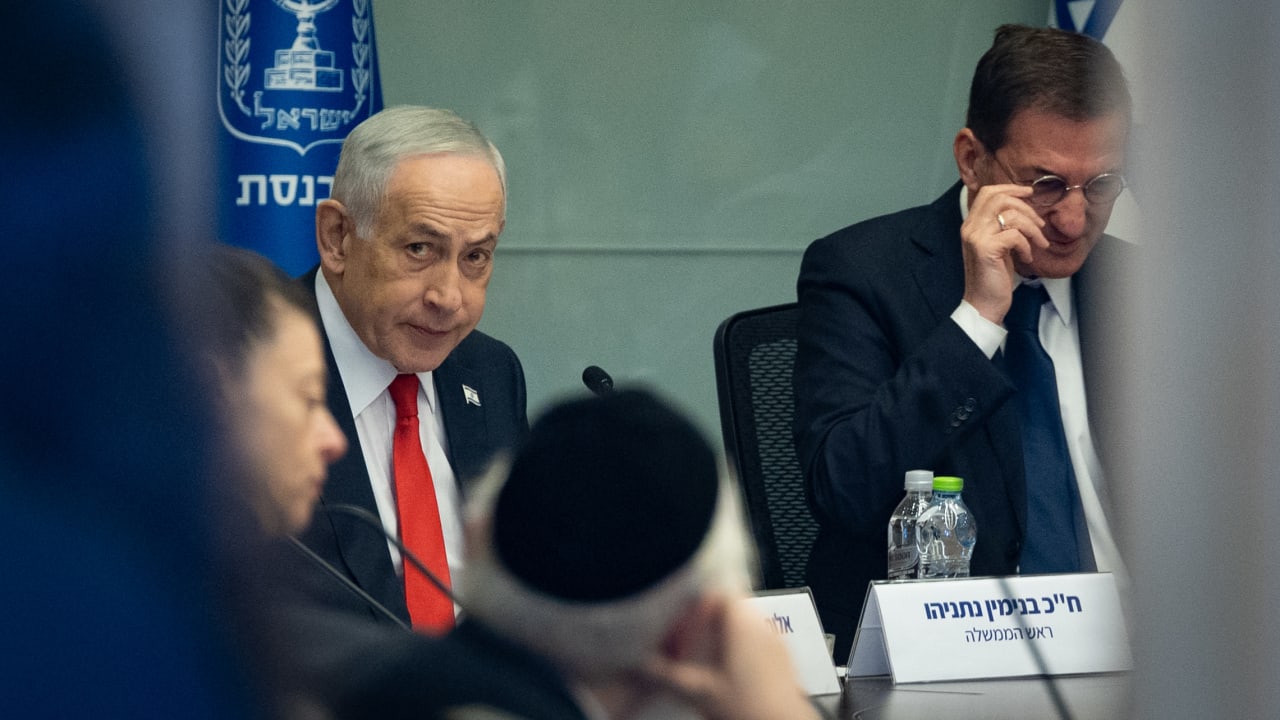
Prime Minister Benjamin Netanyahu held a confidential security assessment at the Knesset’s Foreign Affairs and Defense Committee on Thursday, leading to clashes over remarks he made regarding the government’s handling of the October 7 massacre.
Netanyahu reportedly said during the discussion that the events of October 7 “were a severe intelligence failure, but not a betrayal.”
The meeting sparked outrage among opposition MKs on the panel who left the discussion early. It went on for approximately five hours.
The prime minister arrived at the meeting with folders containing the protocols from a decade prior to the October 7 massacre, and read quotes from officials to show that there was no foresight of the event, according to a KAN News report.
Among the quotes Netanyahu read were reportedly from former prime minister Naftali Bennett, Yashar! party leader and ex-IDF chief of staff Gadi Eisenkot, and former Shin Bet (Israel Security Agency) director Ronen Bar.

The Knesset confirmed that Netanyahu dedicated a significant portion of the discussion to the state comptroller’s review regarding October 7, and presented the committee with materials he had shown to the comptroller.
He brought a long series of quotes from cabinet members and heads of security agencies, along with intelligence documents from the IDF and Shin Bet, the Knesset said.
The prime minister is among the only major officials from the October 7 massacre who has not resigned. The political echelon has repeatedly blocked a state inquiry into the events surrounding that tragic day, despite polls showing huge public support for this type of investigation.
Netanyahu’s remarks led Yesh Atid MKs to leave the meeting. The party released a statement that they “will not take part in the prime minister’s media circus.”
Yesh Atid said the meeting was “intended to evade the truth investigation into the October 7 disaster and turn the committee into an empty PR show.”
Netanyahu arrived with pre-prepared talking points from his office, in a desperate attempt to engineer public perception and rewrite history, the opposition party said.
“No spin will obscure the failure: 2,000 Israelis were murdered, communities were overrun, children were burned, and civilians were kidnapped on his watch.”
The office of MK Elazar Stern (Yesh Atid) told The Jerusalem Post that committee chairperson MK Boaz Bismuth (Likud) tried to kick him out of the meeting when he attempted to ask questions. Stern then left the discussion early.
Netanyahu slammed for 'selective memory'
Eisenkot slammed Netanyahu after the meeting, calling his memory selective and raising a number of points against the prime minister’s remarks.
“On October 7, you were the prime minister; I was five years past the end of my tenure as chief of staff,” he said.
“You are avoiding the establishment of a state commission of inquiry that would reveal the full protocols, not just your selective parts. I will fight for the establishment of such a committee and will be the first to testify before it,” Eisenkot stated.
In recent months, the government has been advancing a controversial bill that aims to establish a politically-appointed committee to investigate the failures surrounding Hamas’s October 7 attack.
The bill aims to promote a new investigative framework that diverges from the traditional independent state commission of inquiry mechanism overseen by the Supreme Court.
Speaking on Iran, the prime minister told committee members that Israel would “respond with force never before seen” should the Islamic Republic choose to carry out strikes against Israeli targets.
The Knesset said that Netanyahu gave a detailed update on regional developments in Iran, Lebanon, Syria, and the Gaza Strip, while addressing the implementation of US President Donald Trump’s Phase II of the ceasefire deal with Hamas.
The prime minister also said in the meeting that the controversial haredi (ultra-Orthodox) draft bill will be passed very soon. He remarked that the bill would be the solution to the IDF’s manpower crisis, the Knesset statement said.
Critics of the draft bill argue that the current outline fails to enforce haredi conscription and serves primarily as a political measure to appease the haredi parties in the Knesset.
The haredi draft bill has been developed by Bismuth in the committee since the summer.
Last week, its chairperson announced that the bill had advanced and would soon undergo its first vote in the committee.
Amichai Stein contributed to this report.