
A Burning Man, a new Israeli film by Eyal Halfon that just opened in theaters throughout Israel, tells a moving, involving story that many parents here will find relatable: Yoni (Shai Avivi) takes his son back to his military base in the Negev after a weekend at home, and feels that he can’t leave. Obviously, he can’t enter the base, but he isn’t able to drive away, and he parks his car nearby and sits on a bench. For days.
He has encounters with people there who represent a cross section of Israel, and we gradually get to know him and his life and see how everything he is going through has led him to this moment, when he is filled with dread about his son’s fate, sensing that another war is going to break out. The father is acting in a way that is both highly neurotic and completely logical, and the film is at its best when it presents his paternal anxiety for his son in an unvarnished way.
No matter where you stand on the political spectrum, there is no parent of a child in the army who hasn’t felt this fear at one time or another, and it has intensified after October 7. The script was completed before the war broke out, but the director and crew made the film aware of what happened on that day, and the thought of the imminent attack will never be far from your mind as you watch it.
While this premise might sound a little too bleak, A Burning Man, which won the Best Israeli Feature Award and the Best Actor Award at the Haifa International Film Festival, works so much better than you would expect, in part thanks to Shai Avivi’s performance. He has played several worried and bereaved fathers in some outstanding movies, notably in Nir Bergman’s Here We Are, where he is raising an adult son who is on the autism spectrum, and in Asaph Polonsky’s A Week and a Day, in which his character’s son has just died of cancer.
Just as in these other movies, Avivi shows the character’s quirks – his flirtation with narcissism – but can still elicit our empathy. He will remind you of yourself, or maybe of your own father. You can completely believe that he can see the mistakes he has made with his beloved child and is aware, as never before, that it may be too late to correct them.
A script 'infused with true emotion'
Halfon said he was inspired to write the script when his eldest son joined the army, and the script is infused with genuine emotion.
Yona, who has been separated from his wife for years but can’t bring himself to divorce, is a writer who seems uninspired, and when there is a long line of traffic, made up of parents dropping off their soldier children at the bus station. Yona tells Omer (Ran Kaplan) that he will drive him all the way back to their base. Omer says fine, and he warns his father that he will sleep most of the way, but we can tell that Yona just wants to be near him as long as possible. On the way, they have one of those talks that keep parents awake at night about whether Omer will go back to competitive rowing after his army service. Yona clearly thinks he should, but Omer has lost interest in the sport that once was his passion.
Later, we learn that Omer was a premature baby and smaller than all the other kids most of his life, and this amplifies what being a champion athlete must have meant to both the father and son. Now that Omer is in a competitive combat unit, he has moved away from his father more definitively than ever before.
Yona’s decision to stay and wait for Omer is impulsive: He simply can’t leave. The people he encounters are curious about why he is there, but no one really questions his decision to hang around. They all understand his fear. Among those he hangs out with are a civilian trucker (Vladimir Friedman, who was wonderful in the movie Golden Voices), who is in debt because his wife got involved in a pyramid scheme. Yona grills him about the military hardware he is delivering to the base, and the trucker would like to enlighten him, but he really knows nothing. Later, Yona runs into a group of cyclists, among whom is the father of a boy Omer went to school with, who got out of army service and is in film school, making pretentious movies, and according to the father, not wasting his life in the military. This encounter enrages Yona, bringing up emotions many viewers will share.
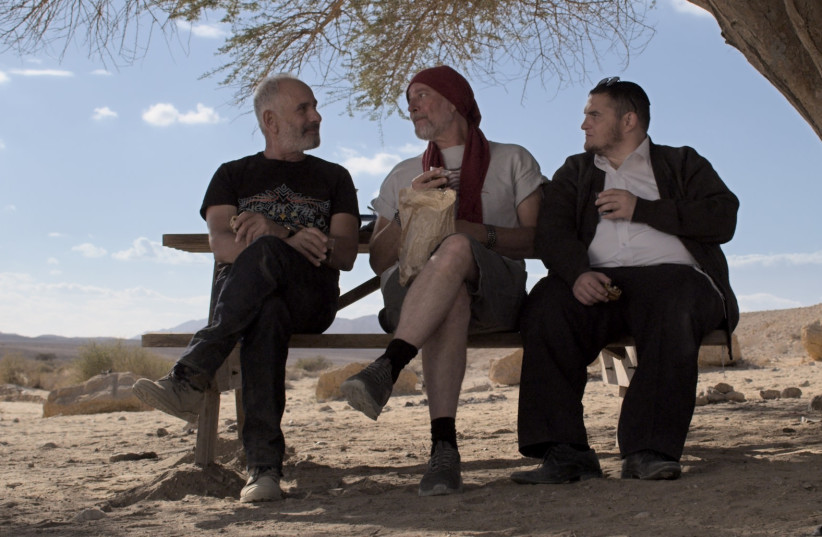
There's also Elinor (Suzanna Papian, the most charming young actress in Israel), who is helping prepare for a music festival in the desert, and yes, the director knows exactly where your mind will go. She gets the father weed to help with his anxiety. He consoles a soldier who is deserting from the base and meets a farmer who tried to set up a community in the area but failed. In the funniest bit, Shimon Yochai (Neveh Tsur, another distinctive and gifted actor), his overly chummy, religious real estate agent – the kind of guy who calls every man “my brother” the second he meets them – who has learned a thing or two about Yona’s ambivalence about finding a new place to live, simply drives down there to be with him. All of them try to offer him comfort for fears that are all too real.
It’s clear from the get-go that this won’t be a subtle film, and the points about Yona’s situation are made more clearly and more often than needed, though that didn’t bother me much when I was watching the movie, but rather when I thought about it later. Some of the symbolism is a little on the nose, but most of the time, you just feel like you’re sitting there with Yona, getting hot during the day and chilly at night, rooting for a happy ending that you know is impossible. Those who are inclined will find symbolism in Yona’s name, that he is meant to warn people of a coming cataclysm.
The movie is similar thematically to Netalie Braun’s recent film, Oxygen, about a mother who can’t let her son go when he is about to be sent into battle, but I can’t remember any other film that looked at this dilemma from the paternal point of view before. They should show this movie on a big screen outside army recruiting centers, although if they did, most of the parents would never leave.