
The Optimist, written and directed by Finn Taylor, is a touching, fact-based drama about a Holocaust survivor who befriends a troubled California teen, opening in theaters across the US on March 11 and likely to be released in Israel in the coming year.
The film stars Stephen Lang, a stage and screen actor best known to movie audiences for his role as Quaritch in the Avatar movies.
In this film, he plays Herbert Heller, a Czech-born Jew who survived Auschwitz and eventually moved to Northern California, where he opened a store selling baby and children’s goods.
Heller lived a full life, but didn’t share his Holocaust experiences with anyone until he received a frightening medical diagnosis, prompting him to tell his story to The Bay Area Holocaust Oral History Project (BAHOHP), which recorded it.
He shared the recording with his children and went on to speak publicly about his life, including at many schools.
In The Optimist, Herbert meets Abby (Elsie Fisher, who starred in Bo Burnham’s Eighth Grade) – a teenage girl who is in a day program following a suicide attempt – who films his testimony.
At first, the elegant older man, who runs a successful business and is reserved and quiet, would seem to have little in common with the withdrawn, depressed Abby.
But as both of them open up and bond with each other, it becomes more plausible that a friendship could develop between the two.
Herbert’s family was torn apart by the Nazis, while Abby’s family harbors some disturbing secrets – and the more you learn about her, the more her desperation makes sense.
At times, the movie plays like a combination of any Holocaust drama you can think of and the HBO series about teen despair, Euphoria.
More of the movie is devoted to Herbert’s story, and it is well told, if familiar to those who have seen previous dramas about the war.
His father (Slavko Sobin) ran a successful store in Prague, and it is clear that Herbert honored his memory by opening his own store later.
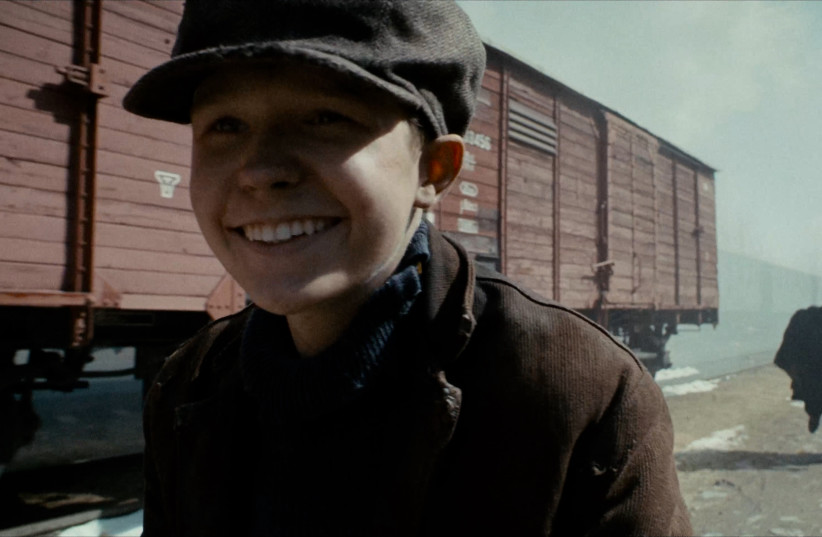
Herbert’s father is also the original optimist of the title, and he tells Herbert (played as a child by Luke David Blumm) and his older brother Heinz (Oskar Hes) that everything will be fine, long after the children can no longer be sure it is.
Some of the scenes set in this era are reminiscent of a much earlier haunting Czech film about a Jewish family during the Holocaust, The Death of the Beautiful Roebucks (1987) by Karel Kachyna.
That film also featured a childlike father – a vacuum cleaner salesman who preached an upbeat worldview to his sons – with similar results.
An unlikely friendship
In The Optimist, the young Herbert, filled with love for his father, takes his advice to heart, despite the horrors he witnesses as Prague’s Jews are rounded up and sent to the concentration camp in Theresienstadt Ghetto.
Notably, the movie points out that it was created to be a generally benign showcase camp to dupe gullible representatives of the Red Cross. While at Theresienstadt, Herbert meets musician and composer Viktor Ullmann, whose music Abby tracks down and plays for him.
Herbert works hard in agriculture there until he and his family are sent to Auschwitz. In the death camp, he remains resourceful and is assigned work details that enable him to help his father, brother, and friends as much as possible.
On a death march close to the end of the war, he continues to take his father’s advice and makes a clever and daring escape.
Surviving in hiding until the war’s end, he burns the Auschwitz camp number off his arm, and following its erasure, declines to speak about his wartime experiences to anyone, even his surviving family members.
Abby knows next to nothing about the Holocaust before she meets Herbert, but after hearing his story and observing the grace with which he tells it, she is able to open up to him about a trauma and the loss of a friend she loved, and to begin healing.
He never makes her feel that his suffering and loss dwarf hers, and a clip at the end, featuring the real Herbert Heller speaking to young people, makes it clear how his empathy left an impression on the teens who heard his life story.
The movie is beautifully photographed and was shot on location in California and the Czech Republic.
In some ways, The Optimist is similar to Ari Folman’s animated film, Where is Anne Frank, which aims to engage young audiences with Anne Frank by telling a story that incorporates the suffering of migrants in 21st-century Europe.
I don’t know whether bringing in contemporary characters, as Folman did in his film, or characters like Abby in The Optimist, really helps younger viewers care about Holocaust victims.
But in The Optimist, Lang and Fisher have a warm, credible on-screen rapport, and both give appealing performances. They make you feel that Herbert has learned from his losses how to help a girl like Abby cope with hers.