
Identity is a curious, often ephemeral, matter.
There have, for example, been numerous cases over the years of people undergoing DNA testing of their genetic makeup and encountering unexpected, sometimes stunning, results. I recall hearing about an American white supremacist who, on a TV show, was presented with the findings of his ethnic backdrop which revealed he was 14% sub-Saharan.
But, while there may be incontrovertible scientifically proven data to provide us with pointers as to whence we hail, how we present ourselves vis-à-vis our social, cultural, and political milieu can often follow adaptable personal takes.
Do we, for example, primarily feed off how others view us, or do we have our own unique personality and emotional entity to which we adhere, regardless of external, possibly extraneous, factors?
Venturing into philosophical domains, there is the well-known poser that asks if a tree falls in a forest without anyone around to hear it, does it make a sound? So is identity just a matter of perception, or is there something fundamentally extant that remains unchanged by and divorced from its surroundings?
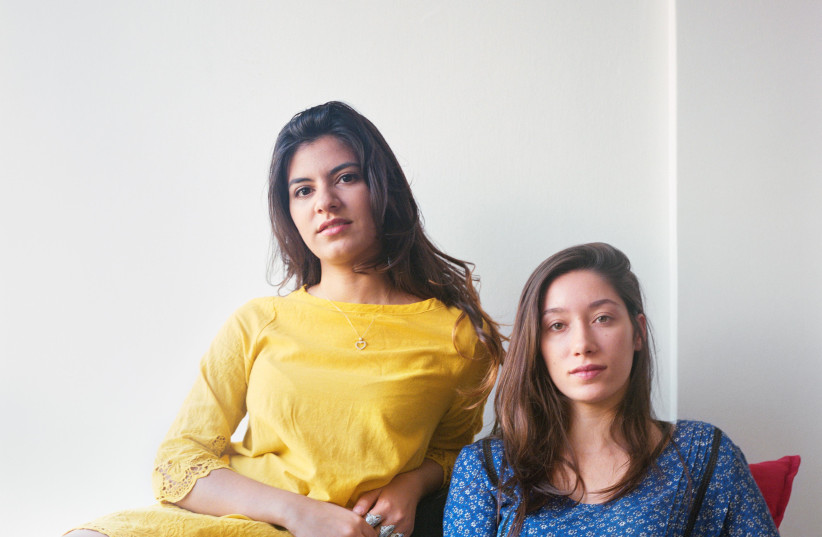
Two of the exhibitions currently on show at the Museum of the Seam (MOTS) in Jerusalem get down and dirty with that very issue, albeit from seemingly opposing social, cultural, and artistic starting points. Iris Hassid’s A Place of Our Own, curated by Shir Aloni Yaari, takes a street-level approach to the idea of transition and voluntary displacement, and how newcomers adapt to very different living conditions, mores, and societal values.
The seasoned Jewish Israeli photographer spent six years getting to know four young Arab Israeli women – two Muslim and two Christian – who relocated from their homes and families in Kfar Kana, Kfar Kara and Nazareth. Three moved to the leafy urban surroundings of Ramat Aviv to attend Tel Aviv University, and one had just completed a degree at the university.
“It took quite a while to gain their trust,” says Hassid when we meet at the museum. “It was a process.”

Considering the deep political schisms rife across all sectors of Israeli society, and the never-ending sequence of regional violence, and plentiful mutual mistrust, that does not necessitate too much in the way of explanation. Added to that, despite Arabs making up around 20 percent of the population, Jews and Arabs largely live – at best – side by side rather than commingling on a daily friendly basis.
That Hassid and the foursome – Samar, Aya, Saja, and Majdoleen – did eventually bond is palpably evident in the 40 or so works on display on the MOTS ground floor walls.
In a part of the world where even the most innocent, bland turn of phrase or action can be interpreted or misinterpreted as stemming from some kind of political stance, the venture must have been challenging and, ultimately, a rewarding experience for all involved, including wider circles of families and friends.

As the works at the museum clearly impart, the latter certainly – literally, too – came into the picture as Hassid documented the lives of the young Arab women feeling their way through the alien minefield of mainstream Israeli dynamics while not overly compromising on their core values or shunting their roots to one side to fit in.
That comes across, in spades, in the prints at the museum. In one particularly fetching portrait shot, we see two of the quartet, Aya and Majdoleen, in their apartment, relaxing in an armchair. They look straight at the camera and convey an unwavering sense of comfort. Here are two assured young women, aware of who they are and confident about their place in the world, which may not yet be their oyster, but they appear to stand a very good chance of achieving their goals in life.
A Place of Our Own started its material existence as a handsome book produced in 2020 by Amsterdam-based Schilt Publishing & Gallery. In the Dutch capital, the Joods Museum (“Jewish Museum”) also hosted the first airing of Hassid’s photographs – around 60 in total – under the steady curatorial hand of Judith Hoekstra.

That initial offshore showing was followed by two more European exhibitions – at the Judisches Museum Hohenems in Austria, curated by Anika Reichwald; and at the non-Jewish Landes Museum in Braunschweig, Germany.
I wondered if laying out the fruits of her six-year labors outside Israel made for a different experience for Hassid, and what sort of responses she got to photographs which, no doubt, offered Europeans a previously unfamiliar perspective on life in these parts. It was, it seems, something of an eye-opener.
'No one really talks about relations between Israelis, Arabs, Palestinians'
“The director of the Joods Museum, in his address at the opening of the exhibition there, told me that the fact that I was an Israeli bringing such a topic to the Netherlands was like bringing the elephant in the room, which everyone normally sidesteps. No one really talks about relations between Israelis, Arabs, Palestinians.”

Added information was also required to enlighten the cultural consumer. “We had textual explanations of various things which aren’t needed in Israel,” Hassid adds.
There were also some pleasing, unexpected developments along the way. “There was a 20% increase in the number of visitors to the museums in Austria, after Oct. 7,” Hassid notes. “That was wonderful.”
That came as quite a surprise, and flies in the face of the media-circulated portrayal of an almost blanket anti-Israeli sentiment around the world. The German institution made much of the event. “The local mayor and the minister of culture of the federal state attended the opening and spoke.”

That was gratifying, although a little lopsided. “They made a lot of Oct. 7, and talked a lot about the plight of Israel, but they didn’t relate to the Palestinian side. That was uncomfortable for me,” says Hassid. Her unease was compounded by the fact that some of her “sitters” and members of their families made the trip to Germany for the opening.
Hassid put in the extra couple of hundred yards in capturing and subsequently proffering, as multifaceted an overview as possible of life in Israel, across the often deep and wide ethnic divide.
The exhibition at MOTS includes photos of the mothers and other relatives of some of the young women, and there is a video with slots for each of the four subjects, including the nuptial preliminaries and festivities of Majdoleen’s wedding in Kfar Kana. This was clearly more than just a photographic project for Hassid.
Politics, inevitably, seeps in here and there. In one frame, we see Samar and a couple of family members picking olives on land they own, which is now closely adjoined by a new Jewish Israeli residential quarter in the Upper Galilee.
“Samar’s uncle is not allowed to build on his family’s own land,” Hassid points out. “This is my mother’s land, inherited from her mother who lived in the village of Makhoul, on the edge of the Israeli-Jewish community,” runs a quote by Samar in the book that kick-started the whole exhibition continuum. “The officials do not recognize this land as ours. We are afraid that we will want to expand the community, and it will harm our land.”
Sadly, politics continues to rear its self-interested ugly head everywhere and anywhere one looks across this dear and ravaged land of ours. But, at the very least, A Place of Our Own offers a glimpse of a personal human side of life here, and the far more manageable – albeit challenging – partly more mundane potholes that have to be negotiated in the normal course of things.
As you climb up to the second floor, you undergo a sharp transition from the relatively quotidian to the patently tempestuous outpourings that make up the On the Boundary of Memory collection by Umm el-Fahm painter and museum founder Said Abu Shakra, curated by Nurit Tal-Tenne. This is an unapologetic display of raw emotion emanating from the 69-year-old artist’s intimate world and more politically tainted circumstances.
Violence is a leitmotif in the spread, as we catch bestial beings gyrating, with heads twisted and facial expressions that run the gamut from unbridled ferocity to patent naked fear. The figures and other elements Abu Shakra employs are packed tightly together in dense affairs that exude an overriding feeling of mayhem, terror, and destruction.
The crowded, crammed frames, verily exploding with figures, squiggles, dabs, you-name-it, grab you by the shoulders and heartstrings and shake you to the core. It is also a deeply personal affair that shines a polychromatic revealing light on the artist’s own bio. “My mother is the source of my inspiration in my life,” Abu Shakra simply states.
That is evident in quite a few of the works in the museum, as we see her – Miriam, or Mariam in Arabic – in a range of poses and miens. Suffering and forbearance are repetitive elements, Abu Shakra explains. He has also conveyed that in a more plain-speaking format, in a book titled Miriam, which he published in 2022.
“She went through what all mothers have endured through wars, and she raised us with love and strong embraces. It is a tough book to read. I reveal very personal things about my mother and how she brought us up. She was married off at the age of 11.”
That is hardly conceivable, and Mariam was later discarded when her husband remarried. “She suffered and remained positive throughout her life,” her devoted son states. Mariam passed away in 2009 at the age of 78, but she lives on, almost corporeally, in Abu Shakra’s work and heart, and in her surviving family members.
That is conveyed unmistakably in a video slot in the exhibition showing Mariam toward the end of her life as relatives and friends come to take their leave from her and demonstrate great affection and appreciation for her.
Abu Shakra unfurls that depth of emotion in all his work, seasoned with motley doses of fear, life affirmation, a palpable sense of displacement and loss, an ongoing quest for identity and belonging, and an unremitting search for meaning and abiding hope.
The search for cultural-national affinity and attachment was bolstered by a long stint as a senior officer with the Israel Police. “I was an investigator for eight years. I was in charge of juvenile delinquency for the whole country,” he notes.
“I tried to take my place in this country. I live here. I want to do my part, to contribute, and to claim my rights as someone who lives here. I don’t want to be different, an outsider.”
That entails adopting a proactive, positive mindset, as per his mother’s philosophy of life, and one that echoes celebrated Holocaust survivor psychiatrist-philosopher Viktor Frankl’s inspiring, productive, and sunny post-Holocaust long pathway in life, through to the age of 92.
On the Boundary of Memory features all kinds of intriguing and compelling figures that suggest some kind of mythological underpinning. In fact, one of the principal animal characters in Abu Shakra’s oeuvre comes from a very personal, close quarters, as well as time-honored cultural sources.
“When I was a kid, and my mother or grandmother put me to bed, they would always tell me stories of hyenas,” he recalls. “I’d never seen a hyena. It comes from Palestinian folklore.”
These were not necessarily PC-tailored, child-sensitive, pristine stories intended to leave the youngster with an unworried, beatific smile on his lips as he drifted seamlessly into the land of nod.
“I heard about the hyena who hypnotized a farmer before taking him to its cave and devouring him, or it may not have devoured him, and the peasant returned home. The stories changed every time.”
Whether or not the farmer survived the experience intact, Abu Shakra has the hyena front and center all over the exhibition, along with bulls and other creatures that all manifest an air of physical and feral strength. “I grew up with the idea of the hyena as something to be feared. The hyena, for me, became the articulation of my terrifying fear as a Palestinian Arab living in Israel.”
Portraying the animal in his work, repeatedly, enables the artist to process that baggage and to exorcise some of his emotional detritus. “The hyena devours, shows no mercy toward others, it mesmerizes you, sucks you in, and takes you away.”
Fighter planes also hover and buzz around the upper reaches of some of the paintings. Yet another early source of dread, dating back to the painter’s memories of the Six Day War. “When I was 10 years old and the war started, I got to school, and the teacher told us to go home quickly. We ran back with jets in the air, with the sounds of explosions. I was petrified.”
That anguish pours out of the charcoal-based works, as does his love for his mother and the formative experiences of childhood, in no-nonsense, unremitting terms.
A Place of Our Own and On the Boundary of Memory close on June 30.
For more information:
www.mots.org.il/en/exhibitions