
On a visit to Vienna almost exactly a year ago, Janet Belleli Goodvach found herself transfixed by displays in a small museum, experiencing what felt like an enormously powerful – and sorely needed – therapy session.
Like her fellow Israelis, Goodvach was carrying the burden of the then-ongoing Israel-Hamas War, with the pain of many funerals and soldier injuries, hostages still being held, families displaced, a son in the army, and a hurting nation. In Vienna, she also carried the scar of the murder by the Nazis of her Viennese great-grandparents.
But what she saw at the Viktor Frankl Museum – housed in Frankl’s apartment in Vienna, where he had lived from his return after the war in 1945 until his death at age 92 in 1997 – gave her strength and hope through Frankl’s approach to suffering and challenges. A cornerstone were Frankl’s words writ large in the museum, which kept spooling through her mind: “The one thing you cannot take away from me is my freedom to choose how I will respond to what you do to me.”
While we cannot always control what happens to us – starkly demonstrated in recent times by COVID, then Oct. 7 – we can always choose our attitude to unavoidable suffering and imagine the future with hope. This has been famously illustrated by the accounts of Natan Sharansky of his nine years of imprisonment as a refusenik in Soviet prisons in the 1970s and 1980s. He believed that while the KGB might physically control him, he was free – indeed, freer than his prison guards – in his thoughts and attitudes, in his actions, however limited they might be, and in maintaining his dignity and integrity.
In the weeks after Goodvach and her husband returned to Israel from their brief trip, she was surrounded by the palpable anguish of lives lost, alongside the joy of Israel’s securing the release of more hostages. She put it this way: “I remember friends saying they couldn’t function. One told me she didn’t have the energy to cook dinner; she was glued to the news, unable to stop crying.”
As Goodvach kept thinking about Frankl’s insights, she found herself gently reminding friends – and herself – about our ultimate freedom to shape our attitude and reaction to the conditions confronting us. She believed our response might be as seemingly straightforward yet constructive as, “To keep loving, keep working, keep strengthening Israel and our people.”
The seed of an idea began to sprout, and Goodvach wondered if she could bring a form of the Viktor Frankl Museum to Israel, to create a space where people could encounter the words and teachings of someone who had studied, deeply and seriously, how human beings survive and thrive beyond the darkest of times, how they find inner strength and hold onto hope.
Goodvach persisted in turning her vision into reality, and her passion project of the past year has culminated in L’Chaim, an exhibition of Viktor Frankl’s ideas, which runs until the end of May in Tel Aviv’s Shalom Tower Library.
How to find meaning
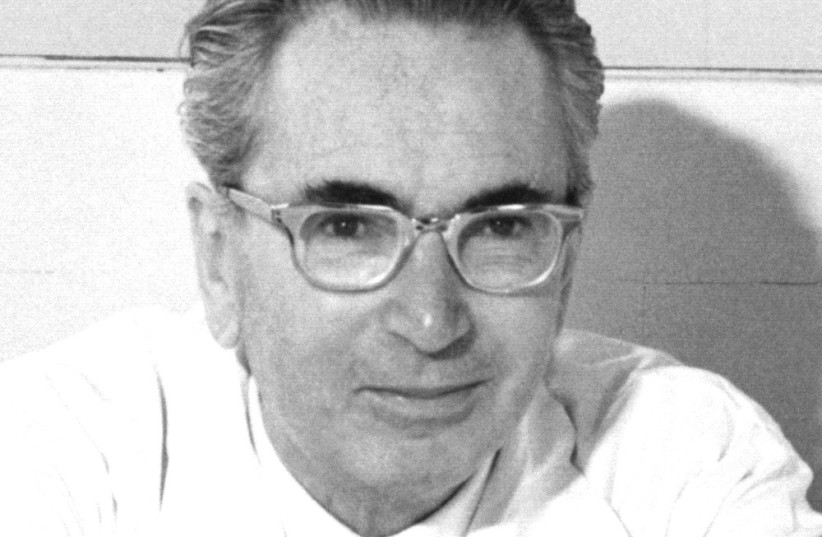
Frankl was a neurologist, psychologist, writer, and Holocaust survivor. Already at age 21 in 1926, he started developing a novel meaning-centered approach to mental healing called logotherapy (logos, meaning). In 1946, following his harrowing concentration camp experiences and the murder of his parents, brother, and wife at the hands of the Nazis, he wrote his seminal work, Man’s Search for Meaning.
He posited that the primary human drive is the search for meaning and purpose in life, and noted that those who survived the camps were more likely to be oriented toward a purpose to be fulfilled in the future, and imagined the realization of that purpose, for example, by having a notional conversation with a loved one waiting for them.
Frankl saw his book’s wide appeal as an indication that man’s search for meaning had been frustrated, and called the emptiness people complained about “an existential vacuum.” He did not purport to say what the meaning is in life, but as a psychologist he could assist people individually to find meaning in their own lives. He argued that pleasures do not give our life meaning; and in dark times of suffering, even facing death, we can undergo inner growth and better handle challenges with clear purpose.
Frankl concluded that life takes on meaning in one of three ways: making, loving, and transcending suffering, that is, by creating, such as making art – something that makes an impact and outlasts us; by lovingly experiencing the world, be it nature or art or another living being; and by transcending and choosing how we adapt or react to unavoidable suffering.
The freedom to choose our attitude even when confronted with the direst circumstances was the very essence of the bestselling 2017 memoir The Choice, authored by Dr. Edith Eger, Holocaust survivor, psychologist, and Frankl’s student. It took the kernel of Frankl’s teaching and illustrated it through Eger’s own Holocaust experiences, and her subsequent work as a psychologist and practitioner of logotherapy.
If you have a why, you can bear any how
Frankl also identified closely with the declaration by German philosopher Friedrich Nietzsche that “Whoever has a why to live, can bear almost any how.” He connected this maxim to the ability to find larger meaning and purpose in life.
These were the very words which Hersh Goldberg-Polin, one of the 251 hostages brutally taken from Israel by Hamas on Oct. 7, was inspired by in the 10 months before his murder by his captors in August 2024, which he shared with fellow hostages including Eli Sharabi, who described it as a gift from Hersh that helped him survive almost 500 days in captivity.
Tel Aviv exhibition
While the L’Chaim exhibition is modest in scope, it is the first such showcase of Frankl’s ideas in Israel. Frankl’s quotes and teachings are cleverly and imaginatively depicted in a series of colorful posters created by graphic designer Lorien Tova Balofsky, based on research by Emma Zucker, who worked with Goodvach to select text and notions that would shape a telling overview of Frankl’s work.
The graphics clearly convey Frankl’s ideas in Hebrew and English, and facilitate an understanding and appreciation of his approach. Two short videos animate Frankl’s work, and several display items add further interest.
The power of the exhibition is through absorbing the ideas, contemplating them, drawing connections to our own experiences and attitudes, and seeing and sensing the potential of Frankl’s ideas in enabling us to navigate difficult circumstances, with hope and inner growth.
See L’Chaim until the end of May (subject to war directives) in Shalom Tower Library, first floor, 9 Ahad Ha’am St., Tel Aviv. Sun-Thurs, 10 a.m.-6:45 p.m. (except Mon, closing 6 p.m.).
The exhibition website (lchaimviktorfrankl.com) includes fascinating vintage films of Frankl speaking about his ideas, a short biography, and additional information not included in the exhibition.