The IDF on Monday provided its first statistics of the war on its shoot-down success against Iran’s ballistic missiles, setting it at 80-90%, with only about 5-10% of ballistic missiles hitting residential areas.
Eight more civilians were killed in Tehran’s Sunday-Monday middle-of-the-night attacks, bringing the total number of deaths to 24, with one more missing person expected to be declared dead in the coming hours at the time of writing.
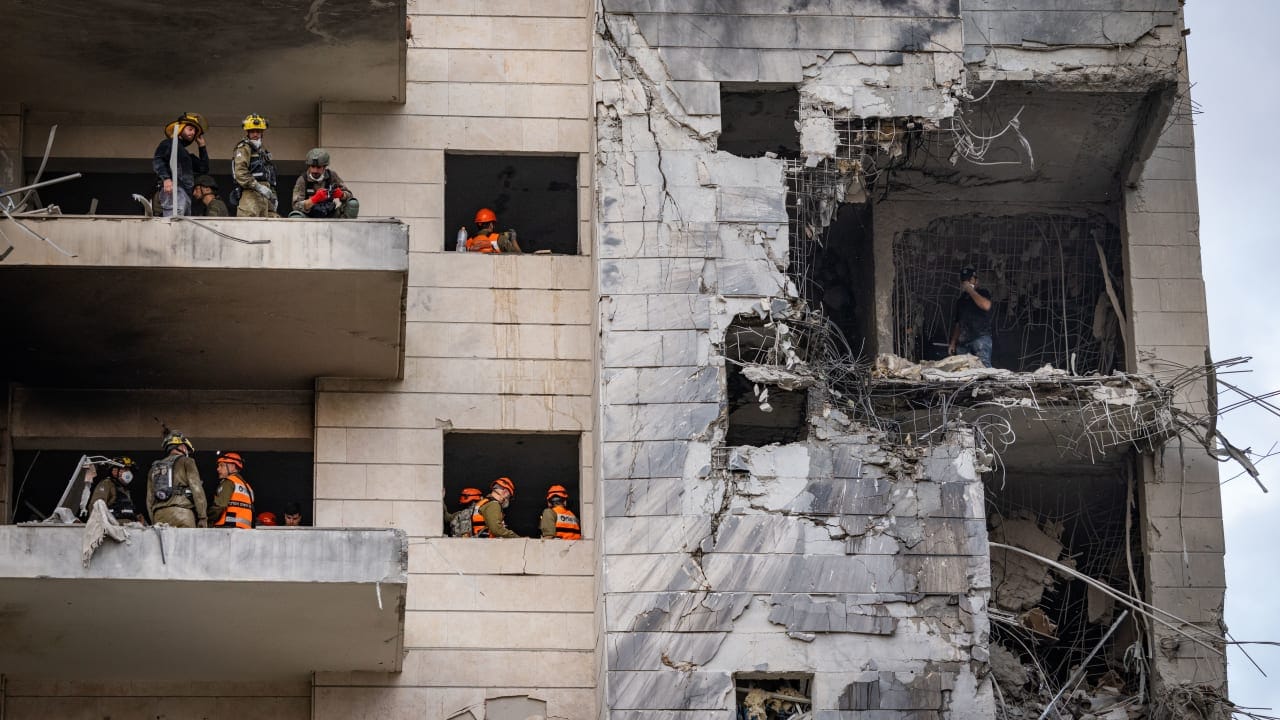
From a salvo of around 40 ballistic missiles at 4:00 a.m., raising the total number of ballistic missiles to around 350, there were hits in Tel Aviv, Petah Tikva, and Bnei Brak, leading to deaths.
To date, the Iranian missile salvos have focused on the Gush Dan/Tel Aviv/central Israel area, the Haifa area, and the Beersheba area.
The military said that the Israel Air Force’s success in destroying dozens of launchers and many missiles has reduced the number of Iranian missiles launched from hundreds at a time to dozens.

Next, the IDF said it is constantly adjusting strategies and learning how the Iranians conduct their missile fire, with the Iranians also making adjustments to try to outplay Israel’s defenses.
Late Monday, the air force targeted several trucks carrying weapons, including trucks transporting surface-to-air missile launchers, moving from western Iran toward Tehran in an attempt to evade IDF strikes.
The weapons and missile launchers were destroyed in the strikes, which is a crucial move because it cuts off a new attempted Iranian strategy of trying to maneuver its ballistic missile concentrations away from the locations where Israel has gotten used to them being based.
If Iran could succeed in outwitting Israeli surveillance and hide the missiles in other parts of the country, it could retain the capability to fire on Israel for much longer.
By Jerusalem immediately cutting off Iran’s attempt to move the weapons, it also conveys to Tehran that moving weaponry is as much of a losing option as keeping them in place.
Direct hits recorded across central Israel
At the hit in the Da Vinci area of Tel Aviv, there was an almost direct hit between two safe rooms, yet all of the civilians in the safe rooms survived.
There was one case where a direct hit on a safe room in Tel Aviv led to two civilian deaths, but that is the only such case.
Even in that case, the civilians in their safe rooms directly one floor above and below the hit – meaning very close by – all survived.
In contrast, a civilian on the fourth floor of the same building and a civilian in an adjacent building, neither of whom went to safe areas, were both killed.
Likewise, nine civilians in Bat Yam who did not go to their stairwells, which they could have reached, were killed, and the IDF believes they could have survived in the stairwells.

Some civilians in Rishon Lezion also could have survived in safe areas but died since they did not evacuate.
To date, no building has collapsed completely after a direct hit.
This is somewhat even better than expected, given that the Iranian ballistic missiles carry a half-ton of explosives, gather tremendous speed and energy from traveling up to the atmosphere and back down, and given the shockwave of the hit.
For example, in Bat Yam, dozens of buildings, even some hundreds of meters away, were damaged by the shockwave, though they were not hit directly.
There have also been hits in open areas, even in Tel Aviv, which did not cause significant damage.
Pressed that the IDF should evacuate to safer areas elderly people who do not have safe rooms in their homes and cannot walk fast enough to get to a public bomb shelter or stairwell, the IDF said that running after hundreds of thousands of such people would not be possible.
Moreover, the military said that civilians have the right to decide to leave their residence and to travel to a public bomb shelter or even schools that have been opened for civilians.
This is why the IDF is giving multiple pre-warning warnings, some 30 minutes out from an attack, it noted, so civilians can leave before the siren warning, which only comes around 90 seconds before the missiles arrive.
In addition, the IDF said it is proud that most civilians have stayed in their homes, as, in dark scenarios, there were concerns that tens of thousands of civilians might flee the Tel Aviv area for the desert.
This would not have necessarily made them safer, would have harmed the functioning and morale of the state, and represented a new challenge for the IDF and the government to provide necessities.
The military said it was considering altering the current arrangement in which the entire Israeli business market is effectively closed and allowing a staged reopening of some sort, depending on whether Iran’s ballistic missile power is reduced in the coming days.