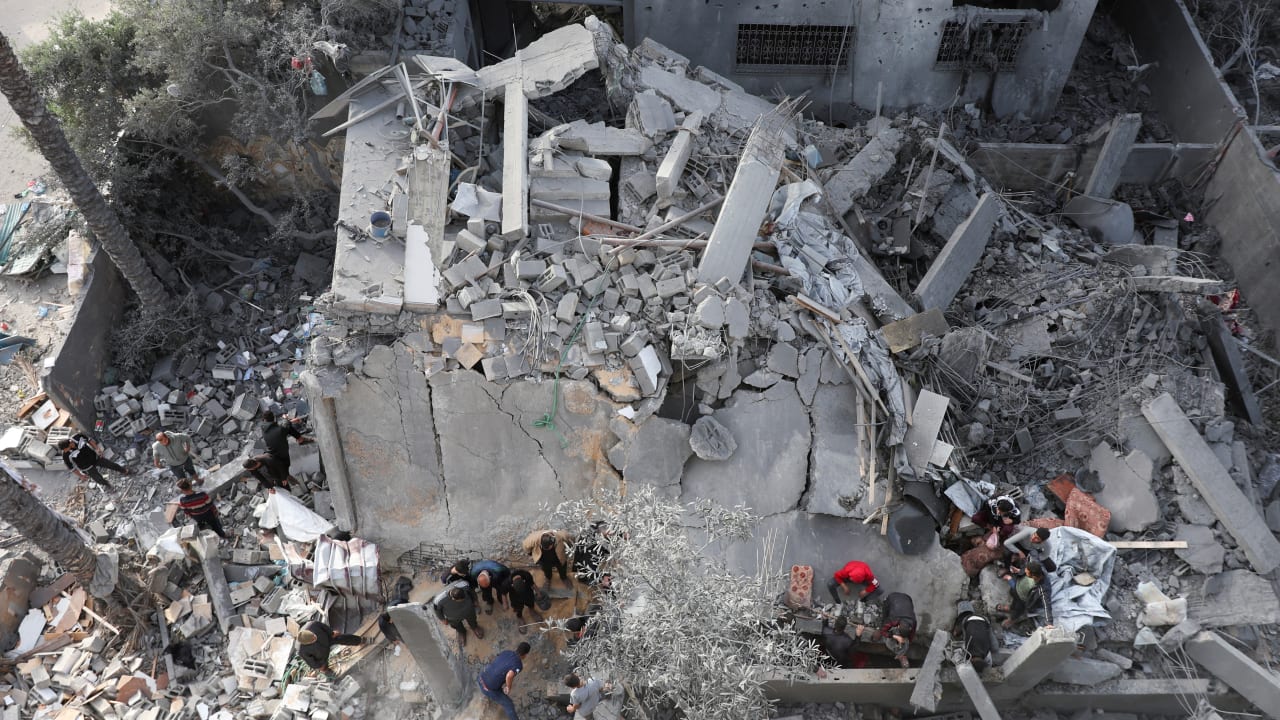
What is happening right now in Deir el-Balah in central Gaza, with the IDF making a large ceremony over attacking certain areas that it has attacked twice before but repackaging them as radical new invasion moves, so far seems like a show.
Division 98 invaded Deir el-Balah both from June 5-10, 2024, as well as sometime during the August 16-30, 2024, period, and the air force has bombed it at least 11 times.
It is possible that the current invasion, which has reportedly included tanks, artillery, and a brigade, shies more into the southern part of Deir el-Balah versus the eastern part, and it seems like the IDF is doing this to put pressure on some remaining senior Hamas commanders (though nearly all senior Hamas commanders, including Yahya Sinwar, Mohammed Deif, Mohammed Sinwar, and Marwan Issa have been killed over 21 months).
But once again, this is not an area where the IDF has stayed far away from it, and the military is reportedly only using one brigade, not multiple divisions.

Usually, when the IDF is carrying out a major operation in Gaza or Lebanon, it is using multiple divisions.
In fact, around the same time that this new move was taking place, the IDF publicly announced that it was pulling the paratroopers and commando brigades out of Gaza, a sign of downgrading how serious the fighting is there.
Chief of Staff Lt.-Gen. Eyal Zamir has made it clear that he does not want to endanger the remaining living 20 hostages held by Hamas in the 25% of Gaza that the IDF has not taken over.
Most of Hamas has been hiding for an extended period in parts of Gaza City, parts of central Gaza, and the al-Muwasi coastal humanitarian zone.
Note that the IDF is still staying out of most of these zones and is making one very targeted new move.
So Zamir will need to figure out ways to go into some of these areas, but in such a targeted and careful way to allow Hamas guards with any hostages who might be nearby to move or escape, or otherwise not feel imminently threatened.
If he fails at that extremely delicate balance, this will end up being another incident in which IDF actions indirectly lead Hamas to killing off hostages, as occurred in August 2024 – or worse – IDF forces mistakenly killing hostages, as occurred multiple times earlier in the war.
Another possibility, which will only work if Israeli intelligence is perfect and if the Hamas guards are extremely cool and collected customers, would be to surround areas where Hamas is holding hostages to try to put them under siege.
But Israel could have done this earlier in the war, and decided not to because of the fear that the Hamas guards would eventually force the IDF to withdraw or kill the hostages – a lose-lose scenario.
The only way this works is if the Hamas guards would rather live and give themselves up, something that has not turned out to be true for most of the war to date, despite Israeli hopes.
If the guards prefer to live, even if they are caught, then Israel could use a siege tactic to improve its chances of reaching a hostage deal.
But if the guards are willing to die like most guards and commanders to date, it may be nearly impossible to bring new, real pressure on Hamas without endangering the hostages.
Into all of this, it appears that the dragging on of the war and Israel injecting itself into breaking Hamas’s control over food aid in Gaza, while an important goal that the world improperly ignored for much of the war, has created a new threat: multiple mistaken mass killing of Gazans by the IDF, which military sources are no longer denying as much as it did before, and is more addressing these allegations by saying it will “learn lessons” to avoid recurrence of such events.
Critics of Israel believe such mass killings have occurred throughout the war. But the IDF has mostly denied such killings until now and, in select cases where there were errors, provided context for what went wrong in complex scenarios.
But in most of those past cases for the last 21 months, the IDF was at least always trying to fight Hamas, and it could use as a defense the fact that Hamas was using human shields or that Israel was targeting a Hamas terrorist, not civilians, or both.
What is different now is that in multiple incidents in recent weeks, IDF sources are not denying that the military has opened fire at large groups of Palestinian civilians when those Palestinians caused certain IDF forces to feel in danger, as those IDF forces were in the vicinity of food aid areas.
It’s possible and even likely that some of these groups of Palestinian civilians were fooled by Hamas and that some people in the crowd were Hamas agents.
Wrong place, wrong time
But at the end of the day, in multiple incidents, the IDF has opened fire on unarmed Palestinian civilians who were just in the wrong place at the wrong time.
What is more problematic is that a top IDF official admitted openly back on July 9 to three to four of these incidents occurring in late June-early July, promising to “learn lessons.”
Instead of learning lessons from those multiple incidents in late June and early July, there has been an increase in such likely incidents as July has drawn on.
The root cause of these incidents, aside from Hamas trying to set up and embarrass the IDF, is simple: soldiers are not trained or built for maintaining public order.
That is the job of police who are often trained in non-lethal means of crowd dispersal, such as the use of water cannons and tear gas.
Why isn’t Israel using such non-lethal methods in Gaza for dispersal of suspicious crowds who are unarmed (the IDF did not claim they were armed or firing on the IDF in any of the recent cases)? Soldiers, generally, are not trained for such non-lethal methods, but to fight wars.
How did top IDF and government officials think this would go when they drew up the plans? Did they think Hamas would go quietly and not try to trick masses of civilians into approaching IDF positions?
All of this is happening in an environment where the IDF’s Legal Division has not produced a single public update of its over 90 war crimes probes since August 2024, despite multiple campaigns to do so.
Whether the delay of publicizing more of Israel’s side of the story relates to politics or bureaucracy is becoming less relevant than the fact of the failure to make Israel’s case on the world stage.
Combining this picture, IDF sources are pushing back less against the implication that even if there was greater control and discipline over soldiers following rules of engagement for much of the earlier stages of the war, the recent stages are seeing larger errors, which might be harder to explain and justify.
Putting the law aside completely and just considering legitimacy, Israel’s current argument is much harder now than earlier in the war because Hamas has been militarily beaten since the summer of 2024.
Recent major operations in Beit Hanun were against a mere few dozen Hamas terrorists.
It is one thing to argue for an operation’s legitimacy to kill 20,000 Hamas terrorists that also accidentally kills large numbers of civilians. It is a different thing to argue for an operation’s legitimacy that accidentally kills a large number of Palestinian civilians, where the only goal is to weaken Hamas politically, and where very few Hamas terrorists are being killed.
If there is a hostage deal soon, all of these trends will fall off the board. But if not, and if Israel feels it must continue fighting, all of these other trends will only continue to raise the costs of the war.