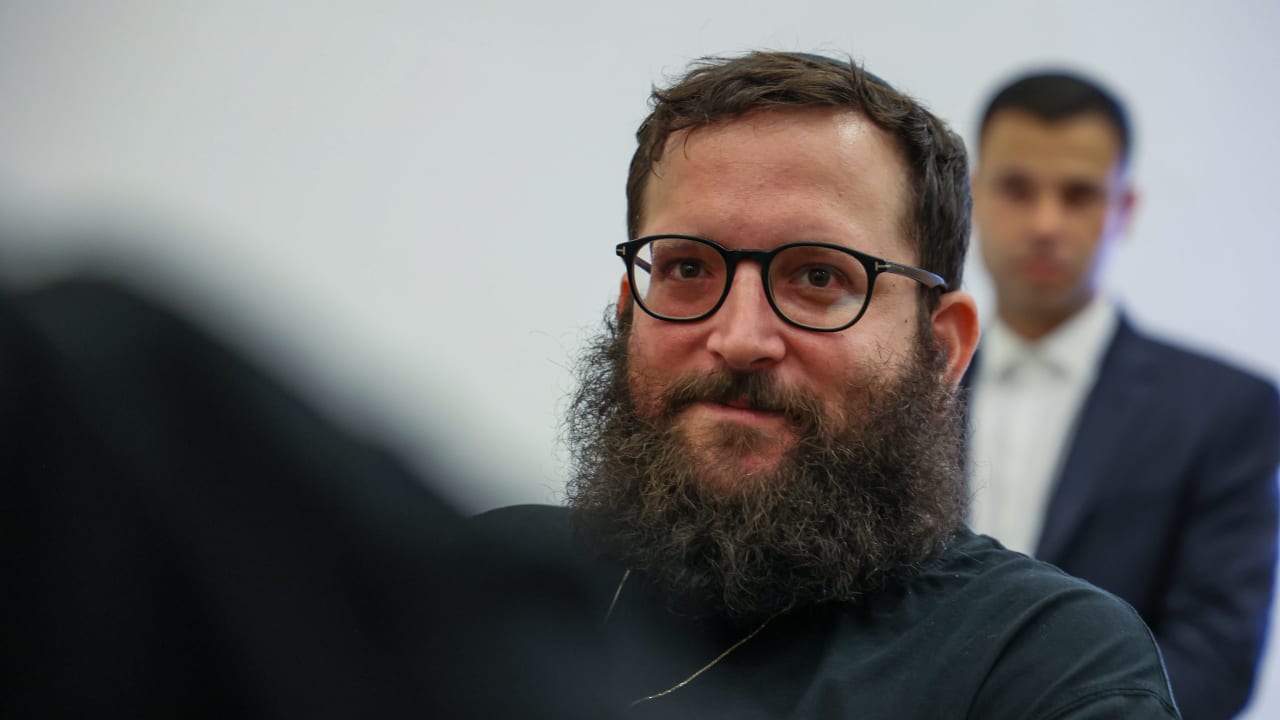
A tense hearing took place at the Lod District Court on Tuesday morning, a hearing before Judge Amit Michles over whether to lighten the restrictive release conditions of Yonatan Urich, an aide to Prime Minister Benjamin Netanyahu and one of the chief suspects in the “Qatargate” investigations.
His legal defense has made two main arguments. The first is that he wasn’t really a public servant, but rather a private citizen. Therefore, there is no danger in allowing him to return to his employment and make contact with anyone connected to the Prime Minister’s Office. The second is that there is no justification for not matching his release conditions to those of Eli Feldstein, the former military spokesman for the PMO and the first individual to be interrogated in connection with the case.
Feldstein was arrested in November, while Urich was apprehended in March, on suspicion of alleged connections to Qatar and having organized a public relations campaign for the Gulf state, while it serves as a negotiator in the Israel-Hamas ceasefire talks and has close connections to the terrorist organization.
Israel Police, in contrast, tried to establish that Urich indeed did function as a public servant, and that his actions undermined the interests of the PMO and the Israeli public at large.

Police representative Supt. Aviv Porat said on Tuesday that materials coalesced in the interrogation indicate a “significant suspicion that after October 7 and as criticism bloomed against Qatar for its connections with and involvement in Hamas, that the Gulf state reached out to Israeli figures to initiate a public-relations campaign to better its image in the eyes of the Israeli public.”
Porat added that this alleged plan was approved by Qatari elements and kicked off. The plan allegedly included several courses of action, all aimed at shifting the impression Israelis had of the Gulf state post-October 7 - “and Urich and other figures played a central role in the execution.”
Urich's specific strength allegedly was formulating and pushing the messages out to the public.
Porat emphasized that at the core of the issue is the nature of the messaging. “If it was a different state working with Qatar on public relations for an electrical company, there would be a greater doubt as to whether state security was compromised,” he said.
He specified, “The suspicions that a man who was employed by the Likud and, in practice, worked in diplomacy in the PMO during the war, and, per the suspicions, was bribed by a foreign state to which he provided similar services - all without coming clean about it, not in the legal realm nor in the moral one.”
Porat pointed out that several of the individuals who provided testimony in the case attested to Urich being a public servant.
He added that there is more work required from investigators. When Michles responded that by that logic, the investigation will never reach a concluding point, Porat responded that the conditions under which Urich will be allowed to return to his place of work “may enable an obstruction of the investigation.” The police representative added that by current estimates, the investigation against Urich is due to wrap up within the next 45 days.
“This is a man who is under investigation and may legitimately be allowed to return to the very same place from which he carried out the alleged crimes,” said Porat.
Noa Milstein, Urich's lawyer, noted that anyone else who was interrogated or provided testimony was allowed to return to their place of work.
She added that the list of forbidden contacts was never actually approved by the court, and that the list indicates “the intentions of the interrogators.”
Michles asked the police for an update, specifically on the hypothesis of him being a public servant.
Last week, Rishon Lezion Magistrate’s Court Judge Menahem Mizrahi released Urich from all restrictions - allowing him to return to work at the PMO and at Perception, the company at the heart of the Qatargate investigations - but gave police the option to appeal the decision. It did, leading up to the Tuesday hearing.
'Leaked documents affair'
The crux of the investigation, as it has been released to the public so far, is the “leaked documents affair,” in which Feldstein allegedly leaked classified military documents to the German tabloid Bild, after permission for their publication was denied by the Israeli military censor. This was allegedly done at the direction of Urich and Israel Einhorn, another aide who was interrogated in connection with the case last month, from where he resides in Serbia.
The documents were eventually published, allegedly to sway public opinion on the hostage negotiations. This was around August 2024, when six hostages were killed by their Hamas captors in a tunnel: Hersh Goldberg-Polin, Almog Sarusi, Eden Yerushalmi, Ori Danino, Carmel Gat, and Alex Lobanov.