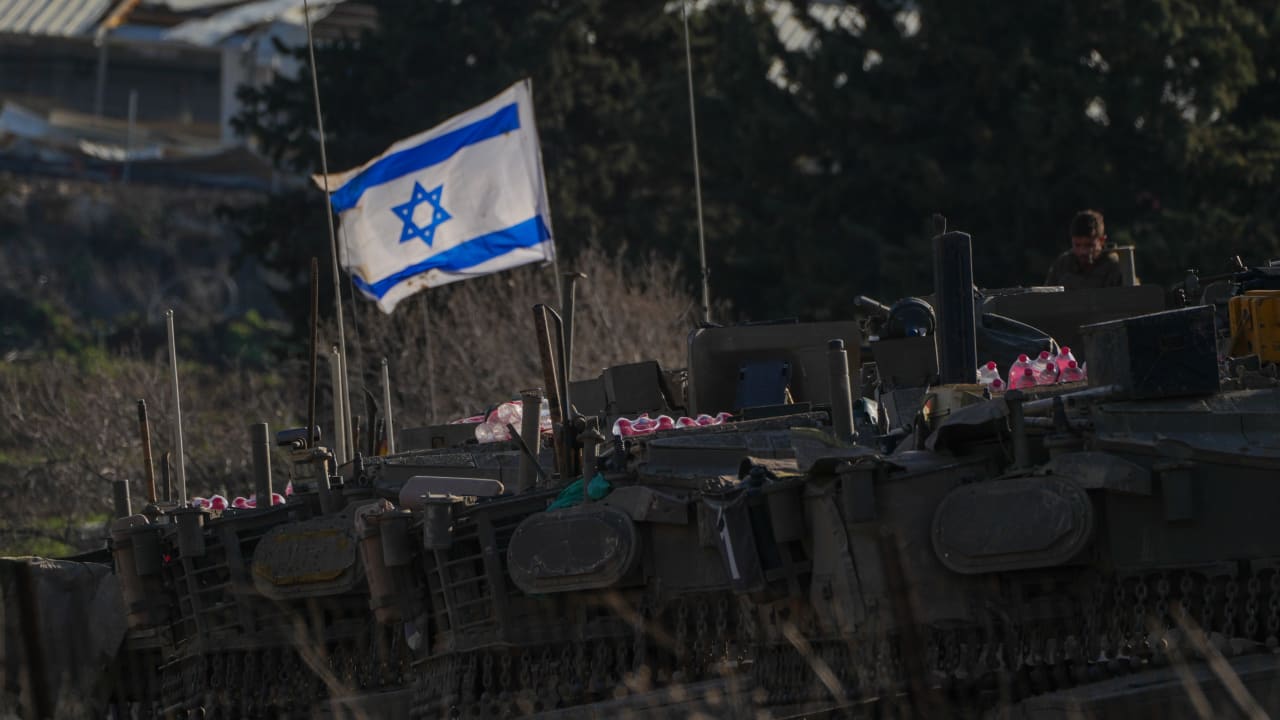
The IDF announced on Sunday that two soldiers were killed by a Hezbollah ambush in southern Lebanon.
One of the soldiers was named as M.-Sgt. Maher Khatar, aged 38, from Majdal Shams, a soldier from the Combat Engineering Corps in the 91st division. The second soldier has not yet been named.
Their military position is parallel to and defending the Margaliyot, Manara, and Misgav Am area on the Israeli side of the border.
Exactly how the soldiers were harmed is still unclear.
Earlier Sunday, a top IDF official said that their Puma transportation vehicle got stuck during a patrol.
In a statement, the head of the Druze Community, Sheikh Mowafaq Tarif, stated that Khatar was the first Druze fallen soldier of Operation Roaring Lion.

"The first [Druze] fallen soldier in Operation Roaring Lion, a title no family wishes to bear the honor of receiving, yet fate determined that the Khatar family from Majdal Shams would carry it," Tarif wrote. "The Druze community continues to shoulder the burden and pay a very heavy and painful price. The best of its young men are being taken.
"Maher’s fall on the battlefield and the bravery of Druze fighters across all units illustrate our partnership in the State of Israel — a partnership that must exist not only on the battlefield but also in everyday life."
Later, Prime Minister Benjamin Netanyahu mourned the two soldiers, and called Khatar an inspiration for Druze citizens of Israel.
"Maher, of blessed memory, a brave fighter from the Druze community, was a role model and inspiration for young people from the town of Majdal Shams who enlist in the ranks of the IDF: a trend that has been growing in recent years and is an expression of the eternal covenant between us," he wrote in a statement.
"Maher, of blessed memory, and the other fallen soldier fought with courage to defend our communities and our citizens against the Hezbollah terrorist organization.
"We bow our heads in mourning over their fall and remain committed to defending our northern border against every threat.”
According to the IDF, the ambushed soldiers were acting in a forward defensive capacity to keep any potential fighting away from northern Israeli residents, but not formally seeking to engage Hezbollah when they were attacked.
A deputy company commander then came with a D9 bulldozer to help the Puma vehicle extricate itself from the situation.
Next, either a Hezbollah anti-tank cell or a mortar firing cell struck the D9, killing the two soldiers.
Pressed about why the IDF is not using solely fully armored, more capable maneuvering Namer vehicles on the Lebanese front, given the last two-plus years of Puma vehicle malfunctions or poor defensive capabilities, the IDF rejected the criticism.
IDF's Puma is similar to what US uses for global forces
The IDF said that the Puma vehicle is similar to what the US uses for many of its forces worldwide and remains a mainstay of the IDF, even though in some cases the IDF uses its limited number of Namer vehicles.
The Namer has superior capabilities to the Puma, and the IDF has purchased more Namers during the recent war, but it is still nowhere near the volume needed to fully replace the Puma and other kinds of transport vehicles it still uses.
A more nuanced question is whether the IDF has properly thought out transferring Namers from Gaza to Lebanon, given that there are now more active fighting operations going on in the North.
However, after all of the debate about the Puma versus the Namer, late Sunday night, the IDF said that the vehicle which had gotten stuck was a tank.
Pressed to clarify why the IDF had earlier said it was a Puma, which looks nothing like a tank, and was even ready to defend and praise the Puma when reporters disparaged the vehicle, the IDF did not respond.
There was also no explanation about how or why such a tank would get stuck, as opposed to a Puma, which is smaller and more fragile.
According to the IDF, it continues to pound Hezbollah's Radwan special forces and the Dahiya portion of Beirut, which was considered the group's capital.