
After passing the turnoff for the Nativ Ha'Asara junction, travel on Highway 4 was halted at a military checkpoint manned by reserve soldiers. Slowly, one gestures with his hand, signaling for me to stop. A quick look into the vehicle, followed by a few questions, and I continued driving, turning right onto a dirt road until I came to a stop at the Gaza border.
I put on a helmet and a bulletproof vest. A protected jeep and two soldiers open the large gate in front of the tall concrete wall.
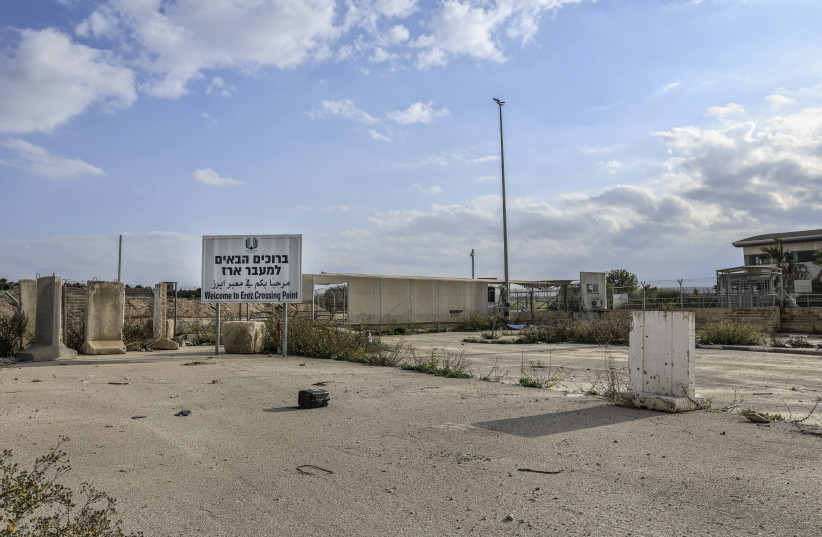
A convoy of jeeps enters Gaza. The immense destruction in the area cannot be ignored. This is the "landscape" that accompanied us throughout the drive toward Jabalya. On the left, you can see the Erez Crossing, which has been closed since October 7.
The signs of destruction remain visible even from a distance. Evidence of the massacre carried out at the Coordination and Liaison Headquarters, where nine Israeli soldiers were killed, and three were kidnapped by over a hundred Hamas terrorists in two separate waves.
About a thousand meters away, we passed what remains of the "Hamsa Hamsa" compound. The infrastructure was completely destroyed, the Hamas compound opposite the Erez Crossing. Hamas's internal security mechanisms used to conduct security checks on Palestinians coming and going from Israel, with the eyes of the investigators watching them.
Some received diverse tasks on behalf of the terrorist organization (message delivery, money transfer, etc.), some underwent in-depth interrogations to identify agents, and some passed as if nothing had happened.
At least according to publications, Israeli intelligence managed to deceive the investigators ten years ago, smuggling soldiers undercover into Hamas's ranks. However, this secret activity came to an end following the exposure of a special operation about a decade ago, an event that shook the system and changed the rules of intelligence in the area. Since then, Hamas has tightened its internal security protocols in Gaza.
Mohammed Sinwar's jeep in a tunnel
What seemed like an instance of intelligence blindness exploded into a full-blown national disaster on the morning of October 7.
About half a kilometer later, one of the officers pointed to a pile of concrete posts and sand and explained that this was the tunnel of Mohammed Sinwar, the brother of Yahya Sinwar. It was a massive tunnel - the largest discovered in Gaza. It was so wide that, in IDF photos, it seemed Mohammed Sinwar was driving a jeep inside the tunnel.
The tunnel was 4 kilometers long, with reinforced-concrete walls, drainage systems, ventilation, electrical, and communication lines. Its depth reached 50 meters at certain points, with many branches and shafts connecting. The tunnel was destroyed by pouring concrete and detonating it in December 2023.
According to Hamas's plan, the Nukhba operatives were supposed to emerge from the tunnel in trucks and assault the Erez Crossing. However, Yahya Sinwar's orders arrived before the tunnel's construction was completed, and the trucks were able to easily reach Erez Crossing while terrorists using paramotors (motorized gliders) landed at Nativ Ha'Asara and carried out a massacre under the nose of the Air Force.
The new dirt road, paved by the IDF and contractors from the Ministry of Defense, twists as time passes, running directly past the officer's housing complex on the outskirts of Jabalya. This area stood out for years because of a group of five- to ten-story towers built to high standards in the northern Gaza Strip. In this fortified complex lived Hamas's military officers and their families.
During searches, sniper and anti-tank positions were found on the high floors, along with weapons caches, explosives, underground infrastructures surrounding the compound, and tunnel shafts connecting the towers to the Gaza metro. The towers were bombed and turned into piles of concrete and blocks.
From there, we climbed a ridge, and one of the commanders in the jeep pointed to a building in the middle of the Jabalya refugee camp. The only thing left of it after the airstrikes was the stairwell rising to a height of six stories. The entire area was destroyed, making it stand out.
Not far from there, on December 7, 2023, a soldier and combat medic from Brigade 551, Sgt. Maj. (res.) Gal Eizenkot, the son of former Chief of Staff Gadi Eizenkot, was killed. The unit scanned the area, and a lethal explosive device was detonated at the entrance to a tunnel shaft.
We passed by the position of the Nitzach Yehuda Battalion, which occupies the sector and receives praise for its operational response in the northern brigade of the Gaza Division. The main activity focuses on Hamas's attempts to locate the Yellow Line and infiltrate Israeli-controlled areas.
Hundreds of meters from there, you could not miss Hamas positions that were crushed by bulldozers or bombed from the air. Before October 7, these positions symbolized Hamas's control over Gaza but were primarily part of a complex system that diligently gathered intelligence on Israel and IDF activities.
At one point, the jeep convoy made a sharp turn to climb toward an IDF defense position built in a methodical manner to allow Israeli forces an angle of sight and control of the area facing the Yellow Line.
In the background, the roar of tank engines could be heard, crushing the terrain and guarding heavy engineering equipment that destroys buildings and clears terrorist infrastructure to prevent its reuse, providing a wide view for IDF surveillance around the Yellow Line, marking Israeli control over about 60% of the territory and deep within it.
Standing at the edge of the defense position, surrounded by clean and organized security positions with lighting and cameras, it is hard not to think about how the political leadership and IDF General Staff allowed Hamas positions to be placed just 50 meters from the border fence until October 7, permitting extensive and hostile operations against Israel.
How, after every round of fighting, Hamas gradually undermined Israel's ability to protect its citizens through negotiations. Now, not only are IDF positions located kilometers deep into Palestinian territory, but they also form the first defensive line to repel any attack.
While a reserve soldier's team operated a drone from a command center in the middle of the position, one of the officers pointed to drills carried out by IDF engineering forces to locate Hamas tunnels dug before October 7 during the fighting.
"This is our persistent war to repel any thought that they can get close to the Yellow Line, above ground, below ground, and from the air," explained one of the officers in the sector.
"This forces us to constantly analyze the terrain, see what's different about it, identify any attempts to approach the Yellow Line, and strike any Hamas organization," the officer continued. "Whether it's intelligence gathering, planting explosives, or, worse, attempts to cross the Yellow Line. Battalion commanders in the sector are authorized to remove immediate threats independently using various capabilities."
The battle for the Yellow Line, despite the ceasefire, was exemplified about a month and a half ago when northern division observers in the Gaza Division, commanded by Lt. Col. A., identified several armed, robed figures moving from west to east toward the Yellow Line, in other words, behind the defense position.
The observers quickly warned an engineering team working to destroy infrastructure in the area and drill the ground to locate tunnels. Tanks swiftly charged toward the point and, in coordination with aircraft, attacked and killed the figures. Subsequent scans revealed that they were a Hamas company commander and four other terrorists who had been trapped in an underground network for months.
The systematic destruction of tunnels by engineering forces left them with no choice. If they had not emerged, they would have been exposed and eliminated underground.
Later that day, they were set to exit and return to central Gaza. The company commander left behind a journal that described the chain of events that led them to wait inside the tunnel and how they survived on food scraps, "hubeizat" (herbal plants), and water.
According to the journal, the company commander realized that IDF forces had cut off his ability to communicate with his superiors or return to central Gaza City and was waiting for an opportunity, such as a ceasefire or the return of territories captured by the IDF.
He did not believe Israel would hold so much Palestinian territory for such a long time. A deep investigation by intelligence officials revealed that the company commander was "neutralized" during Operation Iron Swords, and this was the final and definitive elimination.
Hamas's Dilemma
While walking to a position at the northeastern edge of the defense position, if one looks northeast, one can see an impressive, wide building with Islamic-style decorations: the Turkey-Palestine Friendship Hospital, not far from the "Nitzarim Corridor" in central Gaza, established in 2017 but shut down due to the war.
Unlike other buildings in the area, great efforts have been made to preserve it, as well as a building of the Palestinian Red Crescent (its logo visible on the right wall), which stands tall while surrounding buildings have been destroyed. Also, a large building, the Al-Azhar University complex, and within it the Al-Mouarraka campus, which suffered severe damage from airstrikes.
In the heart of the well-organized, clean, and tidy position, reserve soldiers who had just finished their shift played soccer, and at the entrance, a military vehicle serving as a mobile coffee cart arrived. An initiative of the Southern Command. The soldiers' accommodations and infrastructure are new and clean, and it seems the place is still under development. More cameras are being installed.
They haven't yet decided exactly where the guard position will be. This is how the IDF is building Gaza against Gaza while Hamas leadership debates whether to disarm and hand over power or impose another round of fighting on the IDF, leading to the same outcome at the cost of destruction and casualties.
While Southern Command prepares for the collapse of the ceasefire and a broad war, the forces in the field are not only reinforcing security and defense components but also fighting. Since the beginning of Operation Lion's Roar, five terrorists have been neutralized in the northern brigade sector of Gaza Division, out of approximately one hundred across Gaza.
Two kilometers of tunnels have been destroyed, compared to eight kilometers throughout Gaza.
As we exit the defense position, with the gate behind us and the jeep returning to the dirt road toward Israel, it's hard to ignore the difference between what the area looked like before and after October 7. As well as the political-military debate about what might happen in Gaza after the conflict.
It is clear that challenges still lie ahead, especially since Hamas is busy with military buildup in its territory, primarily using IDF remnants and weapons recovery, while strengthening its rule. In practice, security sources claim that it is buying time.
Meanwhile, the IDF is already establishing facts on the ground. The new security zone is not just a plan on paper; it is already a reality of concrete, positions, tunnel detection and destruction, cameras, and coffee for reserve soldiers, right in the heart of what was once the symbol of Hamas's power, forcing the political and military leadership to ask: what will be required in this area to ensure long-term security?