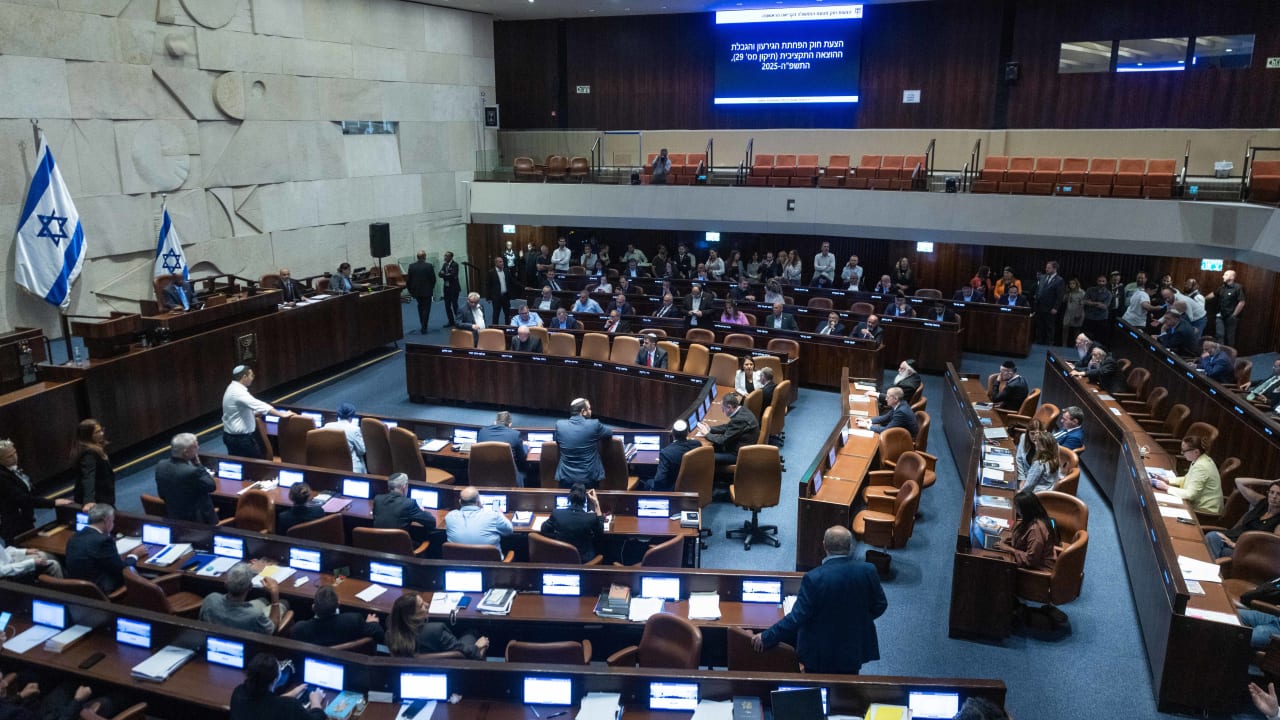
Returning from its months-long recess, the Knesset will open its winter session on Monday in the plenum amid shifting political dynamics brought by Israel’s new ceasefire, and with the issue of Prime Minister Benjamin Netanyahu’s lost coalition majority from before the recess remaining unresolved.
In a flurry of events that occurred just before the Knesset went into recess on July 27, Shas and United Torah Judaism (UTJ), two haredi parties, both resigned from the government.
UTJ left the government and the coalition on July 15, while Shas remained in the coalition but departed from the government on July 17.
The two parties’ eventual resignation was due to fallout over negotiations regarding the controversial haredi (ultra-Orthodox) conscription law. At the time, as the head of the Knesset’s Foreign Affairs and Defense Committee, MK Yuli Edelstein (Likud) had been developing the bill.
When the haredi parties left, Netanyahu then lost his majority in the Knesset for the first time since taking office in late 2022. Shortly after this, Edelstein was ousted from his position as committee head and replaced by MK Boaz Bismuth (Likud).

While Edelstein was working on his outline of the law, he held dozens of committee meetings. He repeatedly said that his committee had “cleaned the slate” on the previous bill, which was widely believed to be irrelevant following Hamas’s October 7 massacre.
A working recess
During the recess, the Knesset was still able to convene its committee meetings, in which bills are discussed before they progress to the plenum to be voted on in three separate readings.
With Bismuth leading the Defense Committee, marathon meetings on the draft law took place over the course of the summer, allowing the conditions for the law to be passed at the start of the winter session.
The meetings on the draft consisted of heated clashes between ministers, with MKs calling the advances in the haredi draft law outdated. Accusations were made that no progress was made on the law, and even more so, that the bill had actually regressed to a period before Edelstein had revised it.
In an early September discussion on the bill, MK Efrat Rayten (the Democrats) said that she had examined the sections Bismuth proposed and compared them to Edelstein’s outline.
She said that she concluded that Bismuth’s sections of the draft were entirely different from Edelstein’s outline on the conscription bill, which was “worked on for a year and a half” and meant to “reflect all the discussions we had here.”
Rayten was one of the many MKs who also criticized Bismuth’s revised version of the draft law.
Meanwhile, during those meetings, reservists and IDF representatives spoke on the urgent need for additional staffing in the military as Israel was nearing its two-year mark of war.
Toppling Netanyahu's government
Separately, opposition party heads met in early October to discuss plans for toppling Netanyahu’s government and expressed shared support in offering a political safety net for US President Donald Trump’s ceasefire proposal.
“The meeting focused on coordinating steps to bring down the government in the upcoming [Knesset] winter session,” the leaders said in a statement released after that meeting.
Those who attended were part of the recently launched forum called “the Change Bloc,” which includes opposition leader MK Yair Lapid (Yesh Atid), former IDF chief of staff Lt.-Gen. (res.) Gadi Eisenkot (Yashar!), former prime minister Naftali Bennett (Bennett 2026), MK Benny Gantz (Blue and White), MK Avigdor Liberman (Yisrael Beytenu), and Yair Golan (the Democrats).

The current elections are slated for October 2026. Toppling the government during the Knesset’s winter session, ergo, would mean triggering early elections in the country.
Where do things stand now?
Currently, the coalition and opposition stand at a 60-60 seat tie, meaning that without the return of the haredi parties, there is no majority for the prime minister to pass any measure that requires legislation or approval in the Knesset.
However, the reality has been that, before the summer recess, the opposition has supported or abstained from crucial votes that mostly concerned security issues. Therefore, it is unlikely that an urgent parliamentary matter will force Netanyahu to call an election.
As for the haredi conscription bill, Bismuth announced that he had submitted a document of the updated outline of the draft law to the committee’s legal advisor on Thursday, which is a key indicator that Shas may very well be returning.
According to sources close to Shas head Arye Deri, presentation of the law’s principles alone would be sufficient to justify the party’s return to the government table at the opening of the Knesset session, as per a Thursday KAN News report.
Ministers can only hold temporary positions for three months, which means that the time left for filling interim positions for the Shas ministers is expected to run out this week.
Bismuth also thanked former Shas MK Ariel Atias “for his cooperation and significant involvement” in aiding with the bill’s outline.
Additional committee meetings on the draft law pertaining to the outline that Bismuth submitted are slated for Tuesday.
“The draft law will be finalized in the coming days and brought for an open and transparent discussion in the committee, with the participation of the IDF and all relevant parties,” Bismuth affirmed again in a Sunday statement.
Meanwhile, Netanyahu’s right-wing ministers, National Security Minister Itamar Ben-Gvir (Otzma Yehudit) and Finance Minister Bezalel Smotrich (Religious Zionist Party), had both laid out red lines to leave the government ahead of the hostage-ceasefire deal’s finalization.
While Ben-Gvir and Smotrich still remain in the government at the moment, they continue to call for Israel to restart its military campaign in the Gaza Strip.
Ben-Gvir stated in early October that if Hamas is not defeated, his party will leave the government, though he was willing to stay for the first stage of the deal to witness the return of all the hostages who were still alive.
With all these dynamics coming into play, the stage has been set for an eventful Knesset winter session ahead, as Israel’s political landscape teeters in a delicate balance, and key legislation will be brought to the plenum.
Eliav Breuer contributed to this report.