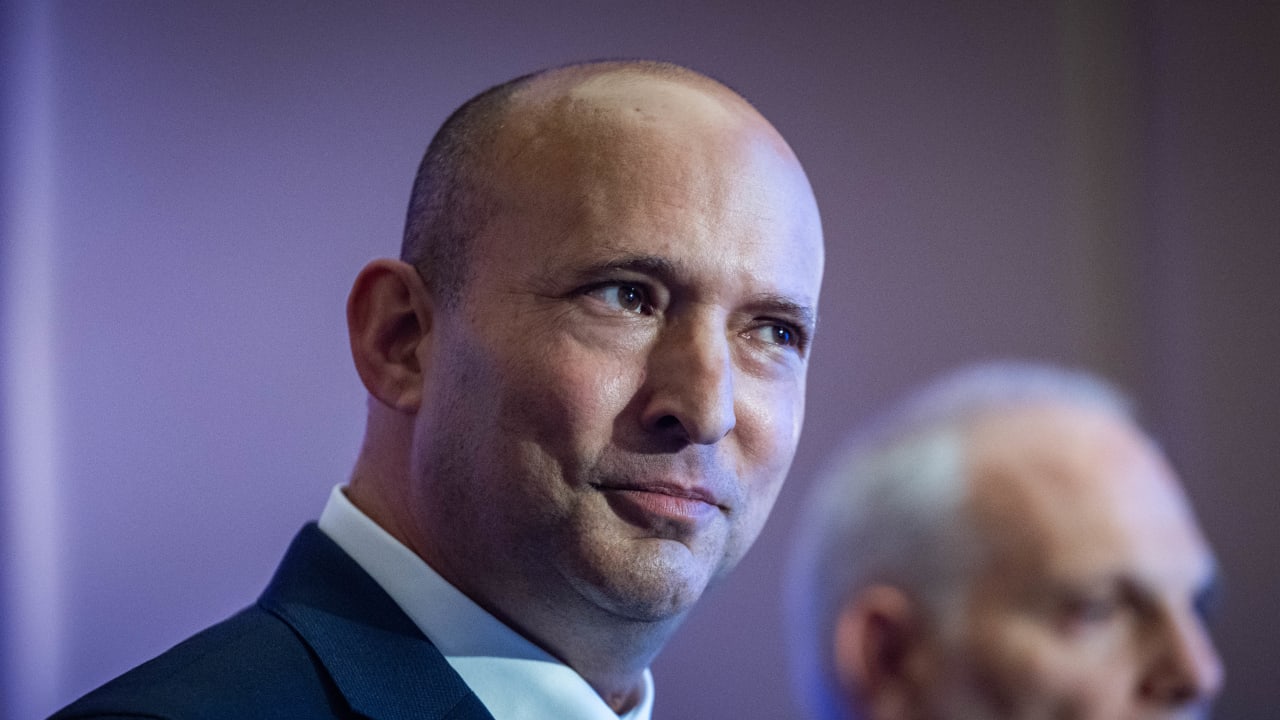
Former prime minister Naftali Bennett said he will not boycott National Security Minister Itamar Ben-Gvir (Otzma Yehudit) and Finance Minister Bezalel Smotrich (Religious Zionist Party), according to leaked recordings released on Thursday.
The comments led to speculation that he would be willing to form a government with the right-wing party leaders after the upcoming elections, which are scheduled to take place no later than October.
The recordings were leaked, Bennett’s office told The Jerusalem Post.
His remarks were said to have been recorded during a conference in Efrat on Wednesday.
In the recordings, Bennett is heard saying about Ben-Gvir: “I don’t boycott him, but he is simply a very, very, very unserious person.”

Regarding Smotrich, he said: “Today, he is very combative, but he knows how to work. So, I don’t boycott him. In the end, I look at the results.”
Bennett said he remains close to the Religious Zionist Party so that after the elections, “there will be very heavy pressure on them to stop boycotting us.”
“What happened? Why can’t you sit with us? There is a boycott today,” he added.
Regarding his term as prime minister that began in 2021, Bennett said he had invited Smotrich to join his government.
“If Smotrich had come, there would have been no need to rely on an Arab party,” he said. “But he preferred that I rely on an Arab party so that he could get angry about it, rather than come and be part of the solution. So, this boycott needs to be broken.”
Bennett's time as PM and the implications of the recording
Bennett became prime minister in June 2021 and entered a rotation government with opposition leader Yair Lapid (Yesh Atid). His government was the first in Israel’s history to include an Arab party. It added the Ra’am Party to the coalition in a controversial move that is cited in the current round of elections.
The released recordings come amid recent speculation regarding Bennett’s stance on forming a government with political rival Prime Minister Benjamin Netanyahu. On Tuesday, Bennett called for a change in leadership after the October 7 massacre, indicating that he would not be willing to form a government with him.
After the release of Bennett’s recordings, opposition party leaders strongly condemned any willingness to form a government with Netanyahu.
Among the party leaders in the opposition bloc are Lapid, former IDF chief of staff Gadi Eisenkot (Yashar!), Benny Gantz (Blue and White), Avigdor Liberman (Yisrael Beytenu), and Yair Golan (The Democrats).
“It is forbidden to join Netanyahu under any conditions and under any circumstances,” Liberman said, tagging Lapid, Eisenkot, and Bennett, on X/Twitter.
In response to the post, Lapid wrote: “Only a large and strong Yesh Atid will prevent a government with Ben-Gvir and the haredim [ultra-Orthodox].”
On Wednesday, he spoke against voting for Bennett. interview.
“When you go to vote, ask yourselves who you are certain will not go with Netanyahu, who has a real party, and whose list includes people you truly know and understand what they stand for,” Lapid told Army Radio.
He has also called for the opposition to unite and for anti-Netanyahu voters to choose Yesh Atid.
In response to Bennett, Golan wrote: “Naftali, Israel needs repair. The Democrats, a party with a strong liberal, democratic, and values-based backbone, will not lend a hand to a government with those responsible for the failure of October 7, for the division, and for the systematic destruction of the rule of law.”
Eisenkot wrote: “We will win the upcoming elections. Believe it and internalize it, Israel will receive the leadership it deserves.”
“Anyone who held office on October 7, including members of the cabinet and foremost among them Prime Minister Netanyahu, is not worthy, not fit, and must not serve in public positions... This is the time to look ahead, to focus on the goal of establishing a Zionist, statesmanlike government that will lead Israel. One that will bring us back to ourselves,” Eisenkot wrote.
There have been talks among the opposition party heads to join forces to form a government against Netanyahu. In recent weeks, however, there have been repeated instances of tensions among them.