
In recent weeks, one of the most striking developments at the UN has been the Gulf nations’ assertive role in curbing Iranian influence.
“I am certainly surprised by what has been happening here at the UN in recent weeks,” Israel’s UN Ambassador Danny Danon says in a conversation with The Jerusalem Post. “In the past, we had cooperation and held similar positions with the Gulf states, but it was behind the scenes. But this time, they are simply operating in an open manner, with determination and assertiveness, I would say, against Iran.”
He pointed to a recent Security Council resolution by the Gulf countries condemning Iranian attacks and a subsequent move regarding maritime freedom – a resolution put on the table of the UN Security Council by Bahrain – as evidence of this new Gulf resolve. “It has a very strong language against Iran and a threat of use of force if Tehran does not allow freedom to ships to sail in the Straits of Hormuz.”
However, he sharply criticized European countries – particularly France – for its attempts to put forward a “light resolution.”
“European countries like France are working to soften these proposals, sometimes even neutralizing them, essentially doing the work for Iran. This is a phenomenon I don’t recall ever seeing in the corridors of the UN,” he said.
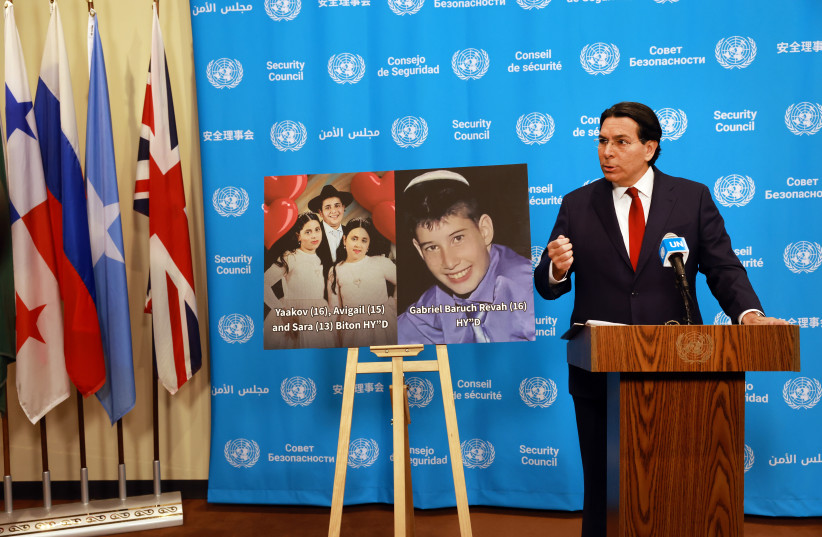
Danon noted that even regional rivals have set aside their differences to face the common threat. “There was very high tension between the UAE and Saudi Arabia on many issues. They managed to set aside all disputes and unite forces right now in their struggle against Iran.”
According to the ambassador, a key part of Israel’s diplomatic mission had been to “wake up” the world, presenting hard intelligence on Iran’s capabilities. He recounted a recent briefing where he presented the exact range of Tehran’s ballistic missile arsenal.
“People were alarmed when they saw that they have thousands of missiles that can reach their homes,” he said. “Most countries in the world have no protection. Suddenly, they feel that they, too, might be harmed by Iran’s bullying.”
This realization has shifted the narrative from a localized Israel-Iran conflict to a global security issue. Danon emphasized that “it’s different when Iran attacks Israel compared to the fact that Iran is attacking 13 countries.”
Israel's conflict with Hezbollah
Regarding the escalating tensions in the north, the war between Israel and Hezbollah, Danon was candid about the failure of both the Lebanese government and international observers to contain Hezbollah. While acknowledging that the Lebanese government has made some symbolic gestures – such as expelling the Iranian ambassador – he insisted that the reality on the ground remains unchanged.
“In terms of actual work, we, unfortunately, see that Hezbollah is still in places it is forbidden from being, and that the Lebanese army is simply not in the game,” Danon stated. He added that UNIFIL is in its “closing stages” and is expected to withdraw by the end of the year following a Security Council decision.
“The problem isn’t UNIFIL,” he said. “The problem is the Lebanese army. It was supposed to dismantle Hezbollah’s capabilities, and they did not do it.”
Despite the intense international pressure for a ceasefire, Danon insisted that Israel’s standing at the UN remains robust, bolstered by both its military performance and its partnership with the US.
“I think that, overall, our situation is good,” he said. “It is good because, first of all, people respect the strong, and we are demonstrating power, strength, and capabilities.”
Dismissing claims of diplomatic isolation, Danon pointed to a Passover Seder he hosted for UN ambassadors as a sign of continued engagement. “Dozens of ambassadors came; it’s as if there is no feeling of isolation right now, but rather, definitely one of appreciation.”