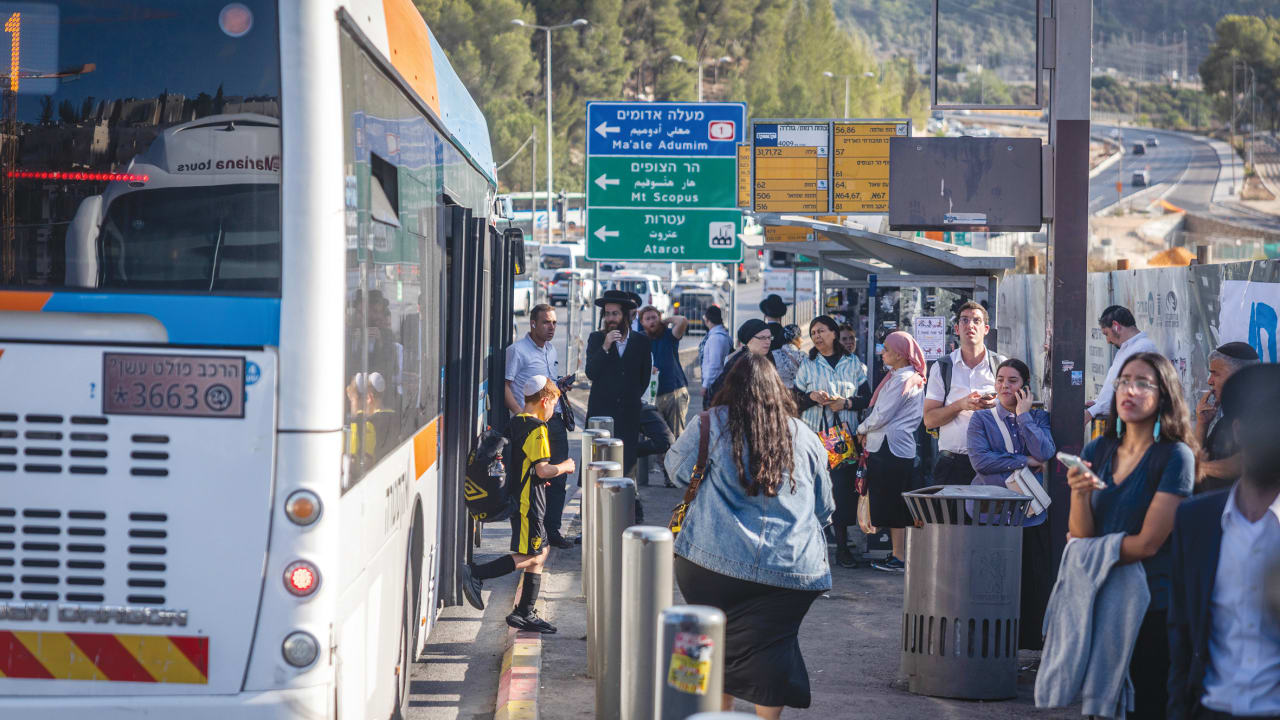

For decades, passengers on Israeli buses have gripped handrails with white knuckles, braced against sudden lane changes that defy both physics and the Geneva Convention, and silently made peace with their maker somewhere between Herzliya and the Arlozorov terminal.
Now, newly declassified documents from the State Archives reveal what commuters have long suspected: Israel’s public bus drivers have been trained by the Mossad since 1949, the result of a bureaucratic error that nobody in government has ever bothered, or dared, to correct.
The mix-up, according to the documents, traces back to a filing mishap in the chaotic early months of statehood. David Remez, then serving as Israel’s first transportation minister, submitted a requisition order for “200 operational drivers for national routes” to the fledgling defense establishment.
The request was intended for the Egged bus cooperative.
It landed instead on the desk of Reuven Shiloah, founder of what would become the Mossad.

“Shiloah apparently read ‘operational drivers’ and ‘national routes’ and assumed this was a request for field agents trained in evasive maneuvering and high-speed vehicle operations,” said Dr. Yael Bergman-Oren, a historian at the Hebrew University of Jerusalem’s Department of Administrative Oversights, a small department that, she noted, stays very busy.
Twelve-week course in counter-surveillance driving techniques
“By the time anyone realized the error, an entire cohort of bus drivers had completed a 12-week course in counter-surveillance driving techniques, tactical lane changes, and something listed only as ‘Protocol Dalet.’”
The documents do not clarify what Protocol Dalet entails, though regular riders of the 480 line to Jerusalem may have some theories. Rather than unwind the arrangement, then-prime minister David Ben-Gurion reportedly saw a strategic advantage.
“Every citizen a soldier, why not every bus driver an operative?” Ben-Gurion is said to have written in a memo to Remez, adding: “Besides, have you tried getting Shiloah to give anything back?”
The program was formalized under a classified memorandum of understanding between the Transportation Ministry and the intelligence services.
Under its terms, all public bus drivers in Israel would undergo what was officially described as “enhanced defensive transit training,” but which, according to the documents, included modules on:
Evasive acceleration – the technique of flooring the gas pedal the instant the doors close, regardless of whether passengers have found a seat, a handhold, or their center of gravity.
Tactical braking – the application of brakes at the last possible moment, a maneuver the documents describe as “creating momentary disorientation in any trailing hostile vehicle, as well as in most standing passengers.”
The Mirror Check Principle, listed in the training manual as: “Mirrors are for identifying surveillance. Pedestrians and cyclists will sort themselves out.”
Route deviation under duress, a protocol that permits drivers to skip stops, alter routes, and refuse to acknowledge passenger requests, all of which are described in the documents as “operational security measures.”
Perhaps most striking is the section on what the manual calls “psychological resistance conditioning.”
Drivers are reportedly trained to maintain complete emotional neutrality regardless of external stimuli, a skill that explains the unbroken composure of the average Egged driver when confronted with screaming passengers, red lights, or the basic concept of a speed limit.
“I always knew something was different about Israeli bus drivers,” said Tamar Feldman, 34, a Tel Aviv commuter who says she has filed over 40 complaints with the Egged customer service line.
“I once saw my driver execute a U-turn across four lanes of Ayalon traffic without checking a single mirror or changing facial expression. I thought he was reckless. Now I realize he was conducting a textbook counter-surveillance reversal.”
Attempts to reach the Mossad for comment were unsuccessful; a spokesperson for the Prime Minister’s Office said “this should neither confirm nor deny anything.”
The Transportation Ministry issued a brief statement noting that “all Israeli bus drivers are trained to the highest applicable standards” and declined to specify which standards or who applies them.
Egged released a somewhat longer statement, reading, in full:
“Egged is committed to the safety and security of all passengers and has been a proud partner in Israel’s national transportation infrastructure since before the founding of the state. We have no comment on classified training protocols. Please note that Route 947 to Beersheba is delayed.”
Current and former drivers contacted for this article declined to speak on the record. One retired driver, who agreed to be identified only as “G.,” met this reporter at a cafe in Netanya, arriving in a Hyundai i10 that he parallel-parked in a space that could not have been more than five centimeters longer than the vehicle.
Asked whether his Mossad training had served him well, G. stared silently for 11 seconds, a duration this reporter counted, before answering: “I can tell you that I drove the 51 line in Haifa for 30 years and never once lost a tail.”
He declined to clarify whether he meant a surveillance vehicle or a passenger running for the closing doors.
Defense analysts say the program may have had unintended strategic benefits.
Dr. Oren Kaspi, a fellow at the Institute for National Security Studies, noted that Israel is one of the few countries in the world where foreign intelligence operatives have reported difficulty maintaining vehicular surveillance in urban areas.
“There’s a CIA internal assessment from the 1970s that specifically warns agents stationed in Israel to avoid tailing city buses,” Kaspi said.
“The report describes Israeli bus drivers as ‘unpredictable, aggressive, and apparently immune to traffic laws,’ which, if you think about it, is exactly what you’d want from an intelligence asset behind the wheel.”
The revelation raises questions about other Israeli institutions that may have been shaped by the administrative confusion of early statehood.
Dr. Bergman-Oren noted that her department is currently investigating a 1951 requisition for “field-ready kitchen units” that may explain certain aspects of army cafeteria food, though she cautioned that the research is ongoing and “some files appear to have been eaten.”
For now, commuters may find some comfort, or additional alarm, in knowing that the next time their bus lurches across three lanes without signaling, it is not mere negligence.
It is, in fact, a precisely executed maneuver, honed over 75 years of institutional expertise, designed to protect the nation and its passengers.
Whether those passengers survive the commute is, according to the declassified documents, “outside the operational scope of the program.”