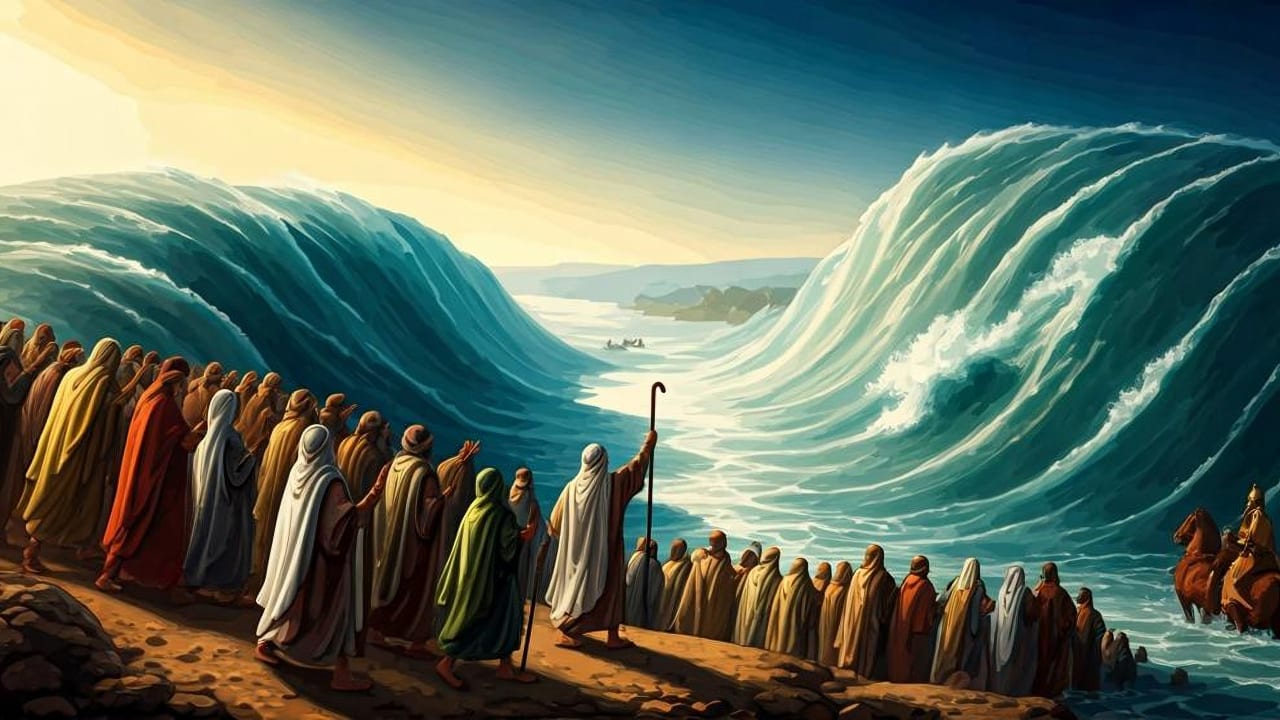
My teacher, Rabbi Jack Cohen of blessed memory, would teach: If we feel different after prayer, we know our prayer has worked. The goal of prayer is not to change outside circumstances but rather our inner reality, our inner mapping.
Prayer can be an oasis along the way. Prayer can also parallel the journeys we take in life. From commencing a sojourn to completing it, we often return as changed individuals. So many of the great works of literature are of that genre: The Odyssey by Homer; The Razor’s Edge by W. Somerset Maugham; The Adventures of Tom Sawyer by Mark Twain. Like those books, the Torah includes adventures, trials, and lessons encountered along the way.
The word “journey” is derived from the old French word, jornee, meaning “day – a day’s travel.” One of this week’s Torah portions is called “Masei,” meaning “journeys,” as it lists the 42 places the Jews camped during the 40 years they wandered in the desert under the leadership of Moses, Aaron, and Miriam.
During the biblical period, a day’s journey was between 27 km. and 40 km. (17-26 miles):, which would ideally be the maximum distance from one water source to another. (Groups with larger numbers and herds would need smaller distances, which raises questions that compound where exactly some of those 42 encampments were.)
Of the 42 encampments of the exodus, we are unclear where most of them are located. Moreover, archaeologist Uzi Avner reminds us that “in Numbers 33, Moses is summing up the trip, under God’s order, in a totally different way than the other two versions about the Exodus route. He added 22 stations which were never mentioned before and talks about traveling to Ezion Geber and other locations before Qadesh Barne’a.”
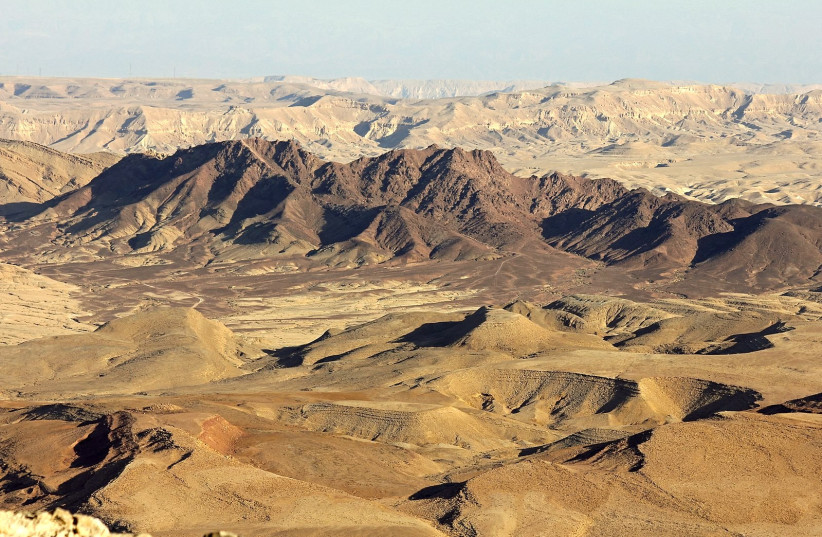
A location that we can be most sure of, though not 100%, is Etzion Gever (Numbers 33:35-36), as we have later references to it. King Solomon housed his navy there (I Kings 9:26; II Chron. 8:17), and it is mentioned as the locale where King Jehoshaphat’s fleet “had broken up.” (I Kings 22:49; II Chron. 20:26).
Based on some archaeological evidence, many think that the port was situated in Tel al-Kheleufeh in Aqaba, Jordan, or the “Coral Island,” seven miles (11 km.) just across the border in Egypt, south of Eilat. For the sake of argument, if we make Etzion Gever our anchor location, and then go 35 km. north, we find the spring of Avrona. A further 25 km. north is the oasis of Yotvata. Avrona (Numbers 33:34-35) and Yotvata (33:33-34) are both mentioned directly next to Etzion Gever (33:35-36) in our text.
Avrona has a long history as an important water source. In the 9th century during the Early Islamic period, a network of underground tunnels (at least 1.5 km. in length) was utilized for an extensive farming system. The tunnels are called fogarat in North African Arabic, while in Persian – from where the technique originated – they are known as qanot. Some sections of the system at the Avrona Farm have been excavated and can be crawled through today.
Yotvata is also mentioned in the Book of Deuteronomy (10:7), where it is described as “a land of watercourses.” In fact, when Kibbutz Yotvata was established in the early 1950s, surface water could still be found at the oasis. The combination of its water source and its position at the narrowest point in the Arava Valley has made Yotvata an important location for some 3,000 years.
Archaeological sites that can be seen there today include an Iron Age fortress that served copper mining at Timna some 18 km. south of Yotvata (copper mines from the 5th millennium BCE. and later); remains of Nabatean activity (1st century BCE to 5th century CE); a Roman fort (which includes a classic Roman bath house) from the Late Roman and early Byzantine periods (3rd and 4th centuries CE); and a structure from the Early Islamic period which has been incorporated today into the regional elementary school Nof Edom as a teaching site.
T. E. Lawrence (of Arabia) visited Yotvata in 1914, calling it by its Arabic name, Ghad’ian, which came from ghad’a, a large bush (Haloxilon persicum) prevalent in that region. Archaeologist Jodi Magness points out that the name “may preserve the ancient Roman name Ad Dianam” of the site.
All of this raises the point: While we have the place names Yotvata and Avrona from the Bible, we do not find those two locations called by those names until the last century, so the modern usage of the names does not necessarily indicate the old locations, which are unknown.
That uncertainty makes locating Hor Haggidgad (Numbers 33:32-33), mentioned before Yotvata, much more difficult. One criterion is that at some point, the Israelites likely would have needed to descend from the Negev plateau to Yotvata in the Arava Valley. Two ancient trails near Yotvata could be considered. Ma’ale Shacharut starts a few kilometers west of Yotvata, while the other, Ma’ale Yitro, lies about eight km. north of Yotvata. They both lead to the Uvda Valley near the edge of the Negev plateau.
But all that is speculation, with no solid archaeological evidence or extra-biblical historical evidence. If that is the case, what can we do with this travelogue of the 33rd chapter of the Book of Numbers?
Each location is a rest spot, a water source, along the exodus journey. This reminds us, as does the message of Shabbat, that we need to pace our lives – not just on Shabbat but during our work week journey. We were originally called Ivrim (Genesis 14:13), meaning “the ones who crossed over” – from one side of a river to the other in our wanderings – both a physical and an existential orientation.
We also know that we never reach our destination, as we are changed by the journey. The “I” who left is not the same “I” who arrives. This is also true of our reading of Torah each year. The “I” who is reading the same text this year is not the same “I” who read it last year, as we have a year’s worth of encounters that have changed us.
A refreshing oasis experience
In this way, the weekly reading of Torah is also a refreshing oasis experience, as we see things anew. My father, Alfred Cohen of blessed memory, told me that each time he listened to Beethoven’s 5th Symphony, he heard something he had not heard previously.
With the reading of the portion of “Masei,” we conclude the reading of the Book of Numbers. When the last word is read at the end of a book of Torah, the congregation traditionally says, “Chazak, chazak, v’nitchazek” – “Be strong, be strong, and may we strengthen each other.” Why do we say those words?
There are traditionally five blank spaces on the scroll between the books of the Torah. They represent those moments in our lives, in our journeys, when we face some completely new experience, with nothing to latch onto – so we can, if you will, cross over to the other side. We say this phrase to make that passage; we gather as individuals, and we utilize our collective life stories up to that point to help give us the strength to face that moment.
Many Torah scrolls are written with 42 lines in a column, reflecting the locations mentioned in this chapter of the Book of Numbers. As we read those lines every Shabbat morning, we are reminded that taking the time to study Torah and prayer is like resting at an oasis to feed our soul. ■
The writer is a Reconstructionist rabbi emeritus of the Israel Congregation in Manchester Center, Vermont. He teaches at the Arava Institute for Environmental Studies at Kibbutz Ketura and at Bennington College.