
Amid an uptick of violence in Israel and a public spat with Prime Minister Naftali Bennett, Defense Minister Benny Gantz met with King Abdullah II of Jordan at the King's Palace in Amman on Tuesday.
According to a statement released by his office, during the meeting that addressed regional security challenges, Gantz discussed the steps that Israel intends to take ahead of the month of Ramadan in order to preserve freedom of worship in Jerusalem and the West Bank, the importance of security coordination during the holy days as well as additional steps that could be taken in order to improve the lives of Palestinians.
The Defense Minister “emphasized the importance of maintaining regional peace and stability and the need to fight terrorism in all its forms, specifically to act forcefully against ISIS, which has coordinated the recent attacks in Israel,” the statement read.
Wishing the King and all Jordanians a “Ramadan Kareem,” Gantz thanked Abdullah “for his leadership and positive influence in the region, as well as for his willingness to deepen peaceful relations and to expand cooperation between the Kingdom and Israel in all areas,” the statement added.
The meeting was coordinated with Bennett, with whom he has been engaged in a public spat with over the defense minister’s desire to meet with the King and Palestinian Authority President Mahmoud Abbas.
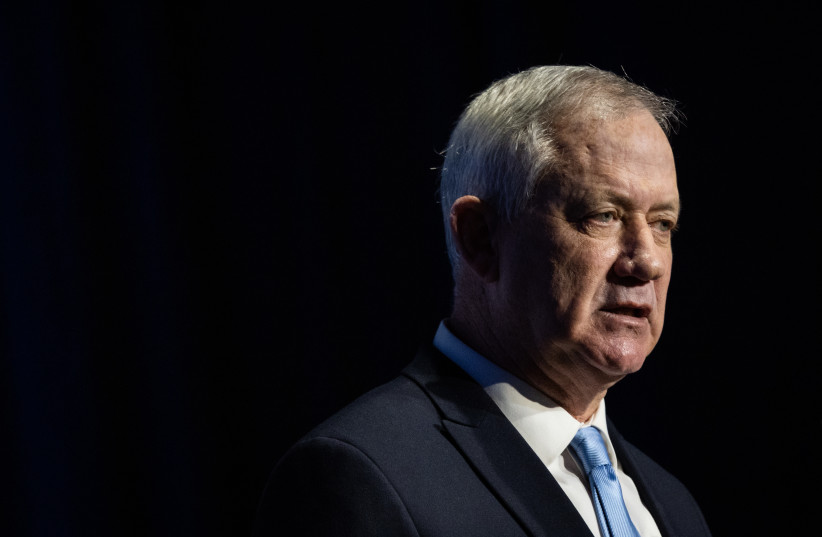
According to Israeli media, Bennett stopped Gantz from participating in the meeting and expressed his “displeasure” from Gantz’s failure to tell him of his plans.
On Saturday Culture and Sports Minister MK (Kahol Lavan) Chili Tropper told Channel 13 that Gantz wanted to meet with Abbas in Ramallah in order to avoid an escalation.
The defense minister has met with the two men before. Gantz first met Abbas in August-marking the first meeting of a senior Israeli government official with a Palestinian Authority leader since 2010. He then hosted Abbas in his home in Rosh Ha’ayin in December in order to discuss issues related to security, civil and the economy.
Gantz and Abdullah then met and discussed how to strengthen Israeli-Jordanian ties and issues of mutual concern including ways to enhance security and stability in the region.
Gantz and Abdullah previously met ahead of the February 2020 election.
Amman and Jerusalem not only have robust security coordination and intelligence sharing mechanisms regarding the common threats, but according to foreign reports, Jordan has allowed Israeli jets to use its airspace for its war-between-wars campaign in Syria.
In October, a German military photographer posted two pictures of Jordanian fighter jets taking part in Israel’s Blue Flag aerial exercise on social media, inadvertently revealing that the kingdom had participated in the drill.
Until the photos were posted, Jordan’s participation in the two-week-long bi-annual exercise had officially been kept a secret.
The strategic depth provided by Jordan, which has not entered into any alliance with neighboring countries hostile to Israel, has kept Israel’s eastern and longest border the quietest and safest for decades.
Both countries understand that should security ties fail, not only will the king face instability at home, but the violence could spill over the border to Israel.
With a majority of Jordan’s citizens of Palestinian descent, Palestinian self-determination and maintaining the status quo of the Al-Aqsa Mosque in Jerusalem, which is administered by the Jordanian Islamic Trust, are key aspects of public discourse in Amman.