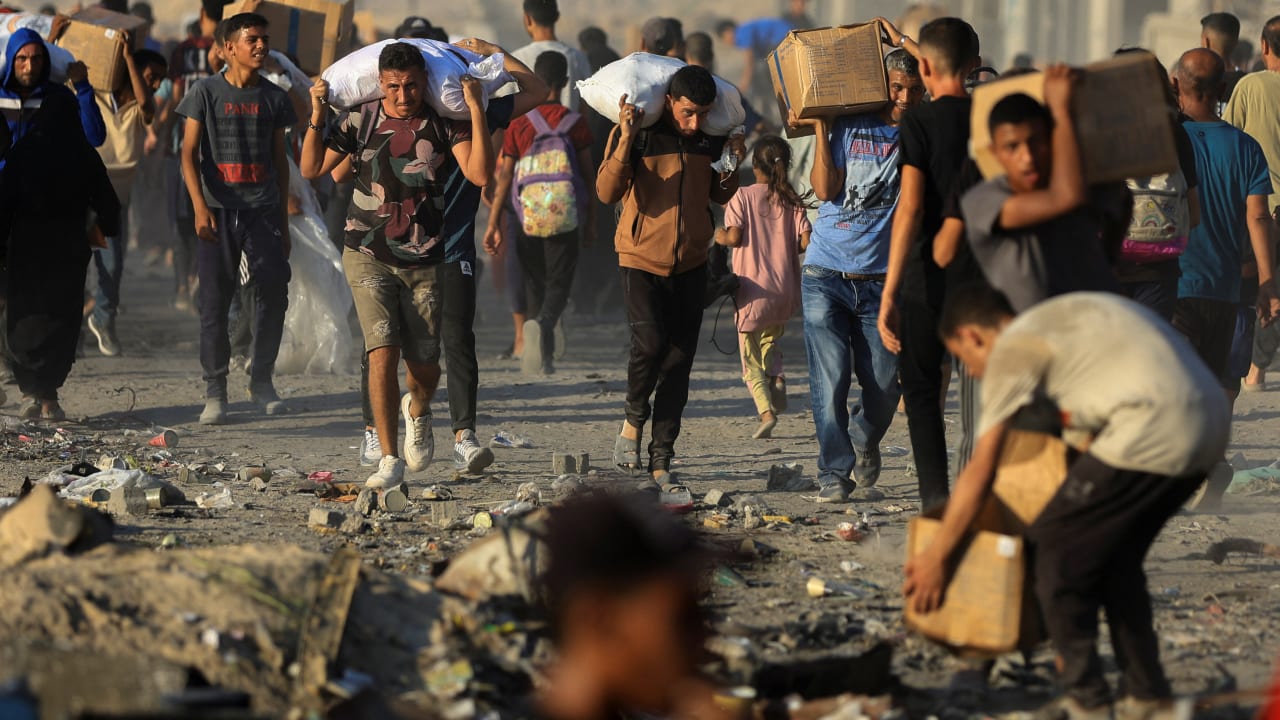
Images circulated on Thursday of masked men on aid trucks in the northern Gaza Strip, who clan leaders said were protecting aid, rather than Hamas stealing it from civilians.
Prime Minister Benjamin Netanyahu, in a joint statement with Defense Minister Israel Katz, said late on Wednesday that he had ordered the military to present a plan within two days to prevent Hamas from taking control of aid.
They cited new unspecified information indicating that Hamas was seizing aid intended for civilians in northern Gaza. A video circulating on Wednesday showed dozens of masked men, some armed with rifles but most carrying sticks, riding on aid trucks.
The reports are murky, as the focal point is the northern part of the enclave, and is the issue on which there are unclear statements. The IDF has been operating in the area, and issued evacuation orders for some parts of it a few days ago.
Two officials told Reuters that Israel has stopped aid from entering northern Gaza but is still allowing it to enter from the south. Government spokesperson David Mencer told reporters that aid was continuing to enter from the south but did not specify whether any supplies were entering in the north.

The US and Israeli-backed Gaza Humanitarian Foundation, which operates aid distribution sites in southern and central Gaza, said it was the only humanitarian organization permitted on Thursday to distribute food in Gaza. A spokesperson said the foundation was exempt from a two-day suspension of humanitarian aid deliveries into the territory.
“Our hope is this will be a temporary pause and all other aid organizations will soon be able to resume distribution in the region,” said the organization.
The IDF confirmed that humanitarian aid reached the GHF sites. What remained unclear were the sites not run by GHF, particularly in the north.
A United Nations source said that all aid that was due to enter northern Gaza had been put on hold. Trucks carrying aid supplies often enter Gaza in the evening. Reuters could not immediately confirm if that would happen on Thursday and Friday.
The Higher Commission for Tribal Affairs, which represents influential clans in Gaza, said that trucks had been protected as part of an aid security process managed “solely through tribal efforts.” The commission said that no Palestinian faction, a reference to Hamas, had taken part in the process.
Hamas, the terrorist group that has ruled Gaza for more than two decades but now controls only parts of the territory after nearly two years of war with Israel, denied any involvement.
Throughout the war, numerous clans, civil society groups and factions – including Hamas’s secular political rival Fatah – have stepped in to help provide security for the aid convoys.
Clans made up of extended families connected through blood and marriage have long been a fundamental part of Gazan society.
Amjad al-Shawa, director of an umbrella body for Palestinian non-governmental organizations, said the aid protected by clans on Wednesday was being distributed to vulnerable families. There is an acute shortage of food and other basic supplies in the enclave.
Aid trucks and warehouses storing supplies have often been looted, frequently by desperate and starving Palestinians. Israel accuses Hamas of stealing aid for its own fighters or to sell to finance its operations.
“The clans came ... to form a stance to prevent the aggressors and the thieves from stealing the food that belongs to our people,” Abu Salman Al Moghani, a representative of Gazan clans, said, referring to Wednesday’s operation.
The war began when Hamas launched a surprise massacre attack on Israel on October 7, 2023, killing nearly 1,200 people, mostly civilians, and taking 251 others hostage into Gaza. Fifty hostages remain held in Hamas captivity.
Israel launched a military campaign to disarm Hamas and return the hostages. According to local health authorities in Gaza, approximately 56,000 Palestinians have been killed so far.
Local Gazan authorities and medics said 21 Palestinians were killed in the Gaza Strip on Thursday, as mediators reached out to Israel and Hamas to seek a resumption of ceasefire talks to end the war. These numbers could not be independently verified.
Local health authorities said an Israeli airstrike killed at least nine people at a school housing displaced families in the Sheikh Radwan suburb in Gaza City, while another strike killed nine people near a tent encampment in Khan Yunis in the south of the enclave.
Medics said that three other people were killed by IDF gunfire, and dozens were wounded as crowds awaited UN aid trucks along a main route in central Gaza.
Petition for safe passage and operations in Nasser hospital
In a separate development, the Association for Civil Rights in Israel (ACRI) petitioned the High Court of Justice on Thursday to ensure safe passage and operations in Nasser Hospital in Khan Yunis.
The second largest hospital in Gaza, Nasser is one of the last few functioning medical centers still able to operate. Doctors testified that patients suffer with no adequate pain relief medication, old equipment, a lack of basic hygiene products like soap and gloves, and cleaning operating rooms with dirty water.
The petition was submitted along with HaMoked (the Center for the Defense of the Individual), Physicians for Human Rights-Israel, and Gisha. The area where the hospital is located is one which the IDF ordered to evacuate at the beginning of the month, reads the petition.
Separately, in the North, the IDF announced that it killed a Hezbollah Radwan Force commander in the Baraachit area in southern Lebanon. Another, from Hezbollah’s observation force, was killed in the Beit Leif area.