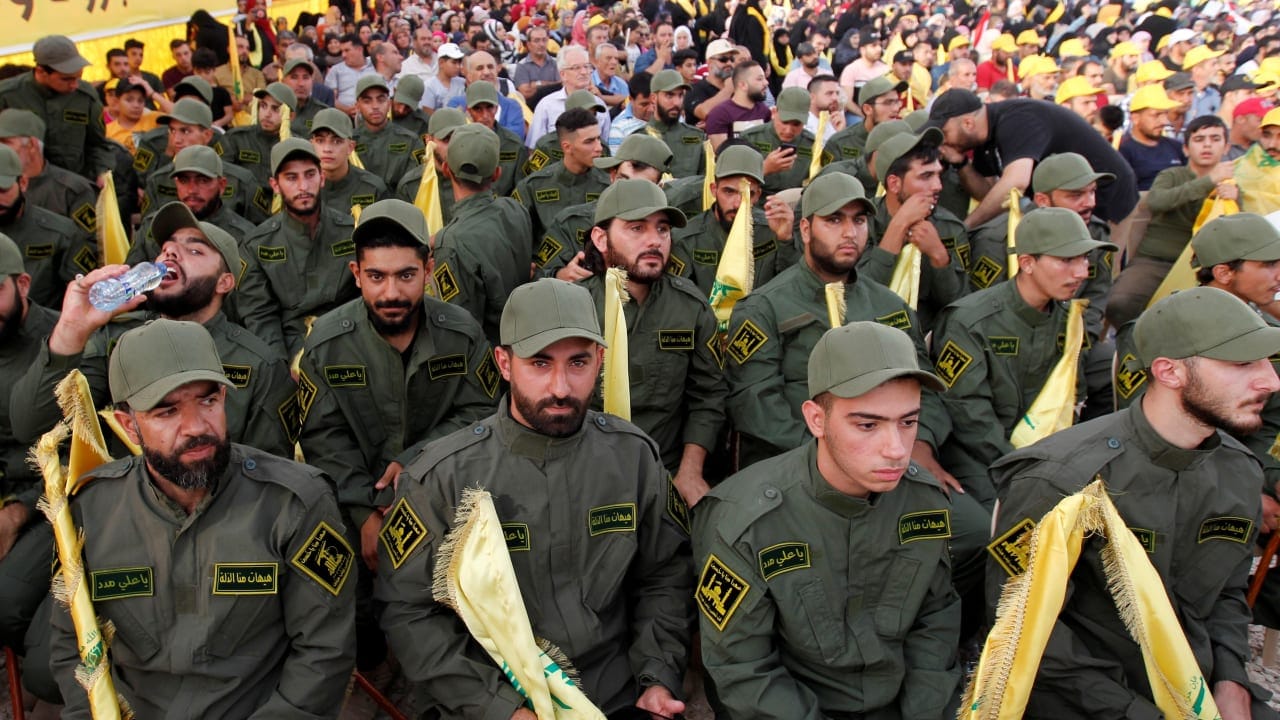
Lebanon continues to say it will disarm Hezbollah. However, when one tries to go by the phrase “trust but verify,” there is no verification so far that Beirut is moving fast enough to take the arms from the terrorist group.
Lebanon has disarmed several Palestinian factions after an agreement with the Palestinian Authority but it seems that it is not yet willing to confront Hezbollah. Beirut has promised disarmament in stages and if successful, this could pave the way for the same thing in Gaza and peace in the region. If it is not successful, problems will continue.
Kamal Shehadeh, Lebanon’s new minister of displaced persons and minister of state for information technology and artificial intelligence, spoke to Al-Ain media in the UAE about what might come next.
The issue with disarming Hezbollah
“The delay in restricting arms to the Lebanese state, as Minister Kamal Shehadeh sees it, does not merely mean a slow implementation, but rather a series of security, political, and economic costs,” the report says. He sees six problems and consequences of delaying disarmament.
These include: Delaying the establishment of the state with all its institutions and responsibilities; Exposing the country to continued Israeli attacks; Obstructing the diplomatic and political process; Obstructing the provision of aid from donor countries; Slowing the flow of investments to Lebanon and Disrupting the reconstruction process (renovating homes, building schools, and returning the people of the South).

In an exclusive interview with Al-Ain Shehadeh said, “Any delay in restricting arms to the Lebanese state will delay the establishment of the state with all its institutions and responsibilities, expose the country to continued Israeli aggression, and delay the diplomatic and political process.” Israel has continued to strike Hezbollah because it continues to have weapons.
He says “the delay will hinder the provision of aid from donor countries, the flow of investment into the country, the restoration of destroyed homes, the construction of schools, and everything related to the reconstruction of the south and the return of the people of the south to their homes.”
He warned of the danger of Hezbollah’s insistence on its refusal to restrict its weapons, the report notes. Shehadeh said, “if the [Hezbollah] party continues to maintain its position, Lebanon will remain in a vicious cycle, Israeli attacks will continue, the five border crossings will remain occupied, the state’s authority will be obstructed, and the building of a just state capable of protecting all its citizens will be hindered.”
In his opinion, “there is no way to protect Lebanon and break out of the vicious cycle except by extending the Lebanese state’s control over all of its territory.” Lebanon must build legitimacy for its institutions and the Lebanese Army. If Lebanon wants to end the chaos unleashed by Hezbollah’s war on Israel, it must move forward.
Shehadeh also warned that “continued Israeli attacks on southern Lebanon will complicate the plan’s implementation, as they will hinder the army’s deployment to carry out its mission of disarming,” explaining that “delaying the final step will delay any international pressure on Israel to halt its attacks, and here we enter a vicious cycle.” The goal now is for Lebanon to turn the corner on decades of letting Hezbollah dictate policy. Hezbollah benefited from the end of the Lebanese Civil War in 1989. It kept its guns while other factions did not.
Shehadeh explained that the government move to restrict weapons “comes within the framework of implementing the Taif Agreement, which ended the civil war decades ago, and in accordance with the Lebanese constitution, as well as the inaugural address and ministerial statement, on the basis of which the government gained the confidence of Parliament.” He continued, “today, the situation has changed, and the Lebanese state is determined to take control and protect the Lebanese.”