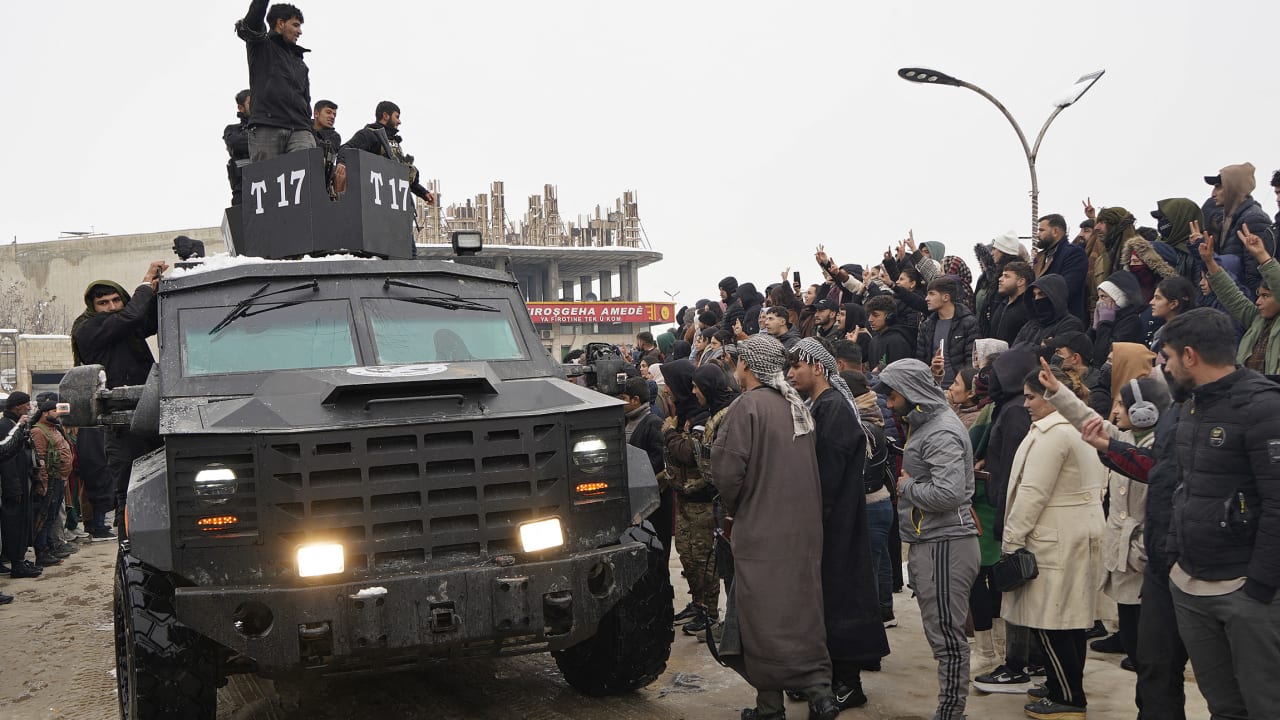
Ensuring the safety of Rojava and the ethnic minorities living under the Democratic Autonomous Administration of North and East Syria is essential to Israel’s own security, board members of the Kurdish-Jewish Alliance told The Jerusalem Post Sunday.
The alliance is one of four Swiss-Kurdish organizations that recently penned a letter to Israeli Ambassador to Switzerland Tibor Schlosser and President Isaac Herzog, warning that Israel’s fate is closely linked to that of the Kurdish people and calling for urgent support from Jerusalem.
The system of equal rights enjoyed by Kurds, Syriacs, Yazidis, Alawites, and other ethnic minorities under the Autonomous Administration of Rojava is facing an unprecedented threat from the Syrian regime, the letter said.
The letter was signed by representatives of the Kurdish-Jewish Alliance, the Swiss-Eastern Kurdistan Association, the European Syriac Union, and the Association of the People of Kurdistan and Israel.
The regime, led by President Ahmed al-Sharaa, also known as Abu Mohammad al-Julani, has been repeatedly accused of targeting minority communities across Syria, including through its alleged role in massacres of Druze communities in southern Syria, Alawites in Latakia and other provinces, and most recently, Kurds in eastern Syria.

These attacks have intensified alongside broader assaults on the formerly US-backed Syrian Democratic Forces (SDF).
The Kurdish SDF had led the battle against the Islamic State, guarding prisons and camps holding terrorist prisoners, and enjoyed autonomy and protection from the previous Assad regime.
Kurdish forces are now relying largely on weapons left behind by the US following the fight against Islamic State, leaving the community dangerously exposed, Gulistan Savgat, a Yazidi board member of the alliance, told the Post. Turkey’s frequent aerial attacks on Kurdish groups have deepened this sense of vulnerability, she added.
Attacks on the Kurdish people should be red line
Facing pressure from both Turkey and Syria, two countries openly hostile to Israel, regional powers must understand that attacks on the Kurdish people should be viewed as a redline for Israel, Savgat said. Only by making this position unmistakably clear can Jerusalem deter Islamists from further destabilizing the region, she said.
More than weapons, the regime’s forces are surrounding Rojava and causing a severe humanitarian crisis, Savgat said.
“They don’t have electricity and heat, so they are freezing in the weather,” she said, adding that many families have been unable to bury their dead as a result of the blockades.
The Syrian regime’s recent decision to release thousands of ISIS terrorists has further fueled instability and violence against minority communities, the letter said.
Israel’s willingness to fight “dark ideologies like Hamas,” despite international criticism, has created hope among Kurdish activists that Jerusalem might extend similar protection to those threatened by radical Islamist forces, it said.
While the conflict may initially appear to be based on an issue of land and control, the alliance members stressed that the root of the issue is religious freedom, meaning its consequences are not restricted to Syria. This became apparent in Antwerp, Belgium, when six people were wounded in a recent stabbing attack during a pro-Kurdish protest.
This threat loomed over the alliance as members demonstrated in Bern, Switzerland, on Saturday, Jewish board member Rebecca Laes-Kushner said. While police prevented the violence from escalating to the level seen in Antwerp, three “Islamists” from Somalia had come with the intention of attacking demonstrators, she told the Post.
“Kurds and their allies did not defeat the so-called ‘Islamic State’ with words, but with blood,” Laes-Kushner said. “Thousands lost their lives, and yet today, we are witnessing how these victims are being politically devalued. What is particularly cynical is how extremist actors are being normalized step by step.”
“When forces that were considered a terrorist threat yesterday are now seen as an ‘option,’ it sends a dangerous message: Those who fought against ISIS are ultimately to be handed over to a repackaged Islamist order,” she said.
According to the alliance, Europe is pursuing a short-term strategy by recognizing Sharaa’s legitimacy, prioritizing the return of Syrian refugees and asylum-seekers over human rights and the fight against Islamist extremism.
“The Turkish soldiers in Rojava are all ISIS,” Savgat said. “We know that, and all the people know that, but they close their eyes. It’s better for Europe. It’s better to close the eyes, to send refugees back, for Europe.”
While Europe may back Sharaa for the perceived stability he could bring to Syria, he “is ISIS,” she said, adding that “if Julani wins, then we have ISIS in Europe too, in all the world… the religion war [will start] again.”
The United States has abandoned a long-time ally in pursuit of broader regional calculations, strengthening Syria in an effort to weaken Iran, Savgat said.
“I think America lost us,” she said. “America doesn’t speak with us. A lot of journalists asked Trump, ‘Hey, [did] you see all the older Kurdish people die, the children die. Yesterday, four children died because [they were] frozen.’ A lot of journalists ask him, but he didn’t give an answer.”
Syrian minorities call on Israel for protection
The groups called on Israel to actively support the Autonomous Administration of North and East Syria, protect the Kurds and their allies, halt political and economic engagement with extremist forces, clearly identify Turkey’s role in the escalation, and support the defense of airspace to prevent further attacks on civilians and local security forces.
“The defense of the Kurds, just as they defend the Druze, will play a vital role in Israel’s strategic and regional interests,” the signatories of the letter stressed.
The relationship between the Kurds and Jews goes beyond shared enemies, the letter said. It cited when the Kurds helped Mizrahi Jews cross the mountains of Kurdistan to reach Israel at great personal risk and how the community has continued to maintain Jewish cemeteries in Aleppo.
Savgat and Laes-Kushner said Israelis should demonstrate in support of the Kurds, both as a sign of solidarity and in the hope of communicating to Jerusalem the Kurds’ desire for Israeli involvement.
“Then the world can see that we’re fighting the Islamic fanatics together,” Savgat said.