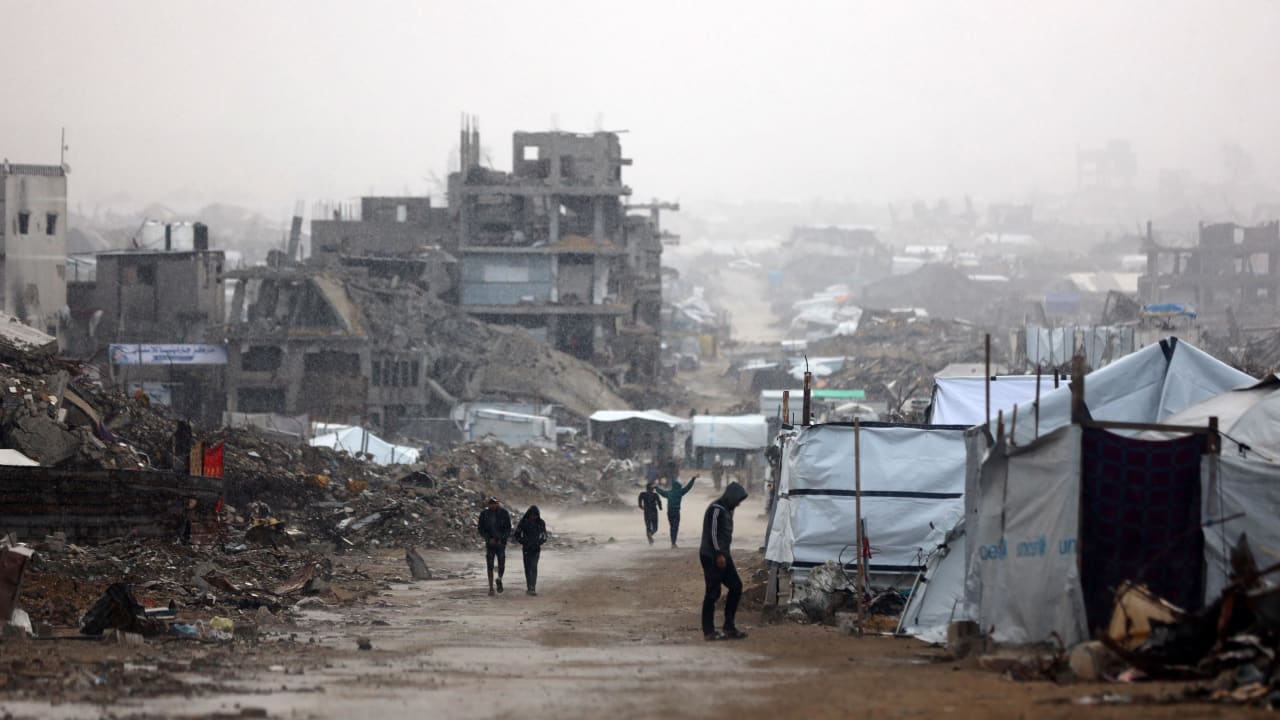
A map of the United Arab Emirates' plans to build a compound to house thousands of displaced Palestinians in a part of south Gaza under Israeli military control was seen by Reuters on Thursday.
The Jerusalem Post learned of the plans to construct neighborhoods on the Israeli-controlled side of Rafah in late December of last year. Now, the planning map seen by Reuters confirms the "UAE Temporary Emirates Housing Complex" would sit near Gaza's Yellow Line.
However, there are doubts about the political viability of the Emirati project, as most Palestinians could balk at being housed in an Israeli-controlled zone while the vast majority of civilians live in Hamas-run areas of Gaza, diplomats said.
Trump's plan saw the establishment of a US-led, multinational mission for Gaza based in southern Israel, where Emirati officials have shared details of their plans to build temporary housing and provide basic services in Rafah, four diplomats briefed on the initiative said.
In response to questions for this story, an Emirati official said the Gulf country "remains committed to scaling up its humanitarian efforts to support Palestinians in Gaza," without confirming or denying plans to build the temporary housing site.

'Choking Hamas off'
One of the diplomats said the Israeli military had cleared a large area leading from the Mediterranean coast toward Rafah for temporary housing projects like the one the UAE was planning.
The diplomats said the Emirati initiative resembled a US proposal to build temporary housing for Palestinians in areas of Gaza that are still controlled by Israel. US officials initially described their plan as "Alternative Safe Communities" and more recently as "Planned Communities," the diplomats said.
A US official said the UAE was coordinating on its housing initiative with Washington, with the Board of Peace, a new global body established by President Donald Trump to resolve conflicts, and with a US-backed Palestinian committee that is to administer Gaza.
"We continue to be impressed with the UAE's efforts for bringing a better life for Gazans in Gaza," the official said.
American officials have hoped that building housing in the Israeli-controlled areas could generate momentum toward Hamas' disarmament, encouraging Gazans to leave Hamas-controlled zones and depriving the Islamist group of a civilian population.
Kenneth Katzman, a Middle East expert at The Soufan Center, a US-based, security-focused think tank, said the "Alternative Safe Communities" were designed as a way of gradually "choking Hamas off," but for it to be effective, it would have to be built at scale, housing hundreds of thousands of Palestinians.
"Only a couple of housing projects is not going to defeat Hamas. You need to do a lot ... to have an effect," he said.
Doubts on numbers
The UAE, which established diplomatic relations with Israel in 2020 under a Trump-brokered accord, sees Hamas and other political Islamist groups as threats to Middle East stability.
The four diplomats doubted whether Palestinians would move in large numbers to areas under Israeli control and questioned whether the proposals risked a permanent division of Gaza.
But unlike the US initiative, the Emiratis had identified a site where no homes previously existed, the diplomats said.
The Israeli military controls about 53% of Gaza, including its southernmost area that encompasses the ruined city of Rafah. Hamas controls the rest of the territory, where nearly all of Gaza's two million Palestinians are living in crowded tent camps and amid the rubble of destroyed neighborhoods.
Foreign diplomats and aid workers say that humanitarian aid and shelter should be directed to areas with large populations. About 20,000 Palestinians are thought to be inhabiting areas of Gaza under Israeli military control, diplomats say, which justifies the Emirati plan, first reported last year.
Reports of plans to construct new neighborhoods emerged late last year
The first reports of the planned construction emerged in late December.
At that moment, the Civil-Military Coordination Center (CMCC), led by the US and with significant Israeli and global participation, began planning the construction and deployment of an International Stabilization Force.
Defense sources who spoke to the Post in December said that in a best-case scenario, the temporary residential facilities in such neighborhoods could be up and running within six months of a green light.
At the end of 2025, the CMCC was working in overdrive to coordinate the IDF’s clearing of tunnels from specific areas in Rafah so they would be better prepared for new building developments, even if other portions of the city and Gaza could take many more years to clear.
The strategy was to focus on the areas where the remaining Hamas tunnels could be cleared the fastest, the IDF told the Post.
In addition, defense sources noted that the strategy of placing some Gazans in temporary residential units, which are still superior to tents, aims to begin building communities while more permanent residential units are constructed in those same areas.
No one associated with Hamas will be allowed to move in.
The building time will depend on whether the structure is built with lightweight or more stable construction materials.