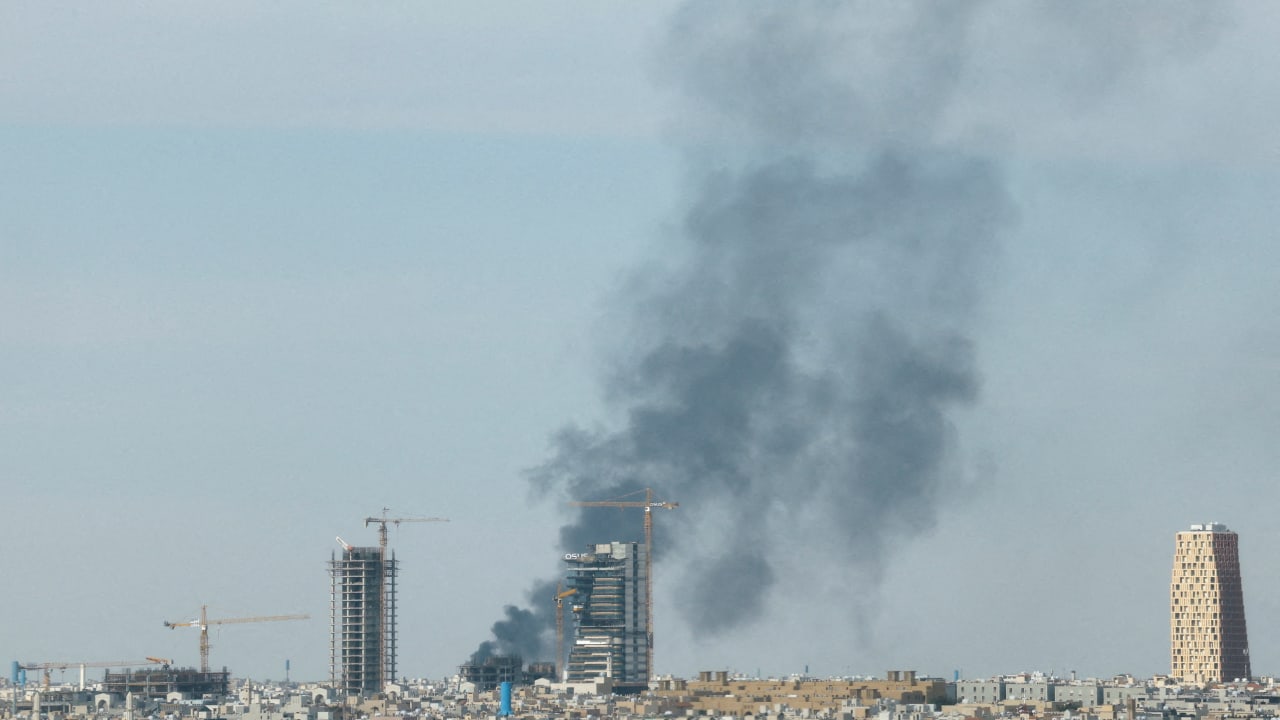
Riyadh is increasingly angry over Iran’s aggression against Saudi Arabia and the Gulf. This comes amid increasing discussions and meetings between Gulf countries and the Arab League. According to Arab News in Saudi Arabia, Saudi Arabia’s Ministry of Foreign Affairs “said that if Iran presses ahead with its attacks, it would bear the heaviest diplomatic, economic, and strategic consequences, and be ‘the biggest loser.’”
Riyadh is angry about Iran’s “sustained campaign of aggression against the Kingdom, fellow GCC and other nations, cautioning that continued escalation would ultimately devastate Iran itself,” Arab News noted. “Riyadh condemned Iran’s attacks on civilian airports and oil infrastructure, calling them a violation of international law and a deliberate attempt to destabilize the region.”
The Foreign Ministry in Riyadh said that “the targeting of civilian airports and oil facilities is nothing but a demonstration of determination to threaten security and stability and a flagrant violation of international covenants and international law.” Saudi Arabia also pushed back against claims in Iran that Riyadh was involved in the conflict by letting military aircraft fly in its airspace. “The reality is that those aircraft are conducting air patrols to monitor and protect the airspace of the Kingdom and the GCC states from Iranian missiles and drones,” the ministry stated.
On Monday, the Saudis continued to contend with Iranian attacks. The air defenses of the Kingdom downed three ballistic missiles and seven drones. According to reports, the attacks were aimed at Prince Sultan Air Base in Al-Kharj. “Two drones were shot down in the northern part of the national capital, Riyadh city, another seven aimed at the Shaybah oil field were intercepted in the Empty Quarter desert, and another one was destroyed in the northern province of Al-Jouf,” Arab News added.
The attacks followed the killing of two people in Saudi Arabia on Sunday. Iran’s deadly attacks are pushing the Kingdom and other countries in the Gulf toward a possible response to Iran.

Meanwhile, in Pakistan, a close ally of Saudi Arabia, reports say that Islamabad has “submitted eight requests to Saudi authorities as part of a broader plan to strengthen economic cooperation,” according to Khyber News. Meanwhile, the Arab League says it has condemned Iranian attacks against Gulf states as a “massive strategic error.” Secretary-General of the Arab League Ahmed Aboul Gheit made the statement on Sunday.
Although only one week has passed since the outbreak of large-scale war, the imbalance in the balance of power is already undermining the capabilities of Iran’s regime, which had long refused to give up these capabilities through negotiations. The outcome is largely expected, despite Iran’s extensive propaganda.
Saudi intervention depends on ongoing cost-benefit calculations
What might come next depends on whether Riyadh feels intervention may benefit it, or whether it feels Iran is largely defeated and now is the time for stability. According to a piece by Abdulrahman Al-Rashed, a Saudi journalist and intellectual. He is the former general manager of Al-Arabiya news channel and former editor-in-chief of Asharq Al-Awsat. Iran is now weakened as a military power.
Writing at Arab News, he argues that “from an analytical perspective, the early results can be viewed as a success in containing the Iranian threat, even if they fall short of a complete victory. At the same time, however, the regime itself remains intact.” He goes on to say that “current assessments suggest the fighting could end within a few weeks, perhaps even sooner if the Iranian Islamic Revolutionary Guard Corps, which effectively controls decision-making in Tehran, accepts a form of partial surrender that allows the system to survive.”
He concludes that “the destruction of Iran as a dominant regional power marks the beginning of a new and significant chapter, the consequences of which will be discussed later.” The Gulf states, which feel that they have been dragged into this conflict and wonder if they should agree to strike back, are now all watching the emergence of a changed Middle East.