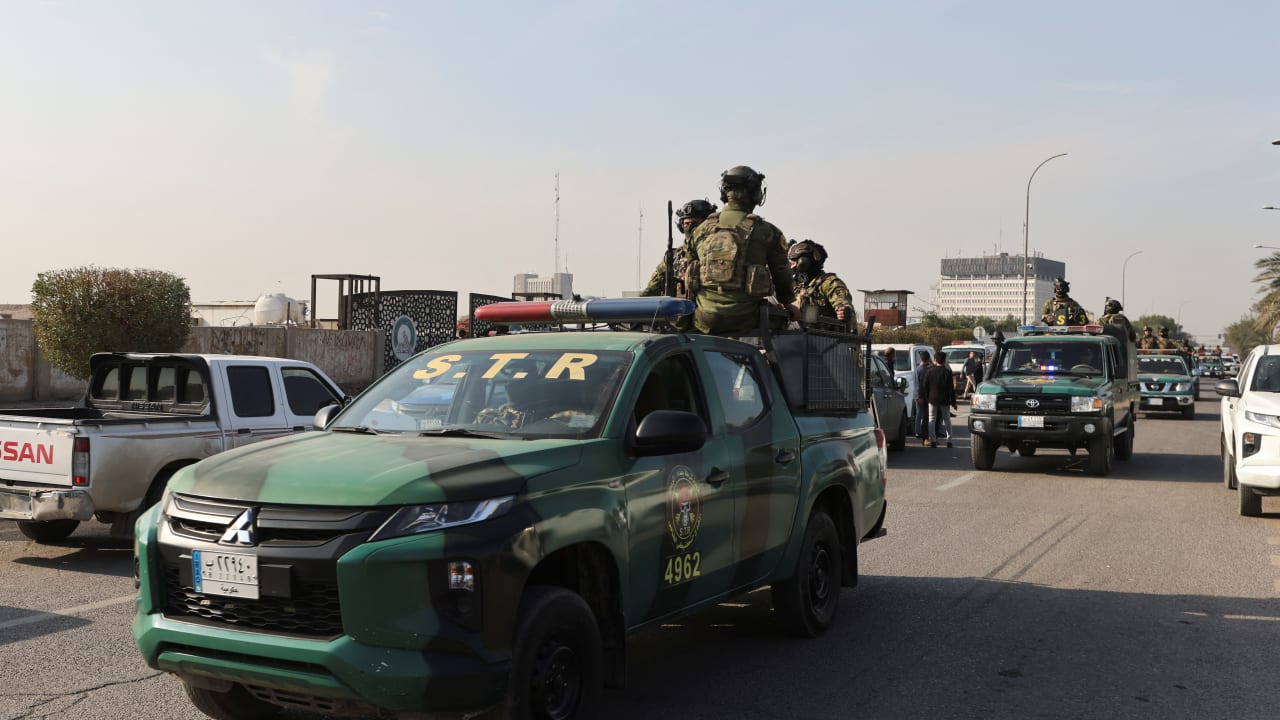
The US is ratcheting up pressure on Iranian-backed militias in Iraq. The goal is to try to encourage Baghdad to appoint a new prime minister who might finally decide to do more to rein in the militias.
Over the past decade, the militias have carried out attacks against US forces in Iraq and on the US embassy in Baghdad and the US consulate in Erbil. During the current Iran war, the militias have increased their attacks, carrying out almost 1,000 strikes, including against Saudi Arabia.
The US-Iran talks are now tied to wider regional issues. For instance, Iran wants a ceasefire in Lebanon, and the US wants to see Iranian support for proxies ended. This is not the top US priority, but it is an emerging one.
Washington sees a chance to finally do more against the militias in Iraq. Some of those militias have roots going back decades. For instance, the late head of Kataib Hezbollah, Abu Mahdi al-Muhandis, was involved in attacks on embassies in Kuwait in the 1980s. Badr, one of the largest militias, emerged in the 1980s and supported Iran against Saddam Hussein’s Iraq.
Today, the web of militias is deeply entwined with the Iraqi state. The militias increased in size in 2014-2015 to fight ISIS. They suddenly were able to recruit some 100,000 fighters after a Fatwa from Iraqi cleric Ayatollah Ali al-Sistani called on young men to fight ISIS.

These young men were channeled into various brigades of what was called the Popular Mobilization Forces. The PMF included dozens of brigades, and each brigade was affiliated with a militia. For instance, some were linked to Kataib Hezbollah, some to Badr, and some to Harakat Hezbollah al-Nujaba or Asaib Ahl al-Haq.
Iraq is seeking to appoint a new prime minister
After the war on ISIS, the Iraqi government was pressured to make the militias part of the state, enabling them to serve as a kind of Iraqi version of Iran’s Islamic Revolutionary Guard Corps.
The militias received salaries, took over various bases in the country, and manned checkpoints. By 2019, they were attacking US forces, using 107-mm. rockets and mortars. By 2022, they also were using drones.
When the US and Israel attacked Iran this February, the militias in Iraq were mobilized by Tehran to carry out hundreds of attacks. Kataib Hezbollah kidnapped American journalist Shelly Kittelson. In 2023, it kidnapped Israeli researcher Elizabeth Tsurkov. She was released last September.
The US is now seeking to use some of the pressure that can be brought to bear due to Iraq’s political crisis to get the country to do more about the militias.
Iraq wants to appoint a new prime minister. US President Donald Trump has opposed Nouri al-Maliki, the former prime minister. Maliki is considered very close to Iran and is unlikely to rein in the militias.
There are other candidates for prime minister, including the current prime minister, who hasn’t done anything against the militias.
The question is whether US pressure and increasing anger in the Gulf states about the militias might finally result in some action. This is a long road, and it is going to be difficult.
The US and Israel have been unable to disarm Hamas or Hezbollah. Iraq is an even more difficult case. It borders Iran, and Tehran considers Iraq to be almost its colony.