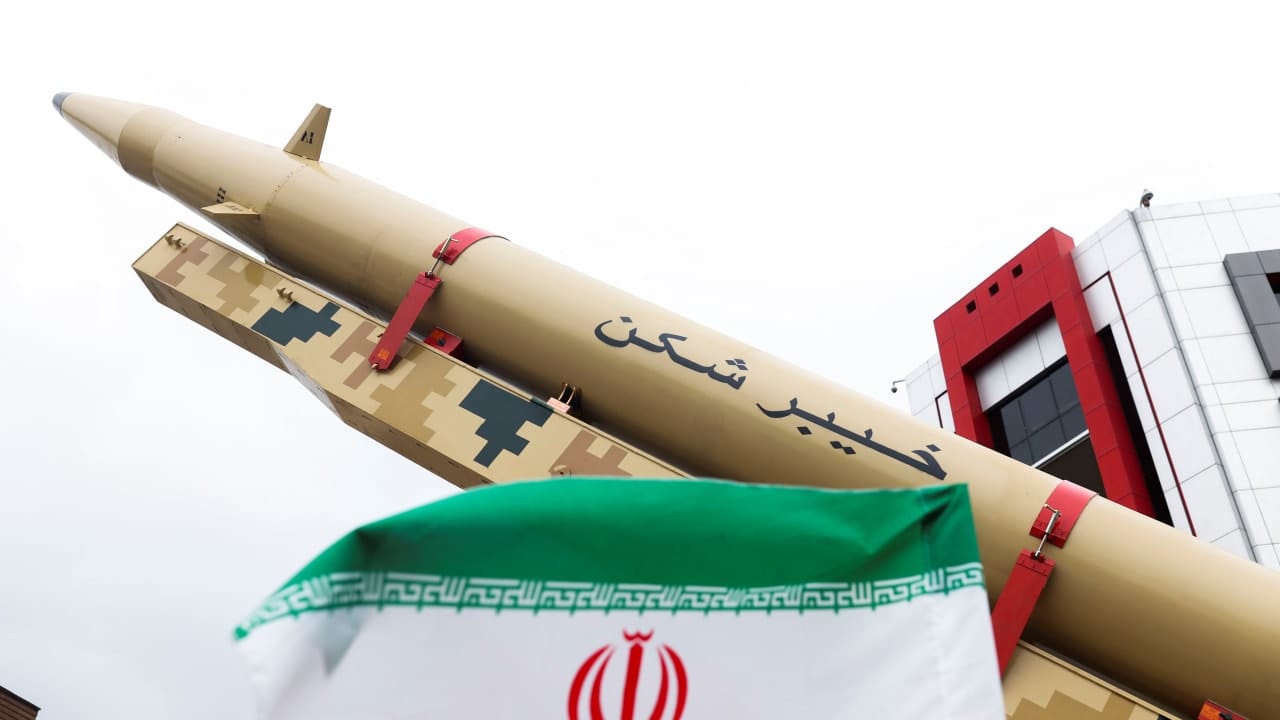
While most of the focus from the June Israel-Iran War was on the Islamic Republic’s nuclear program, there was a jump in attention on the ballistic missile threat.
Tehran’s ballistic missiles killed almost 30 Israelis, wounded thousands, and damaged over 10,000 buildings and residences.
Satellite footage has shown that Iran is rebuilding aspects of its ballistic missile program.
How threatening is that, and how soon might it be a problem?
First of all, after the nuclear program, the other reason Israel said it struck the Islamic Republic in June was that the ayatollahs were racing from their 2,500 ballistic missile arsenal to an increase of 8,800 around mid-2027, and over 10,000 by 2028.

Jerusalem feared such an arsenal could overwhelm Israel’s missile shield.
Currently, Iran is rebuilding many ballistic missile facilities, but the big focus is on “planetary mixers” – the large mixers needed to produce solid fuel for the weapons.
These machines have blades that revolve around a central point, like orbiting planets, and lead to better mixing results than other kinds of equipment that could also be used.
Russia-China cooperation with Iran
There are concerns that Iran will buy new mixers from China, with US officials and others having already accused Beijing of previously selling missile fuel ingredients and other ballistic missile components to Iran.
Big questions have been asked recently about the elevation of cooperation between Russia, along with China, in helping Iran rebuild aspects of its ability to threaten Israel.
The Jerusalem Post has exclusively reported that Mossad Director David Barnea would say that China and Russia must think 10 times about helping Iran. His view is that the Mossad and Israel have declared to the entire world the incredible supremacy Israel has in the air against their missiles.
Based on this, the Mossad is not that sure that so many nations will look to help the Islamic Republic. Barnea thinks that these countries will need to take into account that, like Russia’s weapons this past June, their weapons will fail, the Post has learned. After that, their systems will be thought of as being weak against Israeli capabilities.
Pressed on reports that China is already gambling more on Iran, the Mossad would double down and warn the Chinese to think 1,000 times because their systems can be attacked if Iran uses them.
Clearly, Israel is keeping a close eye on this issue.
Probably there is a preference at this stage for covert action against Iranian efforts to rebuild the ballistic missile program, but now that Israel has shown it can strike Tehran’s key weapons programs with devastating effect, the IDF may be more willing to throw the dice a second time, even if the threat has not yet fully materialized.
All of this brings into focus the importance of preventing Iran from developing a viable air force that can compete with the IDF.
Until now, Iran’s air force has been a disaster, mostly having been produced before the 1979 Islamic Revolution, as no one would sell the Islamic Republic aircraft.
However, an Iranian parliament member has now claimed that Russia sent a group of MiG-29 aircraft to Tehran.
These aircraft would not be a game changer, as it is also inferior to Israel’s F-35 and some of its other fighters.
However, it could provide Iran with some additional real resistance to future Israeli airstrikes.
In addition, if Moscow did give Iran these new MiG aircraft, it might also be considering giving Iran its Sukhoi Su-35 fighter jets, which are more advanced than many of Israel’s aircraft, other than the F-35.
While these developments are of significant concern, there are also signs that this could be a public relations exercise more than a major change in weapons transfers.
Iran said in January that it had received Su-35 aircraft, and none of them fought against Israeli aircraft this past June.
Whether Iran lied and never received the Su-35s or whether they were not ready to use them and risk them being shot down, it seems that Iranian announcements about Russian aircraft do not necessarily translate into an immediate threat, and sometimes mean close to nothing.
Ultimately, the devil is in the details.
Either the rebuilding of the ballistic missiles or the transfer of serious fighter jets could be a major threat to Israel, but all of this could also be mere attempts to deter and intimidate the Jewish state.