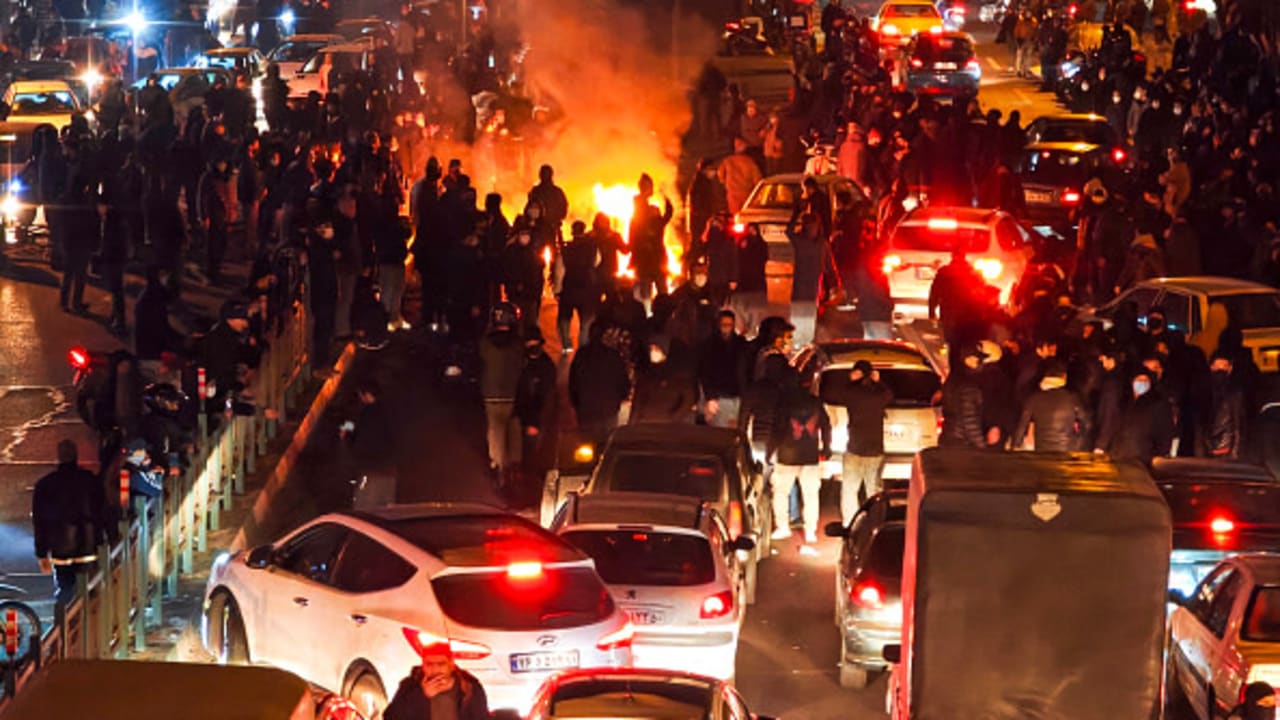
“The situation in Iran is catastrophic. Over 3,000 people have been killed. IRGC ground forces have been deployed. We cannot do it alone. We need help. We urge the US and Israel to help us.” These were the words of Khalil Kani Sanani, the spokesman for the Kurdistan Freedom Party (PAK), a Kurdish Peshmerga group operating in the mountainous regions of Iraqi and Iranian Kurdistan.
PAK’s military wing, the Kurdistan National Army, or SMK, is headed by General Hussein Yazdanpana. SMK’s fighters have years of battlefield experience, gained from fighting the Ayatollah regime to joining Kurdish Peshmerga forces in Iraqi and Syrian Kurdish regions during the battle against ISIS from 2014 to 2017.
The word Peshmerga is a Kurdish term that translates as “those who stand in front of death,” an accurate description of SMK’s fighters.
Since the eruption of Iran’s protests, SMK has carried out a number of successful operations targeting Ayatollah regime elements in Kermanshah and Isfahan. One such operation was the capture and destruction of the headquarters of Firooz Safari of the Islamic Revolutionary Guard Corps (IRGC), located in Bawe Kosay Zamkan in Kermanshah. Its fighters managed to kill a number of IRGC members.
Historically, Kermanshah province has been a hotbed of various Kurdish groups clashing with Iranian authorities, with sporadic armed confrontations with the regime.

Following threats made by Ali Larijani, a top adviser to Supreme Leader Ayatollah Ali Khamenei and a former IRGC officer, who claimed that the IRGC destroyed two SMK units of four and seven fighters in Lorestan province, Sanani said, “SMK’s Dalahu Battalion launched a fierce operation, targeting another IRGC enemy base in its own home in Kermanshah.”
Another attack was launched on January 9, targeting “the office of the Friday prayers imam in Semirom, which the regime turned into a center for espionage and repression against protesting civilians,” Sanani said, adding that SMK fighters “burned it in an act of retaliatory fire and in revenge for those martyrs who were murdered by Tehran.”
PAK has deployed battalions across provinces in northwestern Iran (the Kurdish region). Each battalion is made up of several units, which are engaged in operations against IRGC forces in Kermanshah, Ilam, Lorestan, and Bakhtiari areas, and have even targeted IRGC elements in the heart of Isfahan.
Sanani told The Jerusalem Post: “We believe the regime in Tehran will not refrain from killing people, and therefore the people cannot overthrow this clerical regime with their bare hands. However, given our battlefield experience fighting the regime in Iran and ISIS, we believe the best strategy is to liberate a major city and turn it into a center for encircling Tehran, to make it easier to topple the regime.”
Internet blackout in Tehran continues
For over a week, authorities in Tehran have enforced a total internet blackout. Alarming reports indicate that regime forces have carried out widespread killings of protesters using light and semi-heavy military weapons. According to reports, thousands of unarmed protesters are believed to have been killed across Iranian cities - an alarming figure that cannot yet be independently verified due to the total communications blackout.
Sanani said, “According to our sources on the ground, over 3,000 people have been killed, with many of the victims being youngsters,” adding that “among the victims are many Kurdish fatalities.”
As protests have expanded in rate and magnitude since January 7, especially in Tehran and Iran’s Kurdish regions, Kurdish political parties have called for unity in the face of regime aggression. In response, the IRGC has launched a bloodier crackdown on predominantly Kurdish cities and towns in Kermanshah, Ilam, and Lorestan provinces. The Ayatollah regime has accused PAK and other Kurdish parties of “attempting to incite riots.”
Iranian leaders have long held fears regarding Kurdish separatism and militancy within the Islamic Republic - concerns that grew particularly during the Jina Mahsa Amini protests of 2022–2023.
There are many indications that the regime is worried about its own survival. One indicator is its decision to frame the protests as “insurgency” and “terrorism” to justify increasingly ruthless methods to quell unrest. Sanani said, “The regime rarely deploys IRGC ground forces in Persian-populated cities and towns, whereas it deploys them in Kurdish cities and towns,” because it fears that any formidable military threat will originate in Kurdish regions.
In addition to deploying IRGC ground forces, the regime has also made use of its paramilitary Basij elite force, which specializes in crowd control and the brutal suppression of protests.
Sanani explained that “the regime views Kurdish areas as a security threat,” adding that “there is a political-military strategy behind this aimed at intimidating and controlling the population of those areas.”
The internet and communications blackout appears to be part of a deliberate regime policy aimed at concealing the true scale of the killings and preventing protesters across Iran from coordinating their efforts. However, the deployment of ground forces indicates how desperate Iranian leaders have become in the face of this round of protests.
Sanani said that all the people of Iran are united in believing that the regime must go. He continued: “We at PAK are fighting them with fire and heroism. But we cannot do it alone. We need outside help. We need the US and Israel to help us.”
Sanani also addressed two major developments. First, he confirmed reports that Tehran arrested several members of its security forces on January 8 for refusing to fire at protesters.
“This reflects internal fractures within the regime’s forces and shows that not all its members are willing to carry out orders to execute unarmed protesters,” he said, adding that “if protests continue at their current scale, refusals and internal dissent will definitely increase, playing a significant role in weakening the regime’s military capability.”
However, Sanani also warned of a second, more dangerous development: the Iraqi central Shi’ite-led government’s agreement to send backup forces to Tehran. He explained that “thousands of armed fighters from the Popular Mobilization Forces (known as Hashd al-Shaabi) and Lebanese Hezbollah are being deployed in Iran’s Kurdish region to quell protests and confront SMK.”
This development poses a serious threat to civilians in Iran’s Kurdish region. As the interview drew to a close, Sanani urged the United States and Israel to support efforts to topple the regime. He concluded: “We need help. The uprising and our people’s resistance cannot continue without comprehensive and sustained support.”
Suzan Quitaz is a Kurdish-Swedish journalist and researcher specializing in Middle Eastern affairs. She was an Israel-based journalist and podcast presenter for the Arabic and English series Exposing the Lies – The Voice of Truth from the Middle East at the Jerusalem Center for Security and Foreign Affairs. She previously worked as a field producer and journalist for several Qatari media outlets.