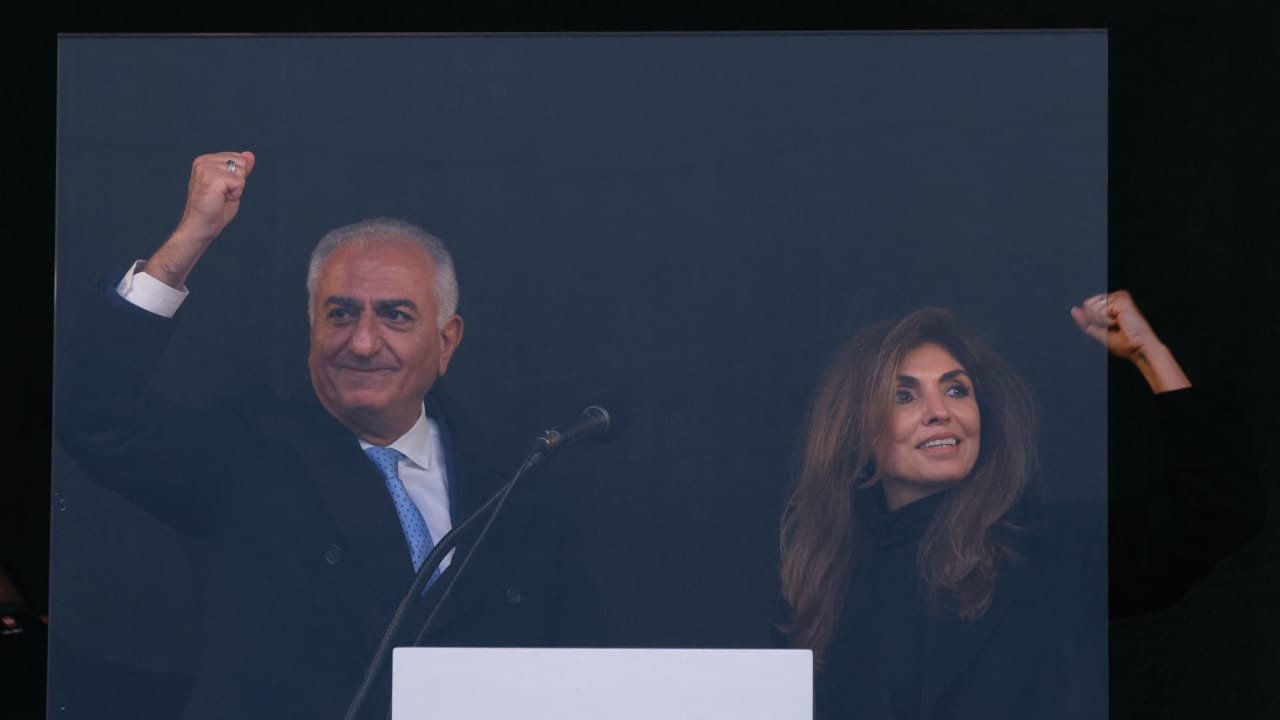
Through all the protest movements Iranians have witnessed over the five decades of the Islamic Republic, there has not been a scene quite like the one witnessed last weekend.
Iranian Crown Prince Reza Pahlavi called for a “Global Day of Action” on Saturday, February 14, and what followed was unprecedented in scale, coordination, and symbolism for the Iranian diaspora. Major marches took place across the world, with mass demonstrations in Munich, Toronto, and Los Angeles, alongside rallies in dozens of other cities worldwide.
Munich alone saw 250,000 attendees confirmed by police, with organizers estimating the number closer to 300,000. In Toronto, police estimates placed attendance at 350,000, while thousands more gathered in Los Angeles, where Pahlavi’s daughter, Princess Noor, addressed the crowd.

“This is not just a protest,” she told the crowd in LA from the podium. “This is a declaration of a nation reclaiming itself.”
In total, close to a million Iranians are believed to have taken part worldwide.
But the numbers tell only part of the story.
The long journey to the protests
One attendee who traveled from Belgium to Munich, along with an estimated 30 busloads of Iranians, told The Jerusalem Post that the journey itself had become part of the protest.
“We took a bus to Munich from Brussels. Many Iranians offered to cover travel costs for students or anyone struggling financially,” he said. “There was an extraordinary wave of solidarity. Problems were solved collectively.”
The journey took 12 hours from Brussels. For others coming from different Belgian cities, it stretched to 16.
“At every rest stop along the way, it felt like Iran was everywhere,” he recalled. “Groups of Iranians gathered, talking, recognizing one another without introductions.”
When they arrived in Munich, the streets were already filled with Lion and Sun flags, the prerevolutionary national symbol that has reemerged as the banner of opposition to the Islamic Republic.
“Suddenly, someone shouted ‘Javid!’ from a window, and we all answered ‘Shah!’ From across the street another voice called out ‘Payandeh!’ and we responded ‘Iran!’” he told the Post. Payandeh Iran – long live Iran.
“It felt as if we had known each other for years.”
At the gathering site, the scale of the crowd was hard to ignore. Near the entrance, a small girl stood with her mother handing flowers to German police officers. Nearby, a man with a disability leaned heavily on a cane, determined to be there despite the rain and cold.
“We had all come for our beloved Prince Reza Pahlavi,” the attendee said, “and for the people inside Iran. Their eyes and hopes were on us.”
The lead-up to Pahlavi's 'Global Day of Action'
In the days leading up to the rally, messages poured in from inside the Islamic Republic. A mother whose son had been killed during the protests asked that his photograph be carried in Munich. Others asked those attending to chant “Javid Shah” in their place.
A young woman from a village near Hamedan sent a message as the rain began to fall. When the cold set in, no one left.
“The most emotional moment was when the prince began his speech,” the attendee said. “With every passing minute, my pride in being Iranian grew stronger.”
He spoke of friends and compatriots who never made it to this moment.
“Their blood will not be trampled,” he said. “Their sacrifice will not be in vain.”
After the rally ended, soaked and freezing as rain and snow fell together, groups huddled in cafés to warm up before long journeys home. At one table sat two young women who had recently returned from Iran.
Their stories would make good cinema if it were not for the heartbreaking reality beneath them.
One said her father, a doctor, secretly treated injured protesters. Patients used coded language over the phone because calls were monitored.
“They would say, ‘I twisted my ankle,’ but he knew they had been shot or hit with pellets and were too afraid to go to a hospital,” she said.
The other spoke of her parents leaving water and food in their yard at night for demonstrators fleeing security forces.
“The three hours we waited for the bus passed in what felt like minutes,” the Belgian attendee said. “I fought back tears more than once.”
His conclusion was simple, and echoed across the world on Saturday.
“I have no doubt that we will bring our shah back to Iran. This generation is paying for the mistakes of the previous one, but we want our children to grow up in a free Iran. I have never felt this proud to be Iranian. We do not doubt that we will prevail. Light will overcome darkness.”
Reza Pahlavi's unofficial coronation
THE SCENES in Munich came just a day after Pahlavi addressed the Munich Security Conference, where he was confronted by a BBC Persian journalist who suggested he had failed to unite the Iranian opposition.
Pahlavi’s response was to the point.
“Whose name are people calling in the streets?” he asked.
From Tehran to Mashhad, Isfahan to Shiraz, protesters have for months shouted “Javid Shah” from rooftops after nightfall in a direct challenge to Supreme Leader Ayatollah Ali Khamenei and the Islamic Republic’s claim to legitimacy.
Which other figure can bring hundreds of thousands to the streets in multiple global cities in a single day? Which other name echoes nightly from Iran’s rooftops, shouted loudly by a population living in constant fear of regime reprisals.
Saturday was the unofficial coronation of Reza Pahlavi.
And yet, throughout the weekend, Pahlavi rejected the idea that he is seeking the throne.
In an interview with CNN’s Christiane Amanpour on Friday in Munich, Pahlavi was asked directly about his ambitions.
“Do you want to be king? Do you want to be president? What is your role in this situation?”
His answer was consistent with what he has told the Post and others over recent months.
“From the first day I started, I considered my mission in life to bring the country to a point that we can have that final referendum and the people elect their first democratic government in the future,” he said. “That, to me, is the finish line and mission accomplished in life.
“I don’t have any personal ambition. I’m not seeking power. I don’t want to have a crown on my head or a title,” he continued. “They should look at me as a bridge to that destination and not the destination itself.”
Less than 24 hours later, that bridge stood before hundreds of thousands of Iranians chanting for the return of their monarchy.
Pahlavi took the stage in Munich alongside his wife, Crown Princess Yasmine, facing a sea of Lion and Sun flags and calls for the end of the Islamic Republic. Last month, he told the Post that preparations were under way for a return to Iran – a country he has not seen in nearly five decades.
In a statement released after the rallies, Pahlavi addressed both Iranians inside the country and those in the diaspora.
“Your resounding cries within Iran on the nights of February 14 and 15, and your remarkable presence in the rallies of the February 14 Global Day of Action were a clear manifestation of our national unity,” he wrote.
He saluted those inside Iran “who stand steadfast against the occupiers,” and those abroad who became, in his words, “the external echo of Iran’s national Lion and Sun Revolution.”
“You have awakened the conscience of the world and made it more difficult to appease this criminal regime,” he wrote.
Pahlavi emphasized the discipline and dignity of the protests, noting that Iranians had demonstrated respect for their host countries while projecting unity.
“You proved that Iranians, wherever they may be in the world, are one united nation with one flag, one unwavering will, and one clear goal,” he said.
“Our struggle to overthrow the Islamic Republic and establish a national and democratic government is irreversible.”
The toll of Iran's protest crackdown
He did not hide from the bloodshed the protests have witnessed, with official figures hovering around 7,000 deaths since the protests began on December 28, 2025, and conservative reports estimating 50,000 killed over the near two-month period (some say that number was killed by the regime during the days of January 8-9 alone).
The regime has reportedly targeted hospitals for wounded protesters, executing them in their beds, and also punished medical staff for attending to wounded demonstrators.
“Between us and this regime lies a sea of blood,” Pahlavi wrote, directly naming Khamenei as “the Zahhak of our time,” a reference to Persian mythology.
“The tens of thousands of precious lives taken have become the driving force of a great resurrection,” he said.
“I will remain by your side until our final victory.”
As talks between the United States and Iran this week continue to flounder over things the Islamic Republic has been unwilling to give up, such as its proxy network, ballistic missile capabilities, and a continuous and deliberate march toward nuclear weapons, the talk of war grows ever louder.
As the US continues to build up its military presence in the region, with the aircraft carrier fleet of the USS Abraham Lincoln already posted to the Middle East – and Iran carrying out naval exercises with China and Russia – it seems US President Donald Trump and Prime Minister Benjamin Netanyahu may finally seek to fulfill their promises to the Iranian protesters and send help.
If it comes to military action and the regime crumbles, as many expect, Pahlavi’s return will be made a lot easier. As for him, last week saw him unofficially crowned by the people, and the people demanded their king’s return.
For now, Reza Pahlavi insists he is only a bridge. But he is a bridge the Iranian people want to cross.