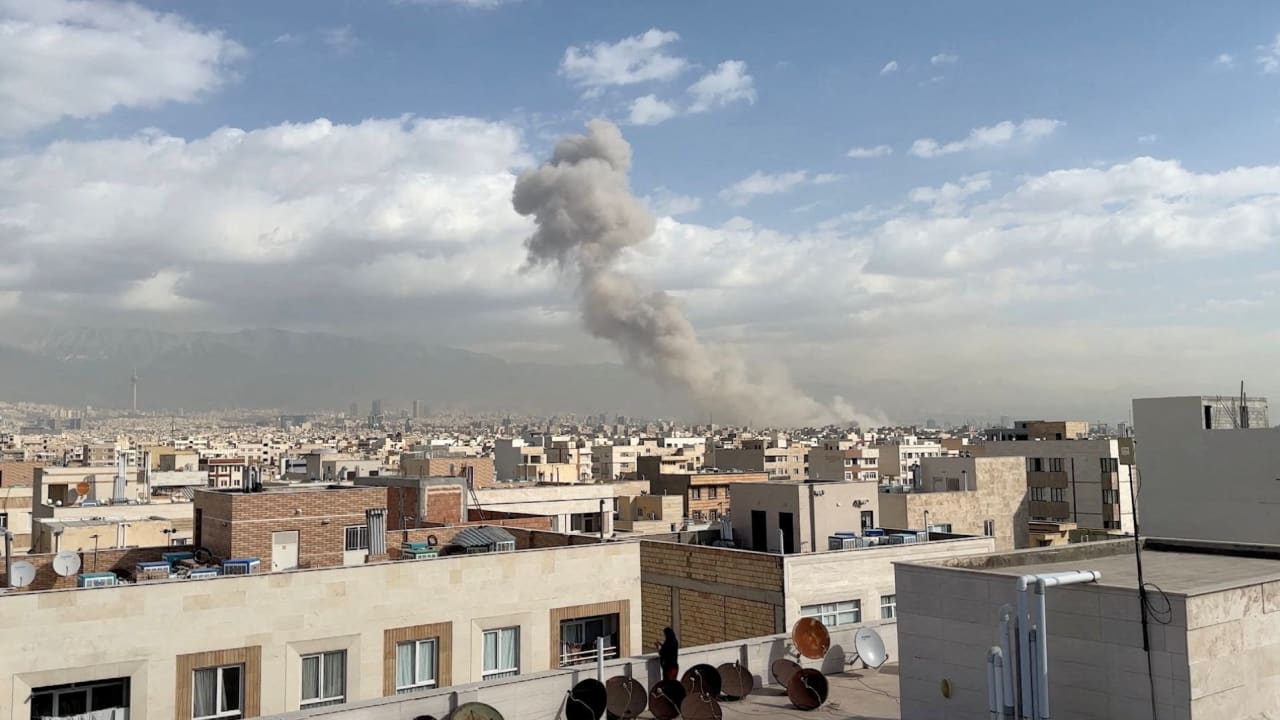
Israeli and American military forces tried to shift their attacks from first-tier army and command targets in Iran to a much broader set of objectives over Monday and Tuesday, which could eventually tip the balance for toppling the Islamic regime itself.
Although Iran’s former supreme leader, Ayatollah Ali Khamenei, and most of his top military and intelligence officials were killed early on Saturday morning, the regime has tens of thousands of hardcore Islamic Revolutionary Guard Corps supporters and potentially millions of general supporters from the Basij militia and otherwise.
Israel has managed to drop 4,000 bombs on the Islamic Republic’s forces by Tuesday night, a pace that has exceeded all the bombs dropped there during the 12 Day War in June 2025, and the US may have attacked one and a half to two times as many targets.
At the time that Israel was saying it had attacked 600 targets on Monday night, the US said it had attacked 1,200 objectives.
However, US Central Command released its 72-hour update on the war on Tuesday, noting that American forces had struck 1,700 Iranian targets overall, nearly double the number of the day before.

In the first 24 hours, America struck 900 targets.
The pace slowed, as was reflected in the 48-hour report, reaching 1,200 targets overall, or only 300 targets on the second day.
With a jump to 1,700 targets total, or 500 targets in the 72-hour report, the pace of American strikes on Iran has nearly doubled.
Collectively, this would mean that the joint forces have, in only three days, already bombed the regime equivalent to between double and triple the volume that Israel bombed in June 2025 over 12 full days.
It was unclear whether this was the “largest” attack foreshadowed by US President Donald Trump in recent interviews, or a lead-in to an even larger volume of strikes later this week.
Unlike Israeli military updates, the US rundowns have had similar generic categories of targets each day, such as IRGC command centers, naval assets, ballistic missile sites, and air defenses, without giving much in terms of specifics.
Operation broadens to quantity of targets, over quality
As the operation has broadened to include a range of targets, not just high-quality ones, it has become more difficult to determine the significance of any given target for toppling the regime, vs its role in the cumulative effort.
Meanwhile, overnight, the Israel Air Force struck a massive leadership complex in Tehran.
Around 100 fighter jets dropped over 250 bombs on the complex, which sprawled over several blocks.
The IDF said that, although referred to as a single complex, the buildings included the president’s headquarters, the headquarters of Iran’s Supreme National Security Council, a compound used by the Islamic Republic’s most senior forum for meetings, and a key site for training Iranian military officers.
“The leadership and security officials of the terrorist regime convened in the compound frequently,” conducting situational assessments regarding “the Iranian nuclear program and advancing the plan to destroy the State of Israel,” the IDF said.
Iranian Assembly of Experts meeting targeted
Also on Tuesday, the army attacked the building where the Assembly of Experts’ vote count was being taken for selecting Ayatollah Ali Khamenei’s successor.
None of the voting clerks were killed as the vote was being operated remotely. Iran claimed the attack would not delay the selection of the successor, whereas the IDF said it would.
There were also unconfirmed reports that the military had assassinated Iran’s Quds Force coordinator for Lebanon, Daoud Ali Zada.
Mid-Tuesday afternoon, the IDF said that its 60 waves of attacks, including 1,600 sorties, were now expanding from a focus on the Tehran area to Western Iran.
This included attacks on dozens of ballistic missile launchers in order to reduce the regime’s ability to continue to shower the Israeli home front with missiles.
IDF sources said that the volume of Iranian missiles fired on the home front had dropped from around 100 or more per day at first to around 20 per day, but that since Monday, a significant decrease had not been registered between Monday and Tuesday.
Israel to remove entire Shiite axis
Israel will remove the entire Shi’ite axis threat led by Iran and Hezbollah, IDF Chief of Staff Lt.-Gen. Eyal Zamir also said Tuesday night during a visit to an IDf air defense command center.
During a visit with Air Defense Array chief Brig.-Gen. “K” to the 947th Battalion of the air defense apparatus, Zamir said that the current conflict has morphed from seeking regime change in Iran to also finishing off Hezbollah as a decades-long threat to Israel.
“This is one axis: The Shi’ite axis,” he emphasized.
For decades, and even more intensely since 2017, Iran sought to encircle Israel with a “ring of fire” to weaken and possibly destroy it.
But now, Zamir said, Israel is strong enough to fight on two fronts to bring the two most dangerous pieces of the ring of fire and the anti-Israel Shi’ite axis to their knees.
As part of this battle, Zamir said, the IDF’s stellar air defense and the resilient public are critical.
Only by avoiding major harm to the home front can the IDF continue to dismantle Iran’s regime and Hezbollah’s source of power, which endured after the 2023-2024 conflict with the Lebanese terrorist group, the IDF chief of staff said.
Despite any general progress by the IDF and US forces, Tehran had already managed to attack the Israeli home front around half a dozen times by press time on Tuesday, including two to three times in the morning (one air siren may have been a false alarm) and multiple times in the afternoon. In some cases, sirens rang only in specific locations, not nationwide.
There were unconfirmed reports of hits in the North, in Petah Tikva and Bnei Brak, and possibly elsewhere in central Israel.
Magen David Adom said it was treating three patients with moderate wounds.