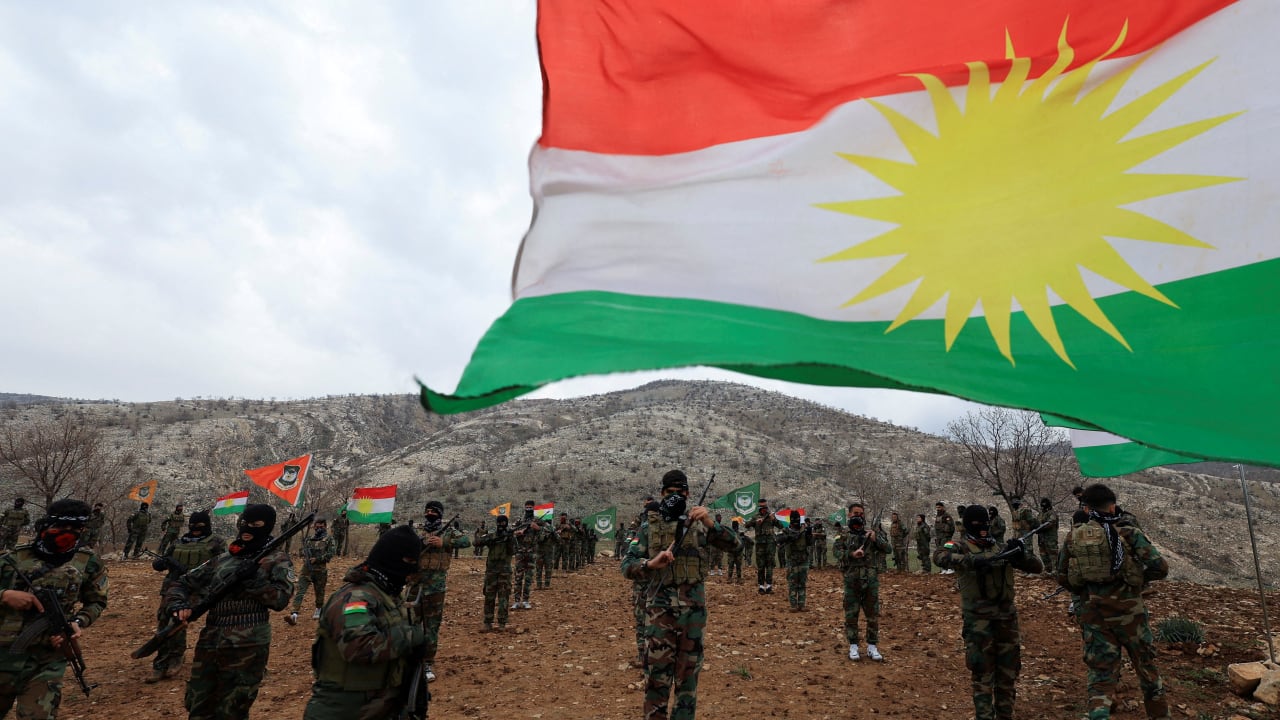
The Kurds are in the spotlight amid the war in Iran, with some eight million Kurds in the country and many more in Iraq, Turkey, and Syria.
Most of the Kurdish Iranian parties and groups have bases in the Kurdistan Region of Iraq. Since the war with Iran began, there has been increasing talk that they might join the conflict against Tehran.
Iran has been attacking Iraqi Kurdistan, launching drone and missile attacks on Kurdish groups, killing some of their members, and damaging areas where they live.
The Iranian threats have grown, with Iranian-backed militias in Iraq also targeting the Kurdistan Region, striking at its airport and US forces there. As such, it is worth reviewing the recent developments among Kurdish groups and in their politics in Iraq and Iran.
Aziz Ahmad, the deputy chief of staff to the prime minister of the Kurdistan Region, wrote on Saturday that “Iraqi militias continue to rain rockets and drones on civilian and energy infrastructure in the Kurdistan Region. Who are these Iraqi militias? They are: 1. Part of the Iraqi government; 2. Paid by the Iraqi government; 3. Armed by the Iraqi government. The Kurdistan Regional Government urges the federal government to get a grip on these state-backed criminal and rogue actors – to have the willpower to confront and arrest them and, for once, keep them in prison.”

Over the last week of the war, there have been increasing numbers of articles about the Kurds, with some suggesting that the US was open to arming them.
In addition, reports said the White House had reached out to Kurdish leaders in the KRG. One report suggested the US had basically told the Kurds that they are either “with the US” or with Iran.
Moreover, false reports appeared that claimed Kurds had launched an offensive against the Iranian regime.
The Kurdish Iranian groups denied this and said they were still waiting. It’s worth examining the interplay between the Kurdistan Region of Iraq, which fears escalation, and Kurdish Iranian groups, who are cautious about next steps.
Several opinions among Kurdish groups
Meanwhile, Bafel Talabani, the head of the Patriotic Union of Kurdistan – one of two large Kurdish parties in the Kurdistan Region of Iraq – gave an interview to Fox News on Friday. He said that he doesn’t think US President Donald Trump’s talk of unconditional surrender in Iran will happen. He said that there might be an off-ramp in Iran, where they could take a deal.
Talabani’s PUK party is considered to have closer ties to Iran than the other Kurdish party, the KDP.
In another significant interview, Baba Sheikh Hosseini, the secretary-general of the Khabat Organization of Iranian Kurdistan, spoke to Al Jazeera.
Khabat is a more religious Kurdish Iranian group. It is part of the six-group coalition against the Iranian regime, which was announced on February 22. Iran also targeted a Khabat site in northern Iraq on Friday.
Asked about whether the Kurds will struggle against the regime, Hosseini told Al Jazeera, “We have been planning for a long time, and now that conditions are more favorable, there is a strong probability of action. We have yet to reach a decisive decision, but it is highly likely we will move forward with a ground operation… The Americans have contacted us through various channels, but until now we have not met directly.”
There are also reports that the Democratic Party of Iranian Kurdistan (PDKI) leader, Mustafa Hijri, might be holding more talks with Trump. This comes days after reports that claimed the US president had spoken to the PDKI head.
Hijri is seen as the most senior of the Kurdish Iranian leaders. The PDKI is the oldest of their parties, dating back to 1945. It once ruled a short-lived Republic of Kurdistan in present-day Iran in 1946 and is seen as centrist, nationalist, and more palatable to the US than some leftist Kurdish groups, such as Komala and PJAK.
According to a social media post, PJAK co-chair Peyman Viyan was quoted as describing her group’s aims. “Our goal is the self-governance of the Kurdish people in Kurdistan. We want to take what is rightfully ours. This decision will be determined by the will and approval of our people in the provinces.” The statement was not confirmed by other networks that follow Kurdish issues.
One Kurdish group that did not join the six-group coalition has also put out a statement about the ongoing war.
Rojhelat Info, which covers Kurdish issues in the Kurdish regions of Iran, noted that the Central Committee of Komala (Kurdistan’s Organization of the Communist Party of Iran) had said that the “US and Israel are trying to drag Kurdistan into war against Iran.”
This part of Komala is more communist than the other two branches, which both joined the coalition. The communist Komala branch “has warned against efforts by the US and Israel to use Kurdish armed groups as ground forces in the war against the Islamic Republic.”
Komala emphasized that such a plan could turn Kurdistan into the main battleground and put innocent civilians at serious risk, Rojhelat Info noted.
“The party stated that its struggle against the Islamic Republic will continue, but it will not join any project or alliance serving the military or political goals of global powers. Komala stressed that only by relying on the people’s own strength can freedom, equality, and the right to self-determination be achieved.”