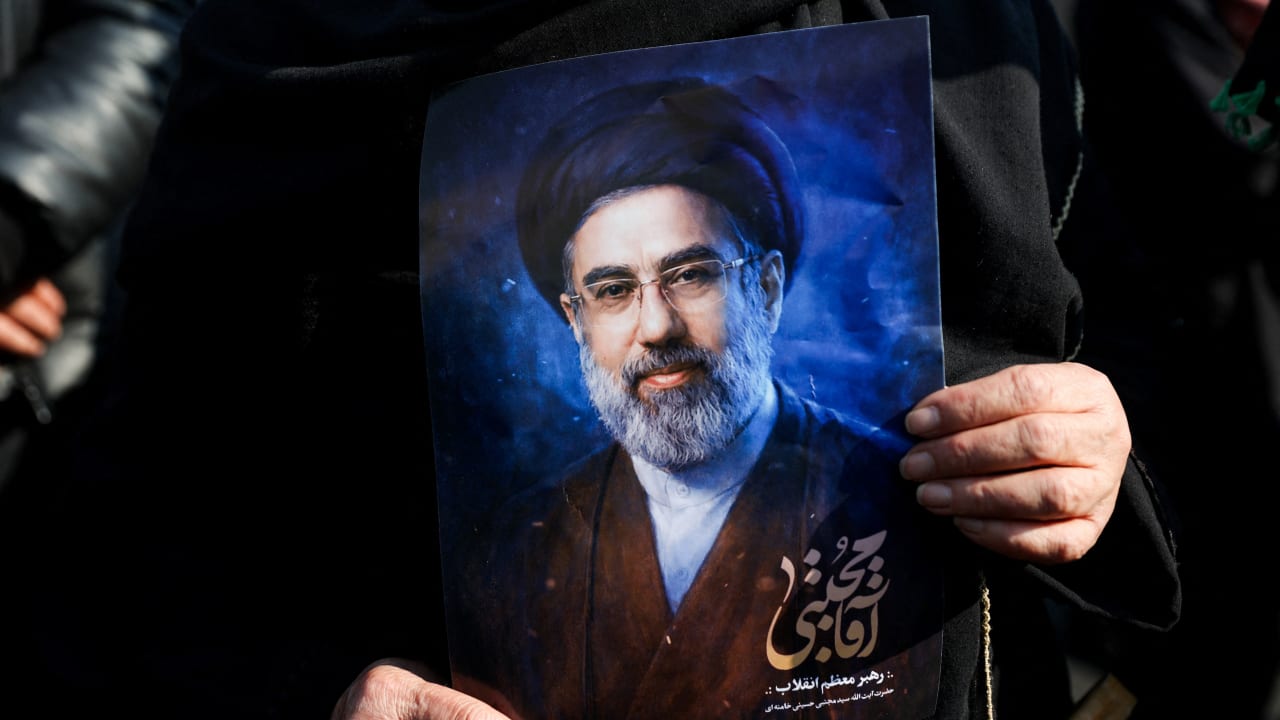
Islamic Revolutionary Guard Corps-backed new supreme leader of the Islamic regime, Mojtaba Khamenei, is anticipated to further isolate Iran’s moderates and reformists and maintain his father’s pattern of financing terror proxies at the expense of the Iranian people and economy, three Middle East experts told The Jerusalem Post on Monday.
Khamenei was publicly identified as the supreme leader late on Sunday night after nearly a week of delayed and disrupted proceedings by the Assembly of Experts. The clerical body’s Tuesday meeting was disrupted by an airstrike, and reports of disagreements and divisions surrounded the Thursday meeting.
The 56-year-old cleric’s appointment was controversial both because Ayatollah Ali Khamenei’s reported rejection of a hereditary line of power, which critics have argued mirrors the monarchical structure overthrown during the 1979 Islamic Revolution, and because of Mojtaba Khamenei’s relatively low religious standing. Still, he spent years being groomed for the role by the IRGC, fighting in the military during the Iran-Iraq War, and studying at a religious seminary.
While Khamenei has kept a relatively low profile, Dr. Ahmed Alkhuzaie, a Bahraini political analyst and managing partner at Khuzaie Associates LLC, assessed that he would replace Ali Khamenei as early as October 7, 2023.
Alkhuzaie rejected the reports that the former supreme leader had pushed for a non-relative to be elected, claiming that Khamenei’s appointment was part of his “devilish strategy.”

“Having long operated behind the scenes through his close ties to the Revolutionary Guard, his formal rise would likely mean a further centralization of authority within the clerical establishment,” he explained. “What gives him more leverage on one hand is that he is the son of the last founding father of the Islamic revolution; on the other hand, he’s close to the IRGC, which makes him not a mere coincidence.”
Having inherited much of his father’s following, and with reformist factions already marginalized from roles of “meaningful influence,” Khamenei can be expected to strengthen “the hardline apparatus that prioritizes regime survival over pluralism,” Alkhuzaie explained.
Alkhuzaie predicted that, continuing with the current trajectory, Iran will maintain its authoritarian-style governance with reduced room for political compromise and a greater focus on “pleasing the IRGC” at the expense of the Iranian people.
Maintaining the status quo in Iran will lead to the same economic challenges that plagued Iran under Ali Khamenei.
“Sanctions, inflation, and structural inefficiencies have left Iran’s economy fragile, and Mojtaba is unlikely to pursue liberalization or reforms that could ease these pressures,” Alkhuzaie noted. “Instead, resources will likely be directed toward military and security priorities, reinforcing the state’s coercive capacity at the expense of economic relief for ordinary citizens. This imbalance risks deepening public frustration, widening the gap between ruling elites and society, and fueling cycles of unrest.”
Frustration among Iran’s civilian population over the country’s economic state has become increasingly apparent in recent months after the eruption – and subsequent suppression – of protests.
THE ISSUE of religious enforcement, which has also caused unrest among the Iranian people, can only be expected to continue, he said.
“Protests and dissent, which have become more frequent in recent years, are expected to be met with harsher crackdowns. His leadership style points toward a regime that tolerates no deviation from its ideological framework, tightening control over media, civil society, and personal freedoms,” Alkhuzaie continued. “This could heighten tensions between the state and younger generations, who increasingly demand change and openness.”
In 2022, protests broke out in response to the regime’s murder of 22-year-old Kurdish Iranian Mahsa Amini, who was arrested by the regime’s security forces for failing to wear a headscarf correctly. The strictness of hijab enforcement has fluctuated in recent years, though the regime has added new restrictions on things like dog ownership, tying cultural separations from Islamic practice to Western sentiment.
Shifting discussions to the international stage, Alkhuzaie said that it can be assumed, based on Mojtaba’s ties to the IRGC, that he will maintain the regime’s “firm commitment” to supporting proxy groups such as Hezbollah, Hamas, and militias in Iraq and Syria.
Iran will likely continue to act as a “destabilizing actor in regional conflicts, ensuring that its influence remains deeply embedded in the Middle East’s fault lines. Such policies will likely provoke stronger countermeasures from Israel and the United States, raising the risk of escalation,” he noted, hinting at possible future conflict if Operation Roaring Lion doesn’t fully eliminate the current power apparatus.
Isolated from the West, he said Iran would continue to “lean heavily” on Russia and China, which have so far acted as “lifelines” for the Iranian economy, but “these powers may come at the cost of Iran’s autonomy, as Moscow and Beijing will expect concessions in return for their support.”
Gulf states looking to strengthen security cooperation with US, Israel
More regionally, the current conflict has already sharpened divisions across the Gulf, Alkhuzaie concluded. Saudi Arabia, the UAE, and other states will likely look to strengthen their security cooperation, including with the United States and Israel.
JONATHAN HAROUNOFF, a prominent former journalist who authored Unveiled: Inside Iran’s #WomanLifeFreedom Revolt and is now working as the international spokesperson and senior communications adviser to the Israeli mission at the UN General Assembly, told the Post that he too predicted Khamenei’s appointment.
With the death of former Iranian president Ebrahim Raisi and the killing of Hamas leadership on Iranian soil, Ali Khamenei’s fears that the Mossad had infiltrated the country’s security apparatus led him to reduce his inner circle of advisers, Harounoff explained. Combined with his son representing the kind of future he envisioned, a generation of young but Islamically conservative men, his son became the obvious choice for future leadership.
While Khamenei had repeatedly decried hereditary leadership as “not Islamic” and dodged questions of successorship, Harounoff said, “We can expect a third supreme leader who is equally, if not more, ideological and dogmatic than his father, Ali Khamenei.”
Taking a marginally different stance, Dr. Menahem Merhavi, a fellow at the Harry S. Truman Institute for the Advancement of Peace at the Hebrew University of Jerusalem, told the Post that nothing concrete is known about Khamenei’s worldview, as he has never had any official role.
The only information on Khamenei is his heritage and his strong affiliation with the IRGC, Merhavi continued, referring back to comments he made to the Post last week, suggesting the regime may shift to a military dictatorship as a more likely outcome than a complete dismantlement of the current apparatus.
“His nomination is, in a way, another phase in the bankruptcy of the Islamic Republic, or the system at the heart of it, which is called Bela at Al Faqih (the rule of the jurisprudent or the rule of the scholar), because he’s not a scholar, and his role is going to be very much in the shadow of the Revolutionary Guards and the powerful people like [Iranian politician Ali] Larjani and [Iranian politician Mohammad Bagher] Ghalibaf, the two really strong men now in Iran,” he surmised.
“What that means is that he’s going to be, at least in the initial phase of his role, much less powerful, much less capable of changing course in Iran in the next few months, or even a couple of years.”
“So I think, in other words, that Khamenei, the father, was, in a way, the last real jurisprudent ruling Iran, and we’re entering a phase that’s closer to a military dictatorship, the military, in this case, being the IRGC,” he said.