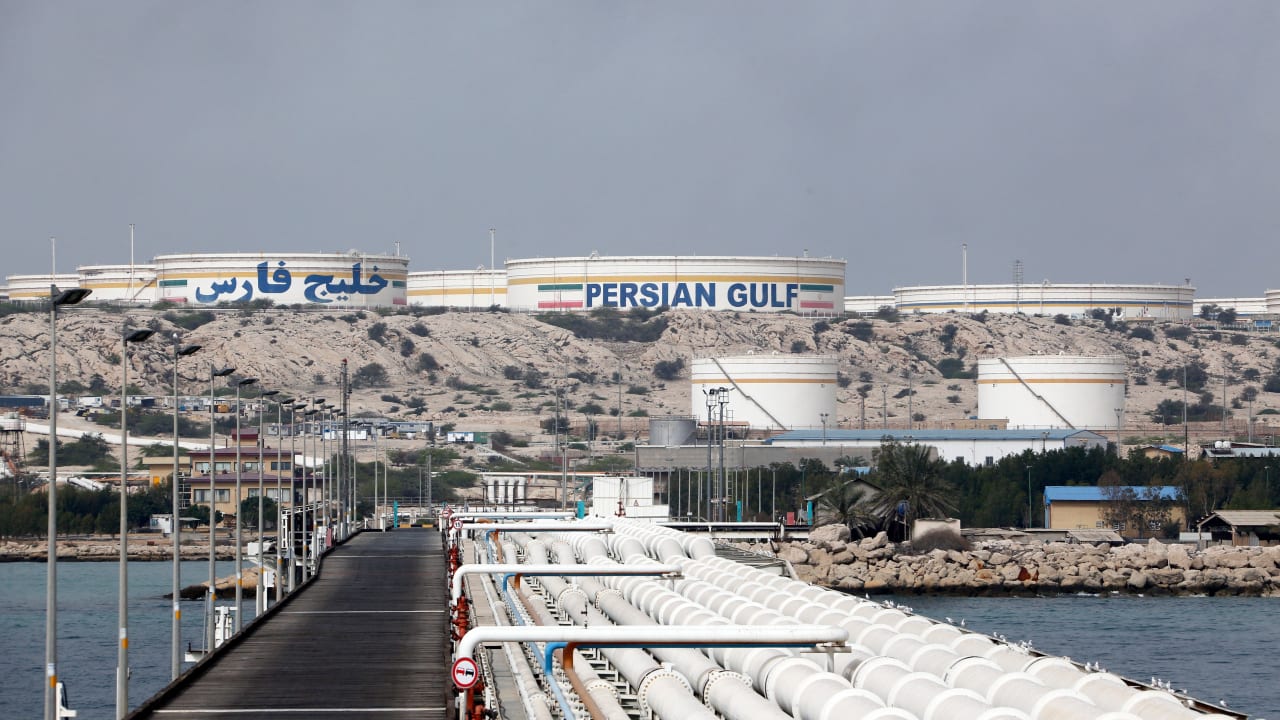
Since the early hours of Saturday morning, when US forces struck Kharg Island, worrying messages have been emerging from workers, engineers, and employees of the island's oil and petrochemical complex.
For more stories from The Media Line go to themedialine.org
Despite repeated requests to evacuate due to the immediate danger to their lives and the threat of further strikes, the regime authorities are refusing to allow them to leave, insisting that operations at Iran's most critical oil export terminal must continue without interruption.
A citizen in Bushehr told The Media Line on Saturday evening that that day, workers, staff, and engineers gathered in front of the central offices of the Iran Continental Shelf Oil Company, demanding evacuation. Fires are still burning in parts of the island, and given the vast oil reserves stored there, any uncontrolled blaze risks triggering catastrophic explosions with severe human casualties.
According to the same source, company managers - citing the absence of an official evacuation order - declared that any departure from the workplace was a violation of regulations and insisted that operations across the island's energy industries must continue.
US Central Command (CENTCOM) announced in the early hours of Saturday that more than 90 military targets on the island had been destroyed, including naval mine depots, missile storage facilities, and military installations. It has also been reported that the Islamic Revolutionary Guard Corps (IRGC) and Iranian Army missile and drone launchers positioned to cover the Persian Gulf may have been among the targets.

Kharg Island has long served as Iran's primary oil export terminal. Located just 25 kilometers off the Iranian coast, it handles more than 90 percent of the country's oil exports. In addition to its oil and gas refinery, petrochemical plant, and the Iran Continental Shelf Oil Company, the island hosts numerous ancillary industries.
In total, more than 7,000 technical personnel work on Kharg, drawn from cities across Iran, local communities, and workers from the southern province of Hormozgan.
On Saturday (Tehran Time), US President Donald Trump posted on his social media platform that Iran's oil infrastructure on the island had been spared, for now, on humanitarian grounds, but warned that this decision could change.
Significance of Kharg Island
More than 20,000 people live on the island, whose administration is divided primarily between the Ministry of Oil and the Ministry of Defense.
Kharg also holds a place in the deep history of Iranian civilization: an Achaemenid inscription found there, damaged beyond legibility by natural and human wear, is said by some to record a Persian ruler's claim to have brought prosperity to this arid land, though archaeologists caution that no such text can currently be read with confidence.
In the early hours of Saturday, this island, a living thread of Iranian history, an economic lifeline, and the last refuge of an endangered Iranian gazelle, was turned into an inferno. Many now fear a further, more devastating strike that could trigger an environmental catastrophe for the entire region.
The island also carries a darker historical legacy: it served as an exile for political opponents during the reign of Reza Shah, when some of Iran's most prominent intellectuals and writers were banished there. After the CIA-orchestrated coup of August 1953, carried out with British complicity against Mohammad Mosaddegh's nationalist government, Kharg once again became a destination for exiled left-wing writers and intellectuals.
In more recent decades, as energy industries expanded and desalination plants came online, the island's population grew substantially, transforming what had once been a predominantly indigenous community.
While Iran continues launching drones toward Persian Gulf cities, including Doha, Bahrain, and Dubai, Hamas, a close ally of the Islamic Republic, has urged the regime authorities to halt strikes against those countries, which are among the group's key financial backers.
Meanwhile, hardline MP Hamid Rasaei expressed hope that the outcome of what they call the "Ramadan War" against Israel and the United States would be the return of Bahrain to Iranian sovereignty. It was Mohammad Reza Shah who agreed to Bahrain's independence in 1970, relinquishing Iran's claim to the strategically vital island with its significant oil reserves.
Bahrain was among the signatories to a draft resolution passed by the UN Security Council on March 11, condemning Iranian strikes against Persian Gulf states and calling for an immediate halt to the attacks, but now, even Kharg Island itself came under American bombardment.
In Bushehr and across Iran's port cities, residents are increasingly fearful following CENTCOM warnings, given that these ports handle a substantial share of Iran's oil and non-oil exports to global markets.
A family member of one of the island's energy workers told TML via a messaging application that all phone and mobile contact with their relative had been severed since Saturday morning. "I am desperately worried," they said, "about what is happening to him on that island, which has now become one of America's targets."
Adding to these fears, rumors have been circulating alongside reports in outlets such as Axios - widely picked up by Persian-language media outside Iran - regarding the possibility of American ground troops and Marines landing on Kharg Island to seize it, or alternatively occupying sections of Iranian territory overlooking the Strait of Hormuz.
These reports have deepened concerns that the war in the region is entering a significantly more dangerous and escalatory phase.