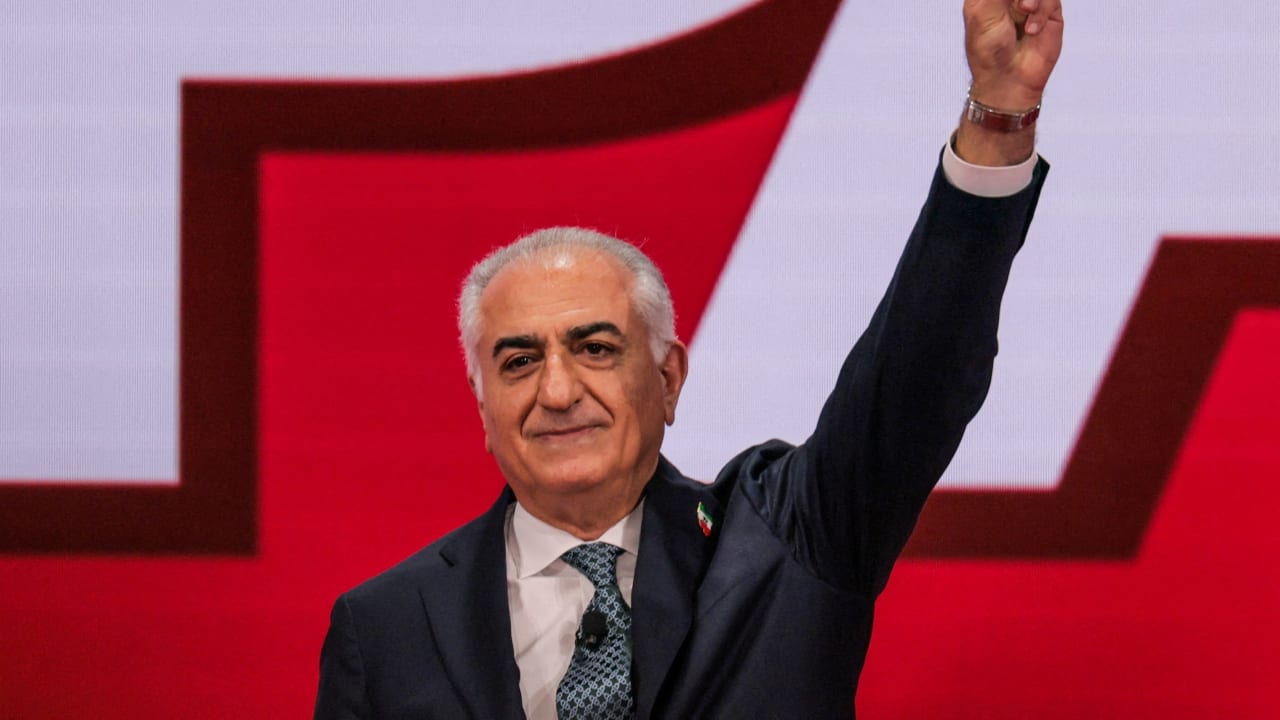
Iran’s Crown Prince Reza Pahlavi told Iranians on Wednesday night not to view the newly imposed ceasefire between Iran and the United States and Israel as a defeat. Instead, he portrayed the truce as evidence that the Islamic Republic had suffered a historic blow and was nearing collapse.
In an address broadcast into Iran by satellite and radio, Pahlavi sought to rally opposition supporters disappointed by the two-week pause in hostilities, arguing that the regime had been forced into a position of weakness after weeks of war and the destruction of much of its military and repressive infrastructure.
“I know that news of the two-week ceasefire between the Islamic Republic, America, and Israel has disheartened many of you,” Pahlavi said. “But today is not a time for despair, it is a time for even greater belief in victory.”
His remarks came as US President Donald Trump signaled that Washington intended to move quickly into talks with Tehran under the fragile truce. Trump said on Wednesday that the United States would work with Iran after what he described as a “very productive regime change,” while also insisting there would be no uranium enrichment and warning that any country supplying military weapons to Iran would face immediate 50% tariffs.
He also told ABC News that Washington was considering working jointly with Iran to secure the Strait of Hormuz, while Vice President JD Vance warned that if Tehran failed to engage “in good faith,” there would be consequences.

Pahlavi says Islamic Republic defeated because of ceasefire
Against that backdrop, Pahlavi cast the ceasefire not as a reprieve for the regime, but as proof that it had already suffered a major defeat.
“The blows dealt to the Islamic Republic in a mere 40 days have been unprecedented, and for this regime, irreparable,” he said.
He described the killing of supreme leader Ali Khamenei as “in itself a historic achievement for our nation,” and said that senior commanders and principal figures within the Islamic Revolutionary Guard Corps (IRGC), the Basij, and the regime’s intelligence services had also been removed.
Pahlavi further claimed that the regime’s command-and-control structure had collapsed and that the military infrastructure built “not for the defense of Iran, but for the export of terrorism and instability,” had been annihilated.
He also accused the Islamic Republic of attempting to hide the scale of the damage through propaganda and Internet restrictions.
“This regime has suffered a devastating defeat in reality, yet by severing Internet access for 90 million Iranians and through its machinery of lies, still pretends victory and issues hollow threats,” the prince said.
Those who had once vowed never to accept a ceasefire, he added, had now “lost their leader and their commanders, lost the war, accepted the ceasefire, and been dragged to the negotiating table for their complete capitulation.”
However, Pahlavi stopped short of calling for immediate mass action, saying that the regime, though badly weakened, still retained enough coercive power to carry out further repression.
He said his “singular objective” was to ensure that any final move against the regime came “at the lowest possible cost to human life.”
“I therefore ask that you remain patient, protect yourselves and, with faith in victory and full readiness, await the decisive moment.”
The crown prince also repeated his longstanding argument that outside military pressure alone would not be enough to topple the regime, and that the final blow would have to come from within Iran.
“We knew from the outset... that the Islamic Republic would not fall solely through the elimination of its command structure and the degradation of its repressive apparatus by aerial strikes,” he said. “It is we, the Iranian nation, who must deliver the final blow to this weakened regime and bring about its ultimate end.”
He linked the current moment to recent anti-regime demonstrations and opposition mobilization, saying the international blows against Tehran were in line with the demands Iranians had made “after laying down their lives in the streets of Iran,” and later echoed during February’s Global Day of Action.
The speech ended with Pahlavi declaring that the Islamic Republic had “no path of escape and no chance of survival this time,” and that its downfall would come “at the mighty hands of you, the great nation of Iran.”