
If a full naval blockade of Iran proves successful, it would, on the one hand, increase the immediate risk of war between Iran and the United States - potentially drawing in all countries in the region - and, on the other, trigger an unprecedented crisis in the global economy, particularly affecting China.
For more stories from The Media Line go to themedialine.org
Forecasts suggest that Iran’s economy, which is heavily dependent on oil exports, could collapse within approximately three months. This would likely be accompanied by massive waves of street protests, driven by subsidy cuts and a sharp, unprecedented surge in runaway inflation.
Following the launch of the naval blockade operation ordered by US President Donald Trump after the failure of negotiations between the two sides in Islamabad, Iran’s ruling authorities have declared that any attack on Iranian ports would be met with retaliatory strikes against ports across the region.
Meanwhile, the Islamic Revolutionary Guard Corps (IRGC) has continued to obstruct passage through the Strait of Hormuz and has reportedly even threatened US military vessels in the area.
At the same time, as the blockade is enforced and President Trump has warned that any Iranian fast-attack boats approaching the area will be destroyed, the IRGC’s warning to US military vessels seeking to enter the Strait of Hormuz could at any moment ignite another war, despite the two-week ceasefire.
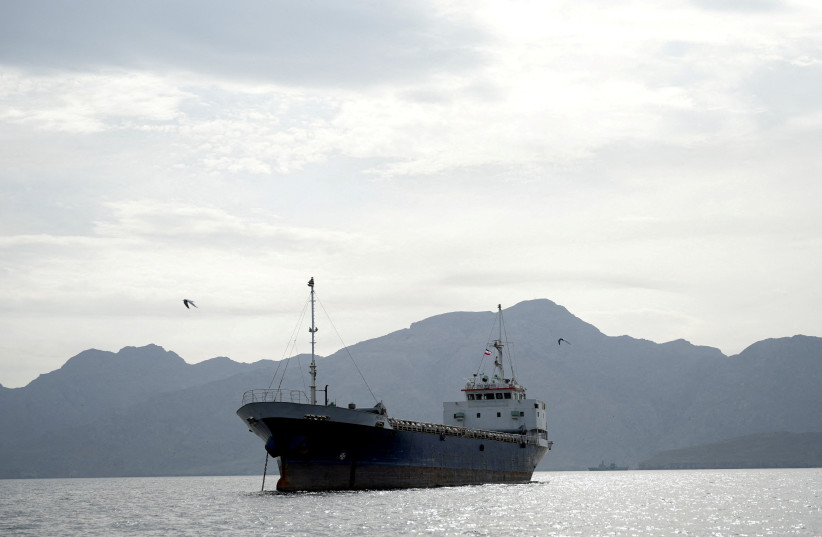
On Sunday, the IRGC declared that the passage of US military vessels through the Strait constitutes a violation of the ceasefire. Iranian state media also released a video on the same day showing what it described as a near-engagement by the IRGC Navy against a US military vessel, in an area from which ships are urged to keep their distance, as Iranian forces seemed prepared to open fire after warnings to leave the area were ignored.
The date, location, and identity of the vessel remain unclear, though the footage appears to be from the past day or so.
In an official statement, the IRGC explicitly warned: “Any attempt by military vessels to approach the Strait of Hormuz will be considered a violation of the two-week ceasefire with the United States and will be met with a severe and decisive response.”
The US Central Command (CENTCOM) had previously stated that the mission of American naval vessels in the Strait was to clear the area of mines allegedly deployed by the IRGC, but it has issued no response regarding the confrontation claimed by Iranian authorities.
In a report, Iran’s state-run Press TV claimed that on Saturday, two US warships, the USS Frank E. Petersen Jr. and the USS Michael Murphy, attempted to pass through the Strait of Hormuz into the Persian Gulf. According to the report, the IRGC Navy identified the vessels near the port of Fujairah as they navigated a risky passage through shallow waters.
After locking cruise missiles onto the ships, the regime forces reportedly gave them 30 minutes to leave the area, and with only minutes remaining before a possible strike, the vessels ultimately withdrew.
This account, attributed by Press TV to military sources, has not been confirmed by CENTCOM or any independent authority. CENTCOM, for its part, states that the two ships completed their mission of identifying a safe route, reopening commercial passage, and deploying mine-clearing equipment in the area before returning.
Some Western sources, including Axios, have reported that the vessels transited the Strait and then returned to the Arabian Sea.
Until last month, the United States maintained several vessels in the Persian Gulf and the Gulf of Oman, including the USS Canberra, USS Tulsa, and USS Santa Barbara, which were part of the Fifth Fleet and were officially tasked with mine countermeasures and ensuring maritime security in the region and the Strait of Hormuz.
However, it appears that these vessels have since withdrawn from the area to avoid potential attacks by the Islamic Republic. Instead, the US naval formation has been consolidated in the Arabian Sea, where the aircraft carrier USS Abraham Lincoln and USS Tripoli are also deployed. It has played a central role in U.S. military operations - particularly in strikes against Iranian naval bases and the destruction of a significant portion of Iran’s naval capabilities.
Nevertheless, Iranian military officials have implicitly stated that the IRGC Navy - relying largely on light vessels, fast-attack boats, drones, and anti-ship missiles - remains operational.
Military confrontation between US and Iran possible, expert says
Given the escalating crisis in the region and the enforcement of an economic blockade targeting Iran, whose war-stricken economy depends heavily on oil revenues despite US sanctions, the risk of a military confrontation in the Strait of Hormuz is now higher than ever.

Farzin Nadimi, an expert on Iran’s military affairs, spoke to The Media Line regarding the likelihood of another military confrontation: “It can be imagined that clashes between the United States and the IRGC could intensify significantly, as the Islamic Republic seeks to control the Strait of Hormuz and could sharply escalate the conflict between the two sides.”
He added that the IRGC may respond to US naval presence through fast-attack boats conducting offensive or disruptive operations, including laying mines or deploying mine-like objects to hinder both mine-clearing operations and commercial shipping.
While the United States aims to achieve quick success through the naval blockade, the IRGC is likely to attempt to prolong the conflict, slow down and limit the scope of maritime operations, and thereby exert broader pressure on global oil markets and the economy.
Nadimi, the Senior Fellow at The Washington Institute for Near East Policy, also noted that the Islamic Republic authorities have previously declared that if they are denied access to their own ports, they will prevent other countries in the region from using theirs.
He emphasized that, should the naval blockade succeed, the ruling authorities in Iran may deploy drones, unmanned vessels, or missiles against the ports of any country involved in maintaining maritime traffic connected to the blockade. Such retaliatory measures could once again lead to war between Iran and the United States - and likely Israel.
Iran seeking to raise economic cost of blockade
According to Nadimi, the Islamic Republic is attempting to raise the global economic cost of the blockade for the United States, while Washington seeks to achieve its objectives as quickly as possible.
However, he stressed that a naval blockade takes time to be effective. He warned that the rising tensions carry the risk of escalating into a full-scale war in the region, as the regime is likely to exert every effort to ensure that the blockade fails.
Given the foreseeable escalation of tensions in the Strait of Hormuz, and as the Islamic regime claims control over the passage and even the authority to impose tolls on vessels, Israel appears to be preparing for a possible resumption of military strikes against Iranian targets.
In such a scenario, the IRGC - which has effectively taken full control of the government - may fight to preserve what remains of its power, or, as some analysts suggest, attempt to expand a “scorched-earth doctrine” not only within Iran but across the region.
Over the course of 40 days of military operations, the United States and Israel have significantly degraded the Islamic Republic’s military capabilities, eliminating key leaders, commanders, and officials.
However, the IRGC - now dominating the political landscape following the removal of Ali Khamenei and the designation of Mojtaba Khamenei as the nominal leader - continues to maintain control within the country, sidelining clerical and conventional state structures.
It has intensified its crackdown on protesters, detaining hundreds in recent weeks and carrying out executions of several dissidents, while continuing to assert its ability to wage war, launch missiles and drones, and control the Strait of Hormuz.
Iran exports approximately 2 million barrels of oil per day through the Strait of Hormuz, with China as its primary buyer, purchasing at prices significantly below OPEC benchmarks.
A cutoff in oil revenues could rapidly devastate Iran’s already war-stricken economy and intensify domestic discontent. If the government is unable to pay the wages and bonuses of its security forces, some of these forces may refuse to continue their duties, and a portion could even join the broader population of dissatisfied citizens.
Although the exact volume of Iran’s oil exports over the past two weeks at the height of the conflict remains unclear, it is estimated that approximately 158 million barrels of Iranian oil are currently stranded at sea following the closure of the Strait. The last reported tankers carrying Iranian oil were vessels flying the Iranian flag that exited the Strait of Hormuz around the time CENTCOM announced the naval blockade.
If the regime’s authorities fail to secure oil revenues in the coming months, the destruction of key infrastructure - such as major industries - could place the government at risk of collapse. However, such an outcome would also bring severe economic disruption and pressure to countries across the region and the global economy.
In the event of a complete halt to both oil and non-oil exports, Iran’s state economy could suffer losses of approximately $400 million per day, while China, as a major buyer of discounted Iranian oil, would also face significant challenges.
Domestically, the immediate impact of lost oil revenues would be felt through subsidy cuts and a sharp increase in the prices of essential goods such as food and fuel.
Given that more than 85% of Iran’s exports pass through its ports, the situation could reach a critical point within less than three months. Domestic production of food and industrial materials - as well as small-scale industries such as plastics, which form a key part of Iran’s microeconomy - would face severe disruption, alongside the near-total collapse of digital trade and services due to prolonged internet shutdowns.
Even if mass street protests do not erupt within the next three months, continued economic pressure could lead to the complete collapse of Iran’s state-controlled and blockaded economy within a year, effectively dismantling the country’s economic and social foundations.