
The three spacious floors of Jerusalem’s Beit Avi Chai are filled with the artwork of Russian Jewish artist Anatoly (sometimes spelled Anatoli) Lvovich Kaplan in an exhibit curated by David Rozenson and Amichai Chasson. His paintings, lithographs and sculptures provide the visitor with an intimate view of a world both vanished yet still vital. But who was Anatoly Kaplan and why has he been honored with this retrospective in a city he would never get to visit?
Born in Rogachov on the banks of the Dnieper River in 1902, the young Tanchum (Anatoly) attended cheder, where he imbibed Hebrew and religious studies. After studying at the local elementary school, he studied at the higher Art and Technical Institute in Petrograd-Leningrad and began a career designing industrial graphics, trade labels and illustrating children’s books. During this period he also revisited his home town of Rogachov, where he painted people and scenes of local life. In 1934 he married, and his wife, Yevgenia, gave birth to their only child, Lubya. In 1937, Kaplan entered the Leningrad Experimental Workshop, where he studied lithography for three years. His first cycle of lithographs was based on Sholem Aleichem’s stories “Kasrilevka.”
In 1939, Kaplan was accepted as a member of the Union of Soviet Artists, which allowed him to flourish as an artist under the Soviet regime. He participated in a number of state exhibitions, including sketches of nature from various places in Russia he visited with some fellow Leningrad artists during 1940. World War II was not far away, however, and in 1941 his parents and other members of his family were murdered in the Rogachov ghetto.
Kaplan and his family were evacuated to the Urals during 1942/43, where he made a number of large drawings and watercolors of everyday day life in the Urals, which were exhibited at the end of his stay there. In 1944, he returned to Leningrad, which was undergoing a post-war revival. His lithographs celebrating this change in the fortunes of the city were purchased by 18 state galleries. In 1950-1951, he was the chief artist of the Leningrad Glass factory, which produced decorative and household items according to his designs.
The artwork of Anatoly Kaplan
From 1953 to 1963, Kaplan created a series of lithographs based on Sholem Aleichem’s story the “Enchanted Tailor.” This was in part a response to the death of Stalin in 1953, when the idea of a Jewish artist creating explicitly Jewish art was allowed. Kaplan had already devoted much of his artistic work to illustrating Sholem Aleichem’s work, as well as other Russian Jewish writers such as Mendel Mocher Seforim, Y.L. Peretz and Isaac Babel. In the last decade of his life, he began a series of 400 works in pastel, as well as dry-point works and charcoal and pencil depictions of his early life in Rogachov. Kaplan died in Leningrad in 1980.
Thus the outline of Kaplan’s career. His works are both playful and serious, whimsical and deeply rooted. Although he appears to have moved away from his religious upbringing, his artistic projects brought him back to his Jewish roots, especially through his lithographs illustrating writers of a couple of generations before him. These illustrations appeared in collections and were offered as such to admirers of his work. They were also sold individually and were enthusiastically purchased by people who were attracted by nostalgia for a Russia no longer in existence.
How he came to lithography – which is a complex form of printmaking, using stone as its base – is also a reflection of the times in which he lived in the Soviet Union. In the early 1930s, the program of socialist realism was ruthlessly enforced on artists, as well as in film, theater, literature and architecture. Paradoxically, the Leningrad State Museum of Ethnography of Peoples of the USSR began to work on an exhibition called “Jews in Tsarist Russia and the USSR” for which artistic works were needed. The ethnographer Isai Pul’ner, who was organizing the event, turned to Kaplan and commissioned him to produce lithographs of scenes of Jewish life. Kaplan had no experience with the technique, although it interested him a great deal. For the next two years, he studied the technique with masters of lithography, resulting in his first series of lithographic works, as mentioned, called “Kasrilevka,” the name of a fictional shtetl created by Sholem Aleichem. In Kaplan’s hands, the images he created were culled from his memory of his own shtetl, Rogachov. Even though the reality of the scenes he depicted no longer existed, he was able to recreate the atmosphere of the place, with its wooden houses, tall trees, people walking, and animals.
Russia after WW II presented more horrors, especially if you were Jewish. It was no longer Jewish religious life that the Soviets wanted to eliminate but also the remnants of Jewish secular culture. Kaplan shielded himself from the excesses of Soviet antisemitism by illustrating children’s books and also, as chief artist of the Leningrad Glass Art Factory, the creation of decorative and household items that were made according to his designs, as well as stained glass productions. His desire to return to Jewish themes was very strong, so at age 50 he began illustrating the stories of Sholem Aleichem. His concern about his neighbors’ reactions was such that he affixed his drawings to the back of his door so that when neighbors in his communal apartment looked in, they would not see what he was drawing.
With the death of Stalin in 1953, the situation became somewhat easier. Kaplan’s illustrations for Sholem Aleichem’s story “The Enchanted Tailor” were created with decorative frames on which scenes of animals sat side by side with texts in Yiddish or Hebrew. In 1957, he began to work on the “Tevye” series, also inspired by the Sholem Aleichem stories. Kaplan created 100 lithographs showing portraits, domestic scenes, landscapes and entire village scenes.
During this period, he illustrated a series based on the traditional Passover song “Had Gadya”(“One Goat”), as well as “Jewish Folk Songs,” in which he based the style on that of a Russian folk tradition of wood engravings. Accordingly, he tried to show the Soviet ideal of a happy life for the Jews, “nationalist in form and socialist in nature.” The goat, which became a central motif in his work, represents both a sign of relative riches, or at least self-sufficiency, and a symbol of the Jewish people – on the one hand, full of material wealth; and on the other, vulnerable to other people, animals and the winds of fortune. Not that this particular symbol could be openly used to praise the Jewish people. Rather, Kaplan refrained from using any overt reference to Judaism or the Jewish people to escape the watchful eye of the Soviet censor, confident, perhaps, that the Jews who viewed his work would know what he meant.
Kaplan integrated tradition with his contemporary situation. In 1962, for example, he illustrated Sholem Aleichem’s “Song of Songs,” in which phrases from the biblical text are set down next to down-to-earth expressions of endearment in Yiddish. He reverted to gouache and tempera when illustrating Dmiti Shoshtakovich’s song cycle “Jewish Folk Poetry,” again adding the Yiddish text, sometimes translated into Russian. He returned to lithographs when illustrating Stempenyu, Sholem Aleichem’s first novel, revolving around klezmer musicians.
Kaplan’s final use of lithography was in his illustrations for the short novel Fishke the Lame by Mendele Mocher Seforim, in which he again returns to his childhood memories of Rogachov, expressing his deep yearning for a world that was lost.
Apart from printmaking, Kaplan turned to ceramics, sculpture and pastels, of which he made 400 in the last decade of his life. Art critic Boris Suris compared Kaplan to Chagall and Soutine, averring that “Kaplan is a realist, presenting the world as it is, unlike Chagall’s stunning unbelievability, nor Soutine’s hysterical, suffering brokenness.”
Latterly, too, Kaplan began to receive recognition beyond the borders of Soviet Russia. Twenty-five albums of his work were published in East Germany. In 1960, he was introduced to Eric Estorick, who owned the renowned Grosvenor Gallery in London. Estorick presented two successful exhibitions of his work, besides buying 90 of his lithographs and arranging further exhibitions of his work in New York and Jerusalem.
The style of Kaplan’s work integrates sophisticated techniques, especially in his work with lithography, and a folk-like, even naive, approach to his subject matter. In this sense, he is very much a visual equivalent of Sholem Aleichem. Both of them express themselves as simple witnesses of their environment, while simultaneously hinting at a much deeper reality behind this folksy facade. It is this duality which informs much of Kaplan’s work. He has left us with a profound record of his times, illustrating in the most direct way his inner world and how it existed, in contrast with the harsh realities of the times through which he, alongside millions of fellow Soviet Jews, were forced to suffer. In particular, his beautifully rendered depictions of life prior to the Soviet regime are an antidote to the authoritarian small-mindedness that followed. His delicate etchings, dry-points, paintings, and especially his lithographs, speak of a deep romanticism that somehow survived under all the madness of his era, which unfortunately is still with us.
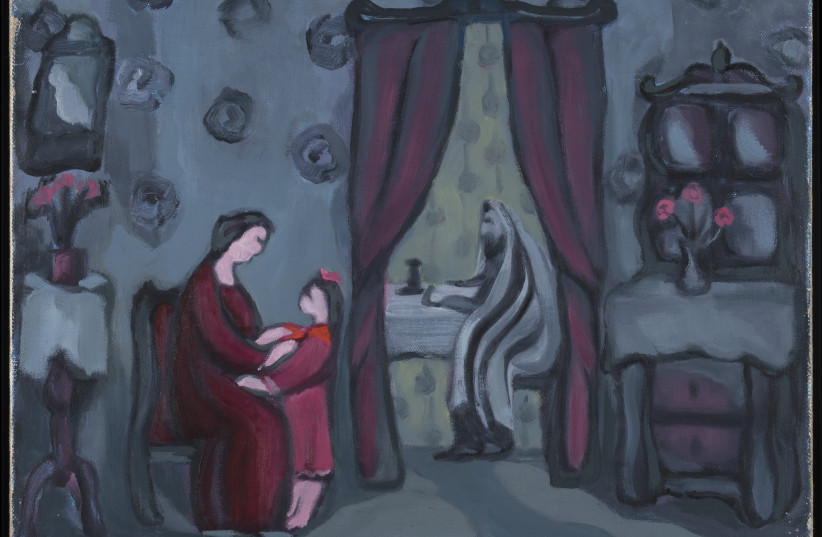
Two paintings show how he coped with the realities of his situation. On the one hand, in The Betrothal the romantic strain is prevalent, as he depicts a young man and woman celebrating their engagement. They are literally on top of the world, standing on the roof of their parents’ house. There is even a fiddler of the roof who, alongside a double bass player, are serenading the loving couple. It is a beautifully realized portrait painted in pastel, harmonized colors, suggesting the completeness of the scene. By contrast, his 1976 Interior shows a mother tying a red band of the Soviet Communist youth movement on her young daughter, while in the background a bearded man in tallit and tefillin is praying behind a heavy reddish curtain that is ready to be drawn at a moment’s notice. Here, Kaplan captures the difficult situation in which many Soviet Jews found themselves at the time, hiding their Jewish identity from the authorities and outwardly conforming to the rules of the regime. This theme is repeated throughout his work, as for example when he depicts in dry-point two lovers holding hands beneath a sun made up of the symbol of the Soviet regime.
Kaplan was never allowed to leave Russia, and the Soviet state took the majority of his earnings. His last few years were accompanied by health issues. Nevertheless, he carried on his “Rogachov” series recalling again his youth, this time openly and fearlessly. When he died, his tombstone in Leningrad was designed by his friend David Goberman, who used the Jewish folk art found on tombstones in old Jewish cemeteries of Eastern Europe. It was a befitting memorial to this unforgettable artist who had persevered under extraordinary circumstances to create a memorial to a lost, and much more human, civilization. ■
The exhibition at Beit Avi Chai is open through August 2023; Sunday-Thursday 10 a.m.-6 p.m.; Friday 9 a.m.-1 p.m.