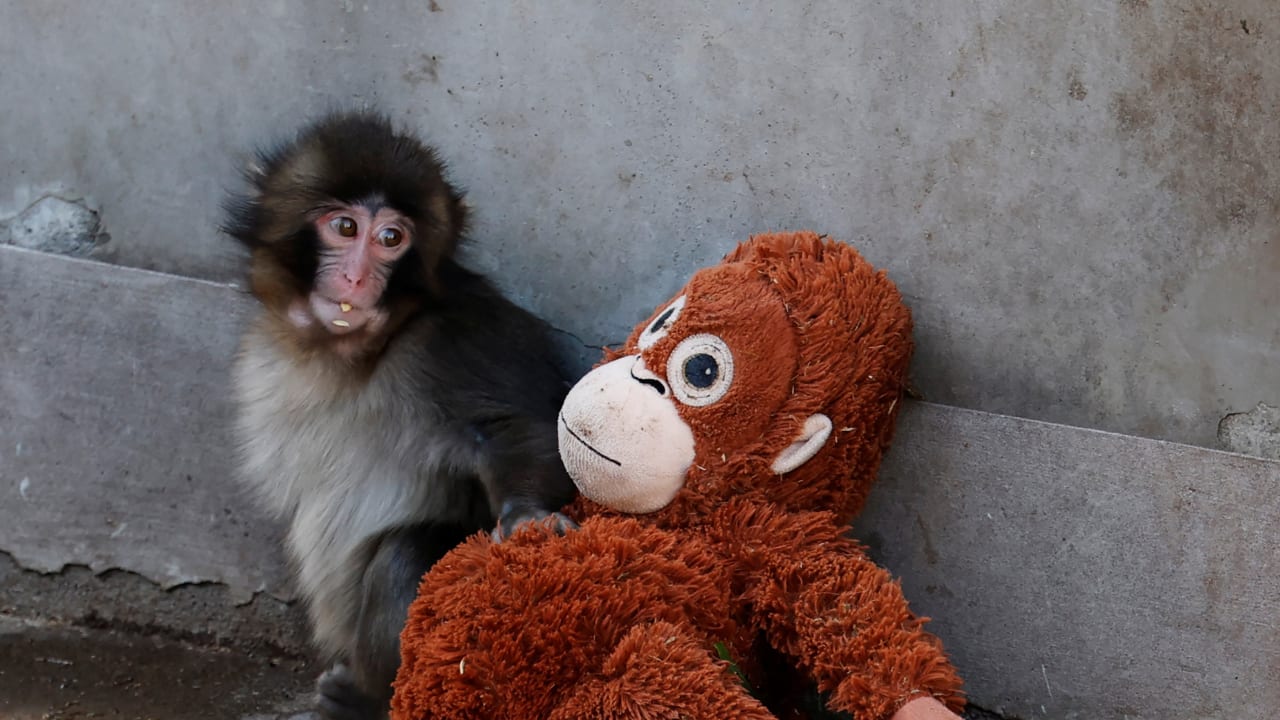
Punch, a baby Japanese macaque who became an online sensation for clinging to a plush orangutan after being rejected by his mother, is now regularly seen bonding with a female macaque named Aiko, also known as Momo-chan.
The pair share close-contact behaviors that include hugging, grooming, cuddling, chasing, and leaping. Specialists say such frequent physical interaction is standard for their species as they build and maintain social ties within a group. During these encounters, the orange plush toy that once served as Punch’s primary comfort object is often nearby. It no longer appears to be his only source of reassurance as he integrates with his troop.
Internet users have circulated videos highlighting the pair’s seemingly affectionate exchanges. Some speculate about a budding romance. Experts caution that this is a common misunderstanding of typical macaque social behavior. The species relies on ritualized proximity, grooming, and play, rather than necessarily mating, according specialists cited by the New York Post. These sequences of contact suggest a shift from isolation toward connection.
Punch’s daily routine is becoming bound up with Aiko’s presence and the rhythms of group life. The plushie remains a visual constant as he navigates these social steps. His focus now lies increasingly with his peers.
Clips show Punch leaning in for gentle face-to-face touches, receiving grooming, and returning the favor in kind. Viewers have described these as “kisses.”
The Orana-Mama
Born in July 2025 at Ichikawa City Zoo, he was abandoned by his mother and initially bullied by other monkeys in the enclosure. Early on, he was frequently spotted carrying a soft toy as a stand-in for the maternal grip and body contact he lacked. Staff provided a large orange plush orangutan to better replicate that tactile support and offset his early nursing deficiencies. It quickly became his preferred surrogate and earned the nickname “Oran-Mama.”
Caretakers took over nurturing tasks typically provided by a parent. They provided a clinical diet tailored to his developmental needs, thermal protection to stabilize body temperature, and sensory stimulation to encourage normal exploration and responsiveness. Over time, these measures helped him close developmental gaps. He reached a mature size appropriate for his age. That set the stage for safe, supervised exposure to other monkeys and the slow building of social confidence he now displays with Aiko.
As he gained strength, Punch began spending more time within the group rather than at its margins. He is now seen being groomed and at times carried on the backs of other monkeys. These behaviors indicate acceptance, learning, and the rehearsal of social roles within a hierarchical structure. Zoo management declined calls to isolate him completely from the troop, maintaining that remaining among conspecifics was essential to his long-term socialization.
He did face occasional corrective actions from dominant individuals. This reflects the strict hierarchy common in macaque societies. Staff observed that these interactions became less intense as Punch learned to navigate social cues, defer appropriately, and seek affiliative contact at opportune moments. His growing rapport with Aiko, who engages him in grooming and play, appears to reinforce those lessons.
Visiting Ichikawa
Footage of Punch and Aiko has drawn visitors to the zoo, who arrive intent on watching the pair.
For visitors, Ichikawa City Zoo and Botanical Garden sits in Omachi, Ichikawa. Omachi Station on the Hokuso Line is the closest rail link, with direct connections available from Haneda Airport. The surrounding city has deep historical and cultural layers. By the 1920s its central districts had become both a retreat for the Meiji elite and a geisha district.
The southern edge of Ichikawa meets Tokyo Bay and includes one of Japan’s 500 designated important wetlands that supports a shorebird habitat. Hokekyoji, a Nichiren Buddhist temple founded in 1260, preserves Japanese national treasures, according to Metropolis Japan.