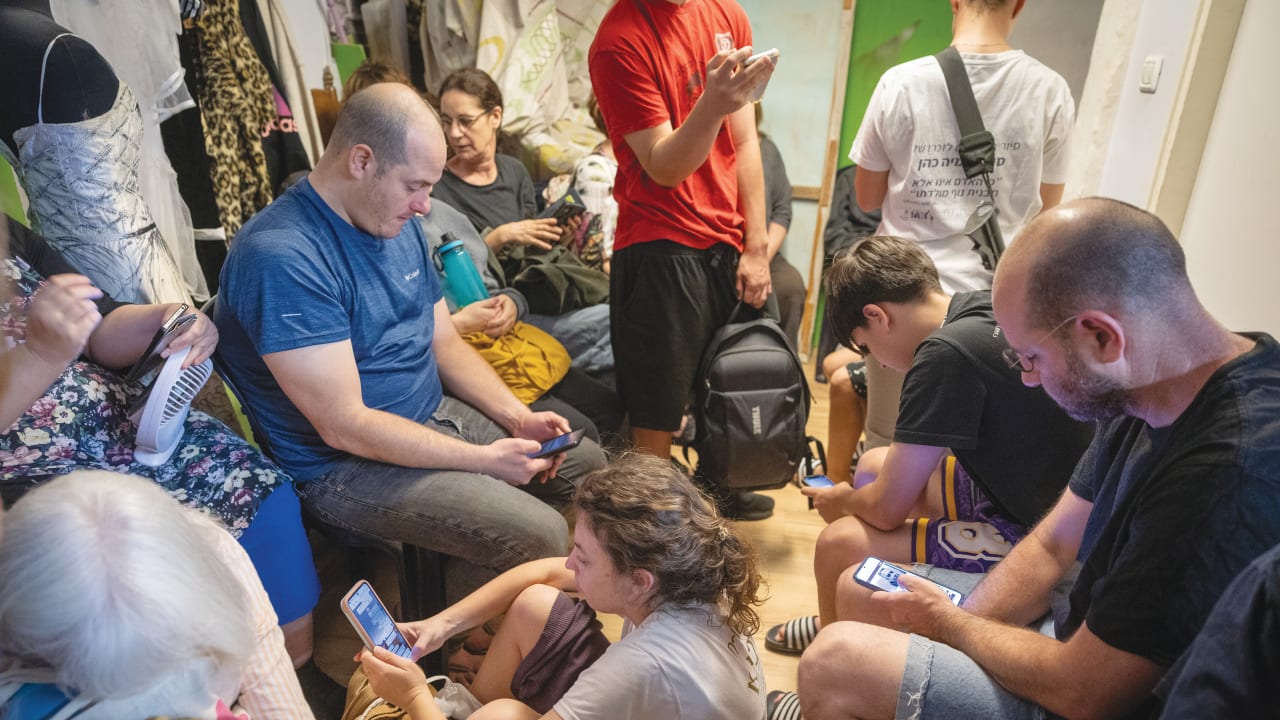
Last week, just before I left the house to choose a tombstone for my father’s grave, the siren sounded again.
We rushed to the safe room and waited 20 long minutes, listening to the booms of explosions nearby. One missile fell just 30m. from us, destroying several junkyard buses – thankfully, all empty.
People keep asking me what I think about the war with Iran. I honestly don’t know how to answer. I hate war. The sheer destructiveness of the weapons we’ve built to annihilate each other horrifies me.
The pain of seeing people hurt or killed, each one a son or daughter with a mother, a family, and a story, is almost too much to bear. It brings a sorrow so deep, it makes me want to scream.
And yet, the Iranian government has repeatedly declared its intention to destroy Israel. They are amassing weapons to match those words. Are they serious, or just trying to intimidate us?

After October 7, I no longer assume that threats are empty.
And I find myself – uncomfortably – grateful that we have the capacity and the courage to strike first and dismantle some of those weapons.
Why now? Is it really about defense?
Or is it about the government holding onto power?
I honestly don’t know. However, I do know this: choosing to act now, after years of fear and dread, required tremendous courage.
We’ve lived under the shadow of Iran’s threat for decades.
And still – what about our hostages?
What about the war in Gaza, which has nearly vanished from public conversation?
What about the rising crime and violence in Arab towns and villages across the country? Is someone trying to divert our attention, as if these colossal issues no longer matter?
I just watched Oppenheimer. What stayed with me most was the final scene – Oppenheimer’s conversation with Einstein.
Would the chain reaction he unleashed stop – or destroy the world?
It stopped. But the arms race never did.
We are all so afraid. And in that fear, we keep reaching for the bomb.
As a healer, the only thing I know to do is to create spaces where people can feel their fear, anger, and grief – rather than acting it out through violence.
In a world burning with conflict and pain, this often feels small – insufficient even. But I’ve learned that feeling is not the same as weakness. Feeling is what allows us to stay human. It’s what keeps us from becoming the very things we fear.
Violence often comes when we do not feel safe enough to grieve. When sorrow turns to rage because there is no one to witness it. When fear curdles into hatred because it has no other place to go.
I cannot stop wars, but I can hold space for the war within us. I can help create islands of honesty and safety in a sea of chaos.
This is not passive work. It takes courage to feel. It takes strength to sit with pain rather than lash out. And it takes deep love to listen to another’s suffering, even when it mirrors or challenges our own.
So I return, again and again, to what I know: soft places for hard truths. Circles where grief can breathe. Spaces where anger doesn’t have to destroy and where fear doesn’t get the last word.
In a world that teaches us to numb, to blame, and to strike back, I choose to feel – and I invite others to feel too. Because healing is not the opposite of struggle. Healing is what makes struggle bearable – and sometimes, what makes peace possible.
Now more than ever, the world needs an army not of soldiers holding weapons but of healers holding space – safe havens to feel, to grieve, and to heal.
And the tombstone for my father’s grave will have to wait, for now.
The writer is director of the Together Beyond Words organization.