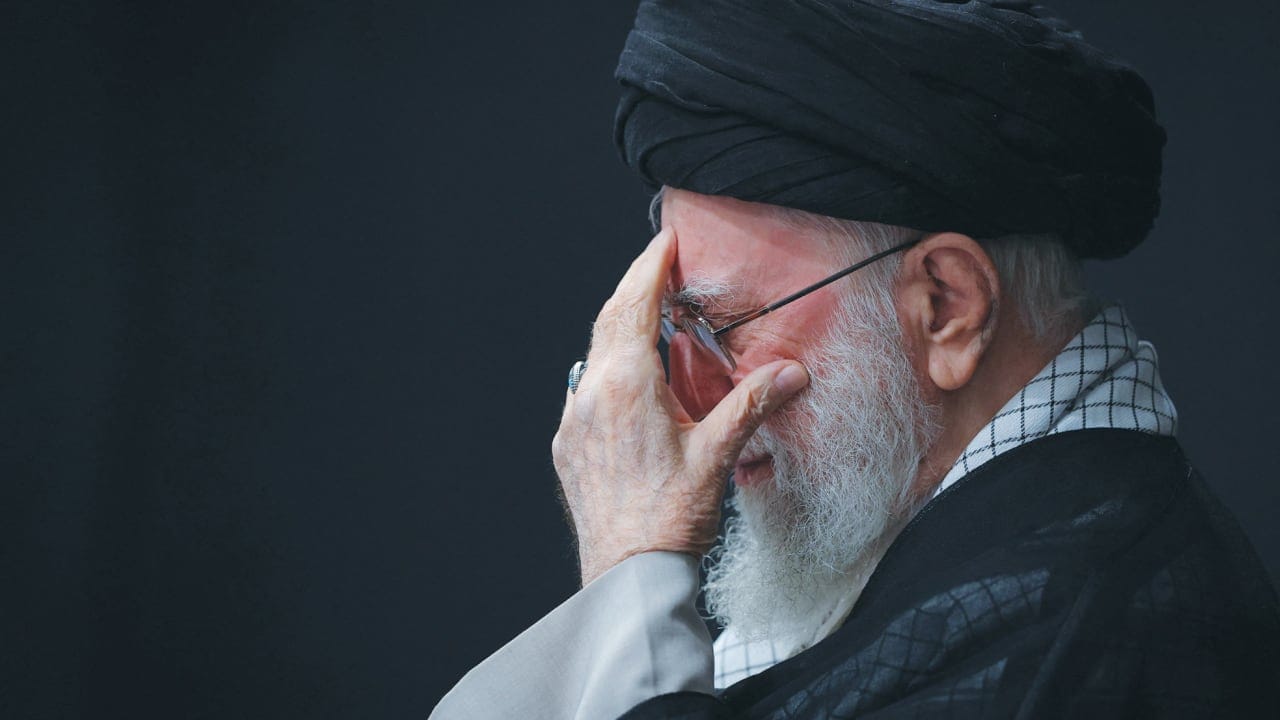
In his first foreign trip as the new head of Iran's Supreme National Security Council, Ali Larijani visited Iraq and Lebanon to salvage what remains of the regime’s "axis of resistance." Larijani replaced Ali Akbar Ahmadian, a veteran of the Islamic Revolutionary Guard Corps (IRGC). This decision is a window into the mind of Iran's ultimate decision-maker, Ayatollah Ali Khamenei, who has concentrated power in his own hand and his office—known in Iran as the "leader’s beyt."
The recent conflict exposed the weaknesses of Tehran’s security and military apparatus. After a large number of the regime’s key military and security officials were eliminated, the regime was forced to appoint many new replacements. Ahmadian, however, is the only high-ranking official who was replaced while still alive. Following the war, Ahmadian and Quds Force commander Qaani became targets of criticism for their forces' humiliating performance.
On August 7, Khamenei issued an order appointing Larijani as his representative to the Supreme National Security Council, replacing Ahmadian. Larijani was then appointed as the council’s secretary by President Pezeshkian.
Historically, secretaries of the SNSC have been one of the two representatives of the supreme leader on the council.

The other representative is currently Saeed Jalili, who served as the secretary for more than five years. On the same day, Khamenei appointed Ahmadian and Shamkhani as his representatives in the newly formed Defense Council.
Ahmadian, who has served as the commander of the IRGC Navy and the chief of Joint Staff of the IRGC, was appointed as the secretary of the SNSC in 2023 by Ebrahim Raisi, replacing Ali Shamkhani, who had been in the role for nine years. Ahmadian’s replacement, Ali Larijani, is now serving in the role for the second time. Like Ahmadian, Larijani had a short tenure as the council's head in the 2000s. More recently, he was disqualified from running in the last presidential election. Despite this public humiliation, Larijani refrained from confronting Khamenei publicly and remained loyal. In exchange, Khamenei kept him around. His elevation after Israel eliminated many IRGC commanders shows that, as Khamenei feels more vulnerable, he is bringing back familiar faces from the old guard.
A headache for Khamenei
Larijani’s promotion may create a headache for Mojtaba Khamenei, the supreme leader’s son, who has long been planning for his succession. Ali Larijani’s brother, Ayatollah Sadegh Larijani, former chief justice and the current head of the Expediency Discernment Council, had been one of the contenders in the succession game. During his tenure as chief justice, Ebrahim Raisi prosecuted individuals close to Sadegh Larijani for corruption, which ultimately damaged his reputation and his chances of replacing Khamenei.
Ali Larijani’s disqualification in 2024 was also seen as the final blow to the Larijani clan’s ambitions to succeed Khamenei. Ali’s return now places two of the brothers as heads of two of the seven critical political organizations in Iran. The seven are the heads of the judiciary, legislative, and executive branches, the Expediency Discernment Council, the Guardian Council, the Supreme National Security Council, and the Assembly of Experts. Mojtaba, however, still controls the "Beyt" or Khamenei’s office and has his father’s ear. However, the Larijani family's reemergence may ignite the succession battle, which seemed settled after Raisi's sudden demise.
Another figure who has benefited from the post-war shakeup is Mohammad Bagher Ghalibaf. Ghalibaf, a veteran of the IRGC and a twice-failed presidential candidate, is the speaker of parliament with little institutional influence on security and military policy. The creation of the Defense Council gives him a new channel to exercise some control over the country's defense and security policy at the expense of Pezeshkian and Larijani.
In the post-war era, the power players are no longer focused solely on succession; they are now deeply invested in survival in the post-Islamic Republic era as well. To many insiders, the fall of the Islamic Republic is now a possible outcome. They now have one eye on who will succeed Khamenei as the supreme leader while keeping the other on what may replace the Islamic Republic.
Saeed Ghasseminejad is a senior adviser for Iran and financial economics at the Foundation for Defense of Democracies, specializing in Iran’s economy, financial markets, sanctions, and illicit finance. Follow him on LinkedIn and X @SGhasseminejad.