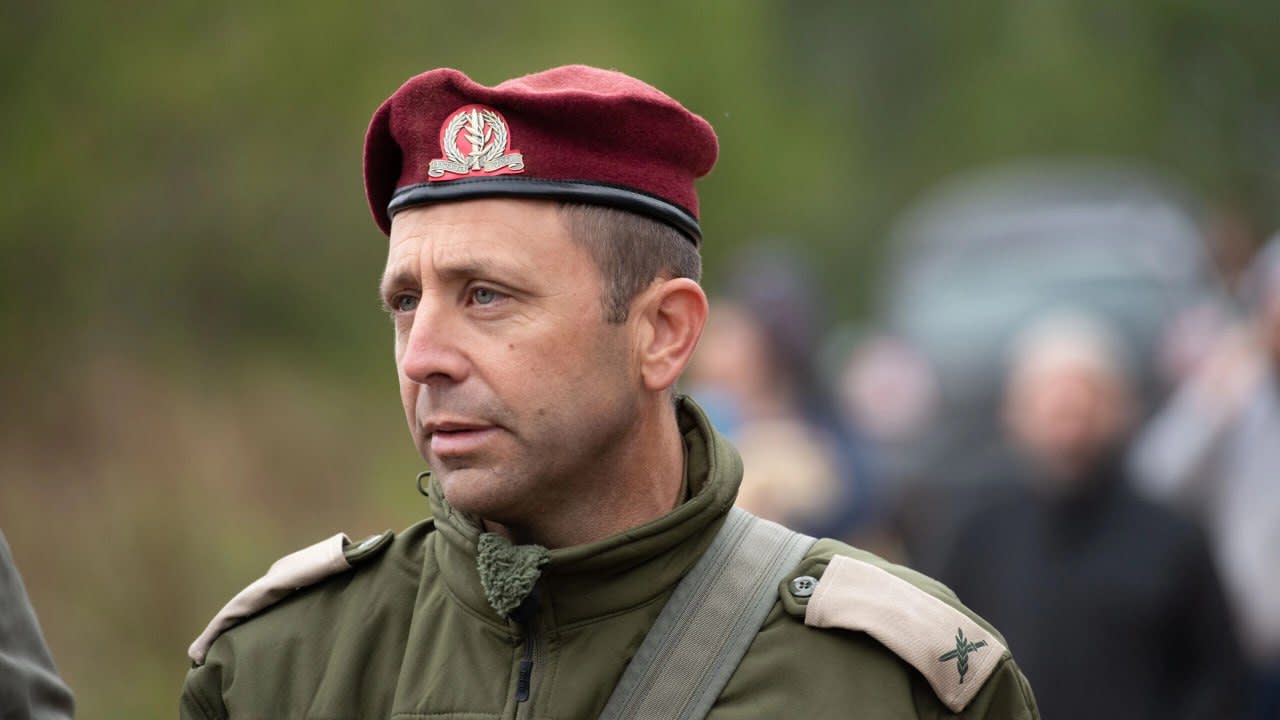
Let’s start with Hebron. Last fall, masked youths from the far Right swarmed Maj.-Gen. Avi Bluth as he secured an annual pilgrimage to the Tomb of the Patriarchs. They shouted “traitor,” blocked his path, and hurled abuse. Five suspects were later arrested. Even Prime Minister Benjamin Netanyahu, who is not known for rushing to defend IDF generals against settler radicals, condemned the attack on the Central Command chief.
It was an ugly scene that made one thing plain: Bluth is willing to enforce the law even when it means standing up to extremists within his own community.
That incident revealed the strange position Bluth occupies in Israeli public life. On one side, the far Right calls him a sellout, furious at his attempts to rein in violent settlers and outposts. On the other side, the far Left calls him a war criminal, accusing him of collective punishment against Palestinians.
On Thursday, Haaretz escalated the rhetoric further. A columnist compared him to a Nazi “Oberkommandant.” The newspaper’s publisher, Amos Schocken, had already branded him a war criminal and suggested he be tried in The Hague. When you are under simultaneous fire from both extremes, you know you are doing something right.
Abraham Aharon (Avi) Bluth is the first religious Zionist to command the IDF’s Central Command. Born in 1973, he grew up in Neveh Tzuf (Halamish), a settlement in the Binyamin region. He studied at the influential Bnei David pre-military academy in Eli, which has produced generations of officers from the national-religious camp.

Bluth’s military career is varied and impressive. He commanded elite units such as the Maglan commando and the 89th Commando Brigade. He later led the Judea and Samaria Division, giving him hands-on experience in the very territory he now oversees. He also served as Netanyahu’s military secretary, sitting at the heart of Israel’s political-military decision-making. Internationally, he studied at the US Army War College, and he holds advanced degrees that shaped his thinking about modern warfare. Beyond the uniform, he is a husband and father of six, a figure very much rooted in the Israeli mainstream.
This biography matters. It explains both why settlers initially greeted his appointment with pride, “one of our own,” and why some felt betrayed when he enforced the law against Jewish extremists. It also explains why critics on the Left distrust him, seeing his roots in Bnei David as proof of ideological leanings. In practice, his career shows a disciplined soldier who has served at the highest levels and earned the trust of multiple chiefs of staff.
The tree-clearing controversy
The latest storm erupted after a drive-by shooting near the Palestinian village of al-Mughayyir. The IDF responded by clearing thousands of trees along roads and hillsides used by attackers as cover. Palestinians and human rights groups accused the army of collective punishment.
ACRI (Association for Civil Rights in Israel) went further, calling it a war crime. Schocken seized on that framing, posting that Bluth should be tried in The Hague. Haaretz followed with columns depicting him as the personification of Israeli brutality.
The IDF, unusually for such cases, issued a formal statement defending him. It explained that the operation was an urgent security step, designed to deny cover for gunmen and reduce ambush opportunities. “Maj. Gen. Bluth acts for the security of Israel and in accordance with the law,” the statement read, while denouncing Schocken’s comments as “inappropriate.”
When the chief of staff, Lt. Gen. Eyal Zamir, felt compelled to add his own condemnation of “horrific and inciting” rhetoric directed at Bluth, it showed how far the debate had strayed from legitimate critique into personal delegitimization.
One can and should debate the effectiveness of such measures. Do they truly deter attacks? Do they come at too high a cost for Palestinian villagers? These are fair questions. What is not legitimate is leaping from operational disputes to Nazi analogies. Comparing a serving IDF general to an “Oberkommandant” is historically illiterate and morally corrosive.
Violence on both sides
Bluth’s record shows a consistent line. He has condemned Palestinian terrorism, yes, but he has also publicly denounced Jewish violence. In April 2024 he blasted settlers who torched a police car, calling it a redline that would be dealt with “seriously.” He also rebuked reservists who vandalized a Palestinian village during an operation. That is not the language of someone who looks away from extremism on “his” side. It is the language of a commander insisting that law and discipline apply to all.
That is precisely why he draws such furious criticism from both ends of the spectrum. For some on the far Right, any enforcement against Jewish radicals is betrayal. For some on the far Left, any strong military measure in the West Bank is oppression. In this polarized climate, Bluth’s attempt to hold a consistent standard makes him a lightning rod.
Haaretz is entitled to criticize the tree-clearing. It is entitled to question Bluth’s policies, to publish reports on the human and ecological damage, and to demand transparency on whether the tactic works. That is the work of a free press.
What is not acceptable is the drift into demonization. “War criminal.” “Oberkommandant.” “General of bloodshed.” These terms are not analysis. They are attempts to delegitimize a commander and, by extension, the soldiers he leads. They do not save lives, free hostages, or make highways safer. What they do is corrode the guardrails of Israeli democracy by turning soldiers into caricatures of evil.
This is part of a pattern. When Haaretz locks onto a target, it often shifts from critique of policy to a rolling campaign against individuals. In Bluth’s case, that campaign not only distorts the facts, it weaponizes the Holocaust. Equating the IDF with Nazis is a blood libel in modern dress.
Tuning Haaretz out
Israeli democracy is loud. We argue on television, in the Knesset, and in the streets. That noise is part of our vitality. But there are limits. Debate must stay tethered to facts and proportion. When it slips into Nazi analogies, it not only cheapens Holocaust memory, it fuels division at a time when unity of purpose is a strategic need.
I have criticized commanders before. That is the job of a journalist. I will continue to scrutinize decisions, especially when civilians bear the cost. But I will not stand by while an Israeli general is caricatured as a Nazi.
Bluth is not beyond criticism, and the IDF is not above accountability. But he has shown a willingness to confront both Palestinian terrorists and Jewish extremists, to insist on discipline and law in one of the most volatile regions in the world. That balance explains why he is under assault from both extremes. And it explains why the IDF, and even political leaders, have rallied to defend him.
You often know you are doing something right when Haaretz runs a sustained campaign against you. Avi Bluth is not perfect. He makes decisions that deserve debate and, yes, criticism.
We stand with IDF soldiers who risk their lives, and with commanders who enforce discipline and protect civilians, Israeli and Palestinian alike. We reject Nazi slurs. If Haaretz wants a serious conversation about rights, tactics, and proportionality in the West Bank, our pages are open. If it prefers to keep hurling caricatures from 1940s Europe, readers should recognize that for what it is, and tune it out.