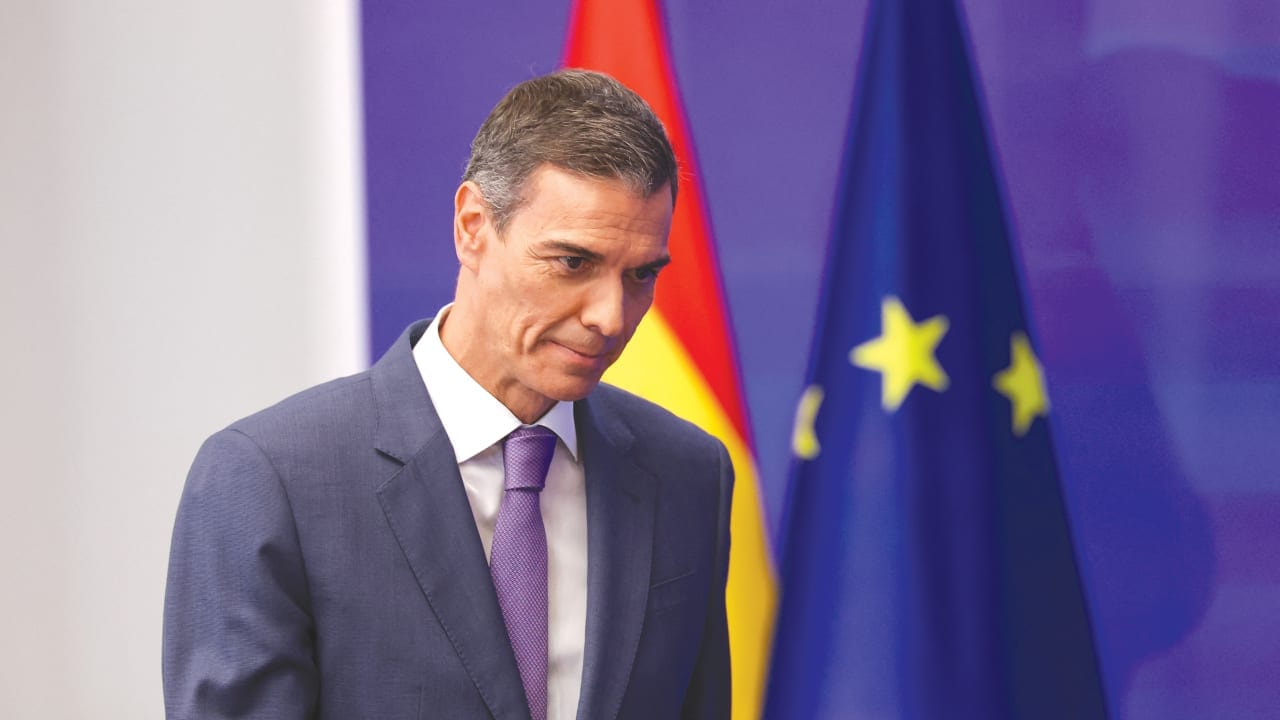
Spanish Prime Minister Pedro Sánchez’s recent remark that “We do not have atomic bombs to stop Israel” is not just another harsh political statement. It is a crossing of a red line that places Spain at the center of an international scandal.
This is not a case of clumsy wording or rhetorical exaggeration; it is an implied threat against the State of Israel, a sovereign nation fighting for its right to exist against terror and violence.
Should Israel understand from his words that if Spain possessed nuclear weapons, it would consider using them against Israel? Sánchez has never issued such threats toward Iran’s murderous ayatollah regime, which openly calls for Israel’s destruction.
In recent weeks, Sánchez has led unprecedented moves against Israel: declaring an arms embargo, supporting boycotts, and leveling false accusations of “genocide.” Yet his latest statement, which refers to Spain’s military capacity vis-à-vis Israel, while invoking the notion of “atomic bombs,” is reckless and resonates not only in newsrooms but also in diplomatic corridors worldwide.
Instead of working to secure the release of hostages held by terror groups, he chooses to direct his fire at Israel – the victim, not the aggressor.

His words are especially disturbing in light of his silence regarding the hostages. Rather than using his international standing to demand their immediate release, Sánchez embraces an anti-Israel narrative that legitimizes terror. Every statement that blurs the line between innocent hostages and murderous terrorists strikes at human dignity and deepens the suffering of their families.
Sánchez has also announced that his government is advancing an arms embargo against Israel due to the war in Gaza, and that Madrid will bar ships and aircraft carrying weapons or military supplies to Israel from Spanish ports and airspace.
Impossible to ignore historical shadows cast by comments
ONE CANNOT ignore the historical shadows cast by his comments. Spain is notorious in Jewish history for the 1492 Spanish Inquisition, one of the darkest chapters for the Jewish people, in which hundreds of thousands were expelled, humiliated, and murdered in the name of “purity of faith.”
Now, 500 years later, voices once again emerge from Madrid threatening Jews; this time in their sovereign state. The comparison is not coincidental: when a Spanish leader feels free to hurl grave accusations at the Jewish state and even hint at military threats, he continues a legacy of hostility that a modern democracy should have abandoned long ago.
The audacity lies not only in his words but in his willingness to jeopardize Spain’s relations with Israel, a democratic nation at the forefront of the global struggle against radical Islamic terror. His rhetoric does not advance peace or reconciliation; it fuels division, hatred, and rising antisemitism across Europe.
Instead of acting as a responsible NATO leader, Sánchez has chosen the language of bullying, seeking domestic political gain at the expense of another nation’s security. Any leader who dares to suggest, even hypothetically, the use of nuclear weapons forfeits the moral authority to lecture others about human rights or peace.
This bullying extends to the European arena, where Sánchez pressures other EU states to adopt anti-Israel policies, threatens leaders who resist, and attempts to impose a hostile diplomatic reality. In doing so, Spain disqualifies itself from any role as a potential mediator and becomes an openly adversarial actor in the Middle East.
Sánchez has also declared his willingness to accept “refugees from Gaza.” While seemingly humanitarian, such a move carries grave risks. Europe has already experienced the consequences of uncontrolled waves of migration, sometimes exploited as fertile ground for terror, antisemitism, and erosion of local identity.
A commitment to admit tens or hundreds of thousands from Gaza without security vetting – without distinguishing between innocent civilians and Hamas operatives – endangers not only Spain but the entire continent.
This declaration exposes Sánchez’s weakness in the face of radical Islam. He knows Hamas uses civilians as human shields, yet instead of condemning this, he is ready to throw open Spain’s gates. This is not humanitarianism. It is ideological capitulation, one that strengthens terror and undermines Europe’s capacity to defend itself.
A leader who embraces every refugee indiscriminately ignores the reality that among them may be Hamas supporters. This is not compassion; it is dangerous irresponsibility. History teaches that surrendering identity and principles never leads to peace, only to disaster. A European leader who fails to grasp this repeats past mistakes and imperils both his people and his neighbors.
Israel does not fear Sánchez’s threats. It is strong enough to withstand diplomatic assaults and will continue to defend its citizens against any enemy, near or far. Europe must ask itself: Is this truly the leader it wants at the forefront? Is this the voice it wishes to project – a voice of bullying, capitulation, and historic hostility toward Jews?
In the judgment of history, Sánchez’s words will be remembered as disgraceful – evidence of moral blindness and failed leadership.
The writer, CEO of Radios 100FM, is an honorary consul and deputy dean of the Consular Diplomatic Corps, president of the Israel Amateur Radio Club, a former Army Radio monitor, and NBC News correspondent.