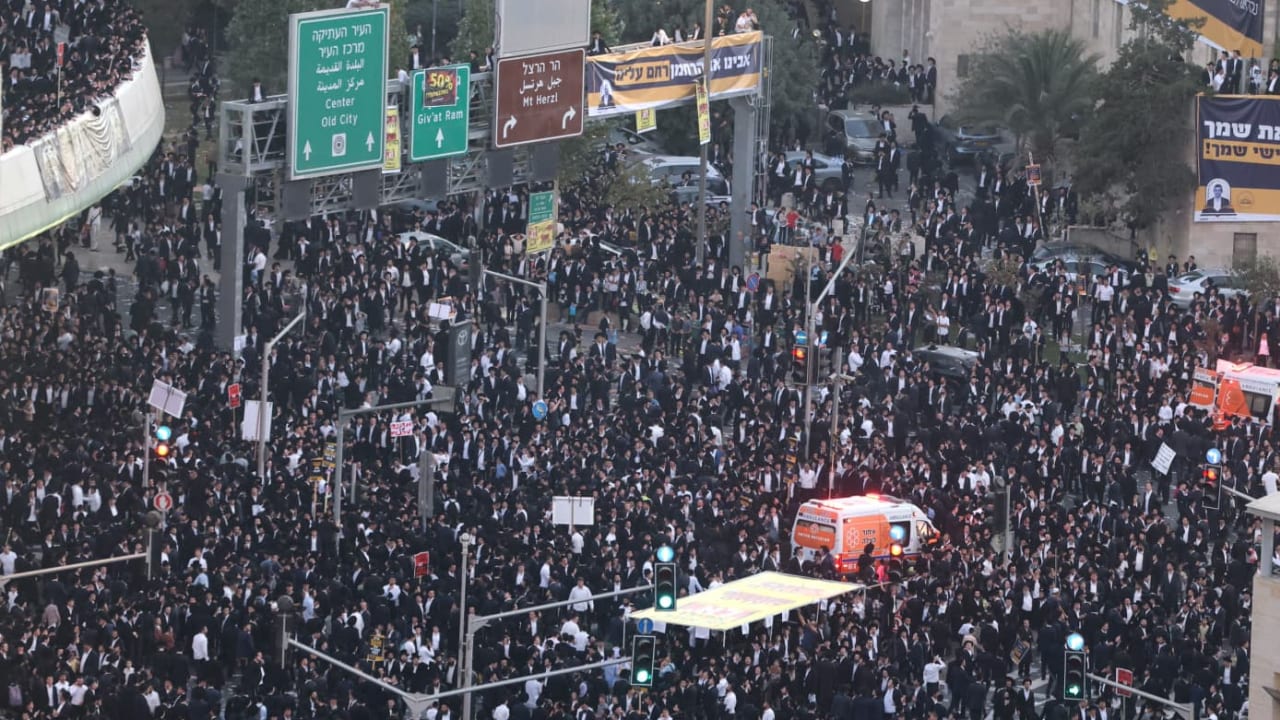
Last Thursday, men from every part of the haredi (ultra-Orthodox) world – from young to old, from the anti-Zionist Edah Haredit to the students of Rabbi Leibel (who believes that the haredi public should be an “integral part of the people of Israel and the state”) – attended a huge demonstration in Jerusalem under the banner “The cry of the Torah: Tens of thousands stand against the persecution of Torah students in the Holy Land.”
There has long been pressure on the Lithuanian rabbinical leadership to hold this demonstration from various hassidic rabbis.
Until now, however, the Lithuanian rabbis chose to refrain from taking steps that could intensify the struggle and result in crisis.
This changed in recent weeks when the authorities arrested several students of mainstream yeshivas who were not accused of any wrongdoing beyond avoiding the draft, unlike past cases when those apprehended were caught in the course of other actions such as attempting to leave the country.
This is a step that the haredi rabbis perceive as a casus belli, a declaration of war by the Israeli authorities, and one that cannot be silently ignored. Thus, all the haredi streams united in organizing the protest.

Haredi demonstrations are not a new phenomenon in Israel. In fact, the first haredi mass demonstration took place on Saturday, June 26, 1948, just a month and a half after David Ben-Gurion’s declaration of the establishment of a Jewish state in the Land of Israel.
Demonstrations about Shabbat observance were a regular feature in Jerusalem in the 20th century.
However, apart from a handful of protests that brought out masses from all the haredi denominations, mainly over the desecration of graves, but also others (such as those in support of a group of yeshiva students who set fire to the Eros sex toy store in the 1970s, and more), most of the demonstrations over the years were held by the extremist haredi group Neturei Karta and were rarely joined by other sections of the community.
The watershed for haredi demonstrations occurred on February 14, 1999, in the form of the huge protest against the Supreme Court.
Opinions about the exact number of participants are divided, with some estimating the number at around 250,000 and others at some half a million, but there is no doubt that it was one of the largest demonstrations in Israel’s history.
This protest followed several High Court rulings that were perceived as changing the status quo on issues of religion and state. Notably, in “the Rubinstein case,” the court ruled that the arrangement granting a sweeping exemption to yeshiva students was illegal and that a new law to regulate the matter should be enacted within a year.
The next mass demonstration took place a decade and a half later, on March 2, 2014, against the backdrop of the discussions over the Conscription Law.
The Shaked Commission had discussed a proposal to set annual conscription targets and to impose economic and criminal sanctions in the event of non-compliance. As a result, the rabbis decided that a huge protest should be held, which was organized under the banner of the “One-Million Rally.”
According to police estimates, around 300,000 people participated, though the organizers claimed that there were more than half a million people present.
Protest aims to strengthen identity and belonging
The motivation behind these two previous mass demonstrations seemed to be a desire to influence public opinion in general Israeli society and to lead to social change.
However, it seems the demonstration that took place last week had a different purpose. This time, it seems that the main reason for holding the demonstration is actually intra-haredi.
Sociologists explain that apart from attempting to influence public opinion and drive social change, the goal of demonstrations in general, and mass demonstrations in particular, is to mold the identity of the individual and to strengthen identification with the group and its goals.
In recent years, the haredi way of life has been threatened by change. The war has had a profound impact on public opinion in Israel, and the draft exemption is no longer perceived as a haredi right.
Even among young haredi men, especially at the beginning of the war, there has been a degree of discomfort regarding their role and place. Yeshiva budgets have been withdrawn, and military recruitment processes have begun to draw students away, so far only in tiny numbers, but even from elite yeshivas.
The haredi leadership has been unable to fulfill its obligation to its constituents of ensuring the passage of an exemption law and preserving budgets. Various haredi denominations disagree on the right course of action and are finding it difficult to form a unified front.
Against this backdrop, there was a growing need for a huge rally that would unite the ranks and strengthen the pride and identification of haredi individuals with the collective and its values – identification that, as noted, has been steadily eroded by recent events and pressures.
At the Jerusalem gathering, the haredim ostensibly demonstrated against the “persecution of Torah learners,” but they were in fact demonstrating in favor of the right to remain a separate community in a world that requires integration.
They demonstrated in favor of a sense of identity that is beginning to fracture. As always, the demonstration is not just a protest; it is also a ritual of belonging.
The “cry of the Torah” that was heard in the streets of Jerusalem may sound like an appeal to the government, but it resonated more deeply inward: a final attempt to unite the haredi world around the question of who we are, before the outside world answers this question for us.
The writer is a researcher in the Ultra-Orthodox in Israel Program of the Israel Democracy Institute and a graduate of haredi yeshivas.