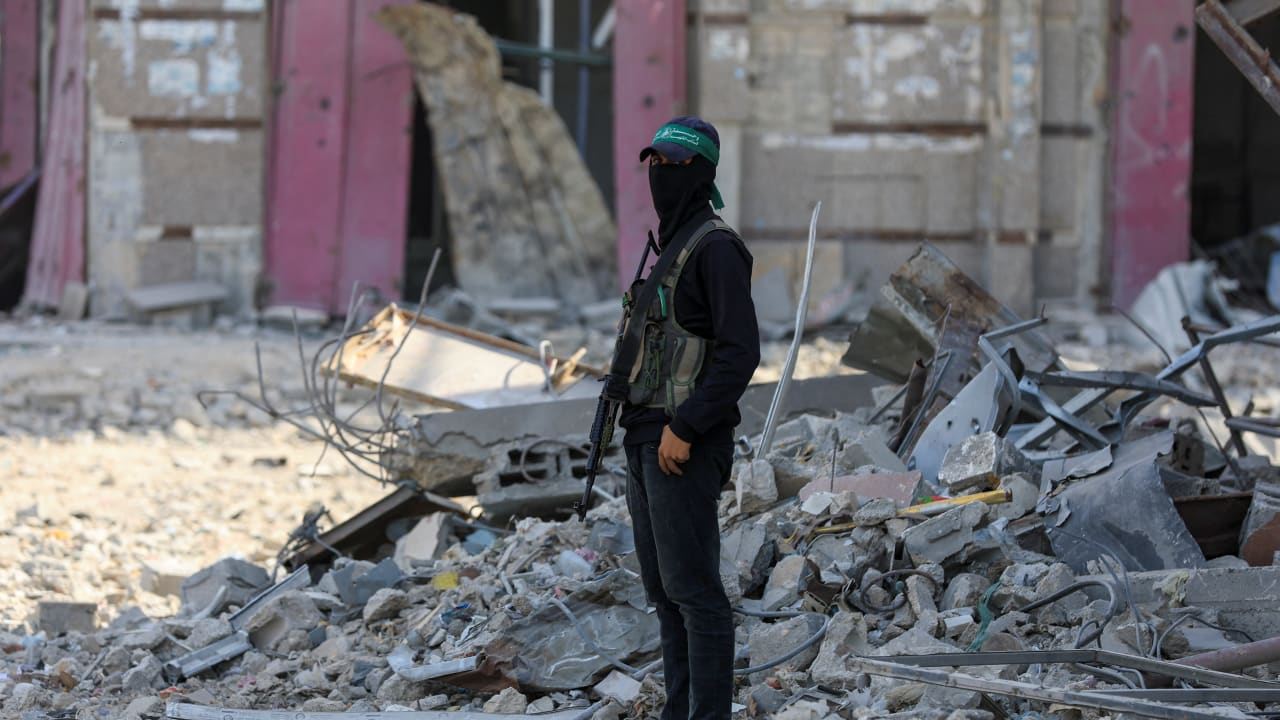
Gaza today sits between a fragile ceasefire and the terrifying prospect of a return to all-out war. After two years of devastation, the gunfire is quieter, but nothing is truly stable.
A narrow diplomatic opening has appeared – just wide enough to imagine a different future, tight enough to close with a single miscalculation. Whether Israelis, Palestinians, and their international partners can pass through this eye of the needle will depend on how the coming stabilization effort is conceived and led.
Thanks to United States President Donald Trump’s 20-Point Gaza Peace Plan and the Franco-Saudi New York Declaration, tentative first steps have been made away from full-scale war in Gaza. Yet three weeks into the ceasefire, Israel accused Hamas of violating the ceasefire, and has continued launching recurrent attacks on the strip.
Accompanying Palestinians and Israelis through this very narrow opening towards a longer-term peace requires intensive international support, including a carefully designed stabilization mission.
The first step will be putting in place the right mandate. The mission must meet a range of needs: provide security, oversee disarmament, protect civilians, unlock humanitarian access, assist in restoring basic services, help establish Palestinian governance, and bring a political horizon into view. To achieve all this, a military-heavy force designed purely to suppress violence won’t suffice. The mission must combine political, civilian protection, relief, service delivery, and security elements under clear leadership.

To remain effective, the mandate should be focused enough to avoid ‘mission creep’, and enjoy the backing of sponsors who will keep the mission on track (with constant pressure on the parties to stay engaged). Vigilant and benign external accompaniment of peace processes and transition arrangements has been vital in ending conflicts from Timor Leste and Northern Ireland to Colombia.
In Gaza, the critical sponsors with leverage over Israel and Hamas are the US, Saudi Arabia, Egypt, Turkey, and Qatar – but a broader United Nations Security Council Resolution would add important legal and political credibility to the enterprise.
Clear diagnoses of the drivers of instability is needed
Stabilization ultimately leads nowhere if no political horizon is in view. As past experience tells us, a good stabilization strategy begins with clear diagnosis of the drivers of instability, and embodies a practical, achievable plan to tackle these in a way that moves the situation towards a widely accepted political settlement. Despite a peace agreement in Mali, the absence of such a strategy and limited national commitment to conflict resolution and reconciliation made stabilization support a thankless task.
In Afghanistan, stabilization could have succeeded if there had been a consistent, long-term strategy, including a path for all regions and parties to peacefully re-enter the political settlement in the years after 2001. Such experiences are why seasoned peacekeepers today recognize the ‘primacy of politics’ as critical for mission success.
In Gaza’s case, the key players all require political reassurance to stop the ceasefire unraveling. Palestinians and their regional friends need to know that stabilization is inseparable from a political drive to end the conflict for good. To answer these concerns, Palestinians should lead the transitional administration; Gaza and the West Bank need to be reunified; the path to reaching a Palestinian state, with inclusive, accountable, and effective governance, must be clarified. It is unrealistic to think Palestinian resistance will transform into peaceful coexistence on any other basis; nor will essential partners Egypt and Saudi Arabia back a stabilization process that lacks a political horizon.
For Israel, this same political path must lead to full recognition, security guarantees, and normalized relations with Saudi Arabia and other regional powers. More urgently still, the main fear of Israelis is that Hamas will not disarm – urgent attention is needed to manage this critical concern, which could easily derail the peace effort. This is also essential for Palestine: until Hamas renounces power and arms, Palestinians will not be widely recognized as partners for peace.
To disarm Hamas, establish security, defuse crises, and protect civilians, the stabilization mission will require credible capabilities, including Quick Reaction Forces. However, any attempt at forcibly disarming Hamas will be a disaster. No troop contributor will sign up for an extension of Israel’s existing counter-terror war.
In Colombia, an amnesty and reintegration incentives were rolled out for FARC fighters well before the 2016 peace agreement, and the peace deal enabled those who reject violence to participate in society and politics going forward.
Hamas must give up power and weapons in Gaza – but it must be shown an exit it can walk through: an agreed process for surrendering arms leading to safe amnesty for those who did not commit crimes against humanity, and the chance to reintegrate into a civilian life worth living. Upon disarmament, monitoring mechanisms will be needed, for example, to track ceasefire compliance, human rights, illicit finance, and arms flows.
Palestinian ownership is vital – not only to ensure that Hamas leaves the stage – but also because stabilization will quickly unravel if it is perceived as a new occupation. Iraq’s experience with ‘deBa’athification’, which shut huge numbers of capable citizens out of their jobs, driving them into the arms of a gathering insurgency, offers a sobering lesson. If stabilization fails to offer local people ownership and agency, failure looms.
An international stabilization mission in Gaza must be presented as a necessity
An international stabilization mission in Gaza must be presented as a temporary necessity, with benchmarks leading to an exit strategy, and an early-as-possible handover to the Palestinian Authority. The PA does need to reform, via inclusive dialogue and elections, but it can only attain governing competency and establish legitimacy if it is trusted and resourced to govern and deliver services, without unreasonable obstacles in its way.

Public support is critical for mission success. The needs in Gaza are massive and must be met with urgency if the public is to accept the stability on offer. The public will not buy into peace and reject calls to violent rebellion, unless stabilization offers them safety, justice, improved services and jobs, and opens political channels for tackling grievances and pursuing inclusive governance reform. To meet these needs, civilian, humanitarian and political players within and beyond the mission need to be in the lead, with military stabilizers playing a supporting, collaborative role.
A core, urgent deliverable for the public is a sense of safety. To achieve this, community policing capabilities will be just as important as the military capacities that oversee disarmament and tackle flare-ups. In Northern Ireland, it was the focus on community policing – centering on trust, consent, and respect for human rights – that mollified a core grievance among Catholics, and enabled confidence in the peace process to grow. Countries with strong community police and rights-based criminal justice systems should ensure the Gaza mission has these capabilities at its core.
To win over the public, the mission must be set up to communicate effectively. In Iraq, General Petraeus made communication central to a strategy that brought violence down by 90% from 2006-2008. His approach was to be ‘first with the truth’ – communicating clearly and proactively to all relevant stakeholders and the public what the Coalition was and was not trying to do to make the situation better. The Gaza mission will need a similar approach.
A Gaza stabilization mission will also find it hard to succeed unless two further options are now firmly rejected: first is the inclusion of a separate counter-terror track in parallel to the mission. Afghanistan and other experiences have clearly shown that aggressive security operations divorced from the wider stabilization structure could undermine the wider effort. Second, private military companies must not be able to use lethal force in Gaza, as this would inject unaccountable violence into the mix in an incredibly delicate situation.
In settings such as Bosnia, Kosovo, Colombia, Northern Ireland, and Timor Leste, international support has helped end wars and support transitions to peace. All these experiences should underpin a careful and urgent search for the support Gaza now needs to pass through the eye of the needle.
Gaza’s fate now hinges on whether this support is shaped around three simple commitments: real security and recognition for Israelis, a credible path to statehood and accountable governance for Palestinians, and an international mission disciplined by the primacy of politics rather than the illusion of force alone. If leaders use this eye-of-the-needle moment to lock in those commitments, Gaza can move beyond perpetual crisis. If they do not, this narrow opening will close, and the next war will not be for lack of warning but for lack of will.
Hiba Qasas is the Founding Exec Director of Principles for Peace and Convenor of the Uniting for a Shared Future Coalition which brings together more than 500 leaders from politics, security, business, diplomacy, negotiations, media, and civil society to promote peace in Israel-Palestine.
Bert Koenders is a Former Dutch Foreign Minister and Development Minister, led UN Peacekeeping Missions as SRSG Ivory Coast and Mali and is Professor of Peace, Security and Law at Leiden University.
Lt Gen CJ (Kees) Matthijssen is a former Lieutenant General in the Royal Netherlands Army, and Force Commander UN Multidimensional Stabilization Mission in Mali (MINUSMA). He also served in Afghanistan, Iraq, and Bosnia-Herzegovina.