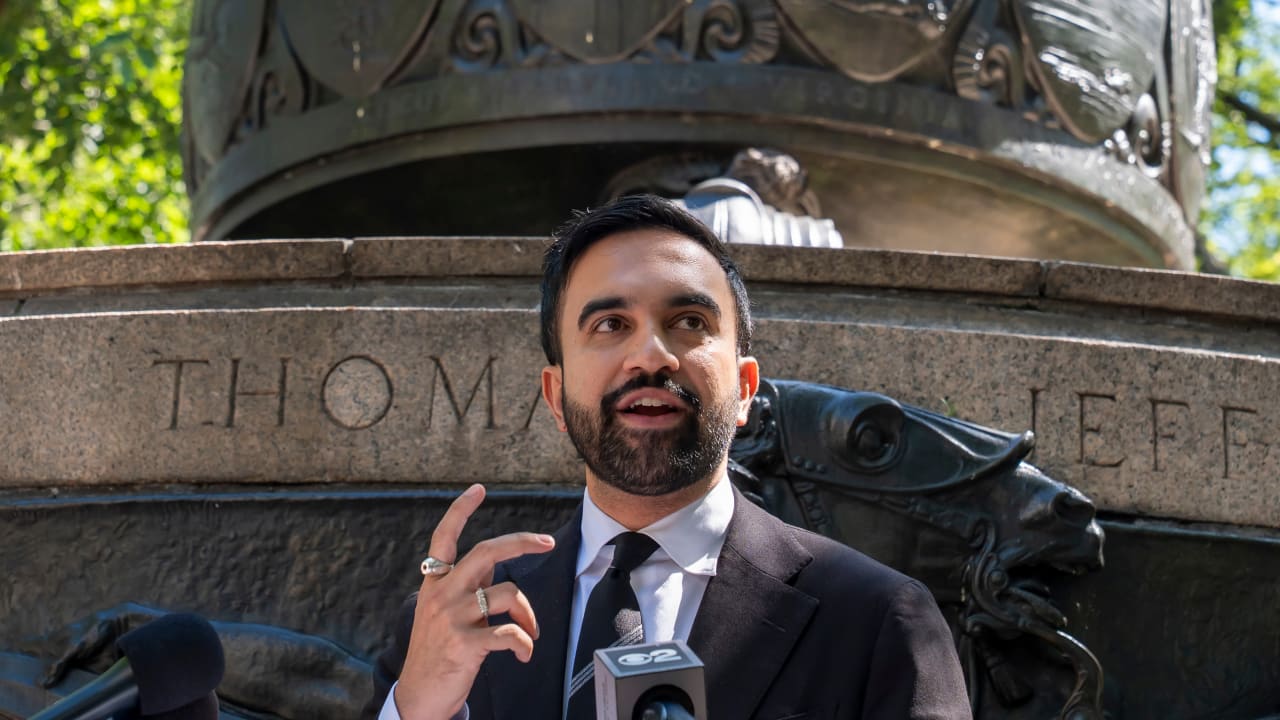
In the hours and days after Zohran Mamdani was declared mayor-elect of New York, my phone lit up again.
This time, it wasn’t simply the expected excitement or mourning we are used to with every post election season. It seemed more, like everyone was scrambling to climb down the apocalyptic ladder we had led ourselves onto. A rabbi in the weeks leading to the election declared Mamdani as someone who “poses a danger to the security of the New York Jewish Community,” another rabbi stated that Mamdani’s “ideological commitments” against Israel served to “delegitimize the Jewish community and encourage and exacerbate hostility towards Judaism and Jews.”
Yet after the election; both offered gracious statements wishing “Mayor-elect Mamdani and his administration every success in leading this city we love” or promising that “we will support Mayor Mamdani’s policies where we can…”
2025 was a pivotal year for Americans. Donald Trump returned to the White House, becoming only the second president in history to serve nonconsecutive terms after Grover Cleveland. Climate disasters shattered records, led by the California wildfires, the costliest ever recorded. In a historic first, Robert Francis Prevost, a Chicago native, assumed leadership of the largest denomination, in the world's largest religion. Former president Joe Biden, announced a late-stage cancer diagnosis. Charlie Kirk, one of America's strongest voices was shot publicly during a rally. We also had a 43-day government shutdown, the longest in American history. Making 2025, a history-shaping year.
For Jewish Americans, 2025 was something more than just historic. It was a year that carried a seismic shift in how our identity was used, and abused, in American politics. It was a year of fear, reflection and worry of what comes next.
On campuses across the country, Jewish students have been the target of physical attacks as well as other forms of violence in the name of “criticism of Israeli policy” without actual confirmation of personal stances in many cases. Fringe Holocaust-denying, racist voices were normalized on mainstream platforms. And in New York, the city with largest Jewish population outside of Israel, an election conflicted Jews like never before, even turning one against another with some putting it as having to choose between being a “good Jew” or a “traitor.” Every mayoral debate, interview, or conversation, the Jewish question was front and center. A top talking point for candidates and commentators alike. A valuable token to be peddled for personal and political gain.

During the fury, I did what I like to do most: listen and try to understand. So I met him in October. After sitting with then-candidate Mamdani and hearing him out, I was surprised that he wasn’t the caricature “Jew-hater” many had framed him to be; he spoke about bar mitzvahs and synagogues he had visited, and he committed to doing everything in his power to root out the scourge of antisemitism. So I wrote an op-ed in The Jerusalem Post, one of the most respected Jewish outlets in the world. The piece quickly became one of the most-commented-on opinion articles on the outlet’s Instagram that month.
But almost none of the comments correlated with what I actually wrote. Instead, they attacked the optics of it. I was called by many a kapo. Some insisted that I must have been paid by someone. Shmuley Boteach condemned it as a “brown-nosing, sycophant article.” Some of my close friends and family criticized me for “endangering Jews” . My phone was blasted for days, but when I asked, did you read my words, most didn’t even respond.
In the New Jersey gubernatorial election, for the first time in history; the sitting president of the United States blasted on his Truth Social account, on the world stage and pleaded: “I need ALL of my supporters in the Orthodox community In Lakewood and its surrounding towns to vote in huge numbers… including all the yeshiva students” yet again, positioning the Jewish identity and its vote front and center of American politics. It worked. Roughly 90% of Lakewood votes went for the Republican nominee, Jack Ciattarelli.
And then, Mamdani won. Sherril won.
In our circles there was a kind of hangover silence. After all the fear mongering and talks of “existential danger,” people asked themselves: “what is supposed to happen now?” So many of the voices who labeled him as a threat and a danger quickly shifted tone, wishing him success, urging unity. Others, like the ADL, doubled down stating they will set up a “special initiative to track his policies…” Everyone was coping differently with the reality that New York chose a mayor whose faith, as a Muslim-American, has been tokenized against him, and in some ways, we had helped perpetuate that.
It didn’t end there. Within hours of the election, Rep. Elise Stefanik, the clear front-runner for the GOP’s 2026 New York gubernatorial nomination, unloaded on her apparent opponent, incumbent governor Kathy Hochul, writing: “Under Kathy Hochul’s weak catastrophic leadership, New York City has now fallen to a pro-Hamas… Antisemite, Jihadist Communist.”
The next day, after swastikas were painted on the walls of Magen David Yeshiva in Brooklyn, Stefanik quickly posted: “The day after NYC elects a pro-Hamas Antisemite for Mayor, Nazi swastikas are found painted on the walls of Magen David Yeshiva in Brooklyn. This is reprehensible and unacceptable and should serve as a wake-up call that Mamdani is ushering in the pro-terrorist antisemitic takeover of NYC aided and abetted by the Worst Governor in America Kathy Hochul. Both Mamdani and Hochul are SILENT and have failed to condemn.”
In reality, Governor Hochul and Mayor-elect Mamdani condemned the incident that morning and Governor Hochul visited the site that afternoon.
This example between what actually happened and what was said about it, is the point. The Jewish community’s fears and trauma is genuine. I, a great-grandson of eight Holocaust survivors, father of two Jewish girls, understand that deeply and live with it every day. However, our fears and traumas are plainly being used in other people’s campaigns and agendas. Our pain is being weaponized by politicians against their opponents and by commentators as a subject which yields high ratings. And if we, the American Jewish community, are not careful, this can ultimately work against our own long-term interest in living safely and peacefully among all Americans.
As we enter a new year, 2026, with the mid-term and significant local elections looming, during which politicians will again try to tokenize the Jewish community for political gain, we are facing a choice. Will we reward those who use our fears and squash our identity into cheap talking points? Or will we demand something better? This is not a plea to choose red or blue. It is a plea to stop allowing anyone to treat us as a symbol for their base.
I want to urge my dear American Jewish community; let’s learn from the past and let’s not fall for this trap again.
Antisemite cannot become a cheapshot word. We should not deploy that on people for opinions they hold which we dislike. Whether internal or foreign conflicts. When we call everyone an antisemite, the word stops carrying weight for when we truly need it. Instead, let’s focus on merit and policy. Let’s argue hard on substance and speak with respect even when we think the other side is wrong.
And of course, let’s never stay silent in the face of hate. We must call it out when it's real. When Jews are threatened, when synagogues and schools are attacked, when conspiracy theories about us are spread, when the Holocaust becomes a comedy point, when crowds chant “Jews will not replace us,” when leaders brush off Hitler jokes.. Not just when it's politically convenient.
And to our leaders and would-be leaders: stop using us, the Jewish community, as your prop. Don’t hold us up as a political shield. Don’t speak about us as if we are a “problem” that needs to be managed or a little child who needs constant reassurance.
We are citizens like everyone else. If you want our vote, rather than promising to protect us from the monsters in the closet, show us, with your policies and your conduct, how you will govern, protect, and enhance the lives of a diverse and divided population with seriousness and integrity. That’s all we’re asking for.
The writer is an Orthodox Jewish New York businessman.