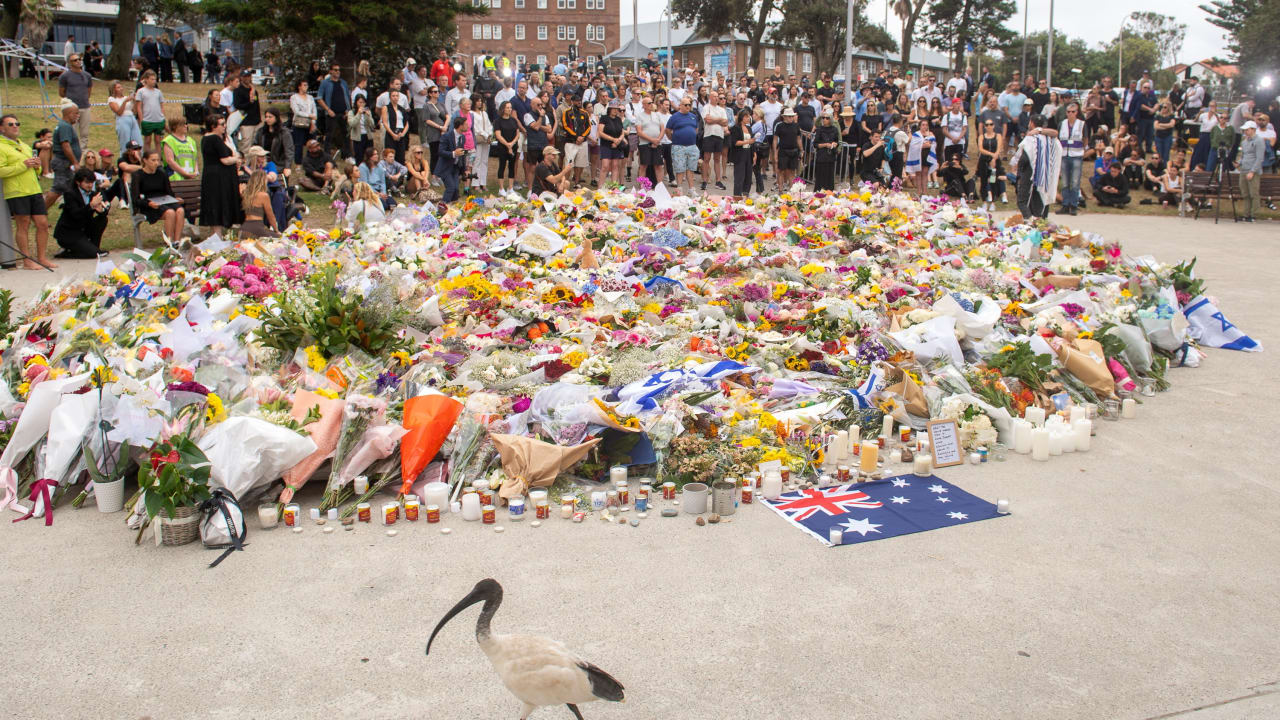
‘This doesn’t happen in Australia.”
The sentence arrived in waves, from stunned community leaders in Sydney to ordinary people who sounded like they had just discovered gravity. It showed up in messages, headlines, and the tone of phone calls that began with silence and ended with disbelief. It became a mantra, a defense mechanism, a desperate attempt to tape reality back together.
On Sunday, the entire Jerusalem Post staff followed and reported on the deadly terrorist attack at Bondi Beach, a Sydney suburb, while Jews were lighting the first candle of Hanukkah. That detail matters. Terror always chooses its stage carefully. A beach, a public celebration, a holiday that is literally about bringing light into darkness. The attackers did not just target people; they targeted visibility.
There was another strange layer to it, one that journalists do not talk about enough. The phone calls. The calls from abroad. The calls that usually come to Israel after an attack, when someone wants to check if “you are okay” and then ask, gently, what it is like to live like that.
This time, the tables turned
This time, my colleagues and I were the ones explaining how the first hours feel, how the body does not understand what the brain is trying to process, how anger and helplessness take turns like kids fighting over a toy. The same questions surfaced, the same shocked pacing around the same rooms; only the accents were different.

Some Israelis have learned to live with terror the way people learn to live with humidity. They do not enjoy it. They do not accept it. They just learn how to function when it returns. That does not make anyone “stronger”; it just makes the soul develop scar tissue. Watching Australia experience that moment, on the first night of Hanukkah, felt like watching a country publicly lose a kind of innocence in real time.
For Australia, this attack was a turning point. Not because antisemitism was absent before – it was not – but because there are “before” moments and “after” moments in the life of a community. France had one in 2012 with the attack at the Ozar Hatorah Jewish school in Toulouse. The US had one in 2018 with the Tree of Life shooting in Pittsburgh. In both cases, there had been incidents before, ugly ones, sometimes violent ones, but nothing that smashed through the national story the way those did.
The national story is always the same: “That’s not us.”
Then it becomes: “It happened, but it’s not a trend.”
Then, eventually, it becomes: “What do they do now?”
Bondi Beach was Australia’s collision with that progression.
The news from Sydney threw me back to 2012.
I was a boots-on-the-ground reporter then, covering an event in Paris, when word began to spread about a shooting at a Jewish school in Toulouse in the south of France. The early reports were confused, the numbers unclear, the names trickling in like poison. I remember the speed of the decision. Train. Bag. Notebook. Phone. Go.
A few hours later, I was standing at a school I knew too well. Years earlier, I had served as an emissary for the World Zionist Organization in that same school. I slept there for a night, prayed with the students and staff, and ate with them. I knew the feeling of being inside those walls, the feeling of being protected by community and also boxed in by the knowledge of why the protection exists.
Even on a normal day, the security there struck me. An armored electronic gate. Approval required from inside. This time, reaching the area outside the gate was its own ordeal. Police had blocked the surrounding streets. Broadcasting vans and reporters filled the neighborhood like a siege of microphones. Everyone wanted a story, and almost no one was welcome inside it.
In that chaos, something almost comic happened, except it was not funny at all. For once, wearing a kippah was an advantage. It softened faces. It broke the ice. It hinted at belonging. There are moments when Jewish visibility makes you a target and moments when it makes you a password. Toulouse was both.
I did not stroll in like a VIP. I had to work my way in, explain, insist, promise. At one point, a police officer, tall and wide, essentially made a threat in French that did not require translation. I do not speak French, but I understood him perfectly. He wanted me to pray to my God that I would not film anything.
I did not listen.
Then God, fate, technology, call it what you want, stepped in with an odd form of censorship. None of the recordings from that evening worked. The file was corrupted. In journalism, that is a nightmare. In life, it felt like a message: Some nights are not meant to be consumed as content.
Inside, the school courtyard was packed late into the night. Young people, older people, tears, hugs, and the kind of quiet comfort that is actually louder than shouting. French everywhere and also a striking amount of Hebrew. The tragedy drew relatives from Israel, dozens upon dozens, sleeping in dormitories that had been emptied of students who were sent home.
The dining hall became an improvised mortuary. That sentence still sounds unreal when I write it. Four bodies lay at one end of a room built for meals and chatter. Hundreds crowded in to recite Psalms, hear words of Torah, and embrace – because standing alone felt impossible.
A member of the community asked me later, “Did you pray Maariv (the evening prayer)?” It was not a theological question. It was a way of saying: “You are part of this now.” Journalist or not, foreign or not, detached or not, it wraps around you.
Outside those walls, France was in shock. “This doesn’t happen in France,” I heard again and again.
A decade later, the sentence has traveled to Australia.
Every country that thinks it is immune eventually says it – sometimes right before the first major attack, sometimes right after. It is never comforting. It is simply a denial, trying to buy time.
One of the most haunting lines I heard in Toulouse came from a local Jewish leader who was not surprised, just exhausted. “This is insane,” he told me, “but we knew it would come. We felt it. Antisemitism has been getting worse.” That was 2012. He was describing a community moving from graffiti and harassment to the fear of something more organized, lethal, and deliberate.
He had no idea how right he would be.
The modern Jewish condition has shifted in plain sight. It is no longer just slurs on a wall or a shove in the street. It is the normalization of the idea that Jews, especially visible Jews, are fair game. Sometimes the perpetrators wrap it in ideology, sometimes in “rage,” sometimes in imported slogans. The result is the same: sophisticated violence designed to kill as many Jews as possible and to broadcast that it is acceptable.
Sydney was not only an Australian story. It was a Jewish story, and it was a Western story. When Jews are targeted in the public square, the country is tested. Not in speeches, but in action. Not in hashtags, but in protection.
Which brings me to the question Israelis always ask after a diaspora attack, often too quickly and sometimes too casually: “So, will they make aliyah?”
My answer, in 2012, was complicated. It remains complicated now.
Aliyah rarely happens immediately after a Western-country crisis, even when intent spikes overnight. People need time to sell homes, change jobs, move children, learn systems, secure schooling, and find community. They need time to admit something out loud that they have been avoiding: the place that felt permanent might not be.
In the French case, the data eventually reflected that shift. The large surge did not happen the next morning; it gathered momentum over a couple of years, climbing to roughly 7,000 a year in 2014 and 2015. Fear can ignite the decision. Logistics determine the timeline.
And logistics are not romantic. Anyone who has tried to buy an apartment in Israel knows the real national anthem is not “Hatikvah”; it is “How much per square meter?” Even in 2012, selling a prime-location apartment in Paris did not guarantee a similar home in Tel Aviv. Australia is no different. People will do the math. They will hesitate. They will try to believe the country will fix it. They will hope they can keep the life they built.
Still, something shifts after a turning point. The vocabulary changes. The community starts to speak about “options.” Someone who never considered Israel begins to say the word “maybe.” A grandparent begins to speak differently to a grandchild. People start to look at synagogue security not as an inconvenience but as a sign of where they live.
So will Australia’s Jews make aliyah?
I do not see a wave in the near future. That is not cynicism; it is realism. But it would be naïve to believe Bondi Beach will not leave a mark. Turning points do not always produce immediate movement. They produce a new awareness, and awareness has consequences.
Hanukkah is about stubborn light. The Jews are very good at lighting candles. The question is whether countries that pride themselves on tolerance are willing to do the harder work: protecting the people holding the candles.
“This doesn’t happen in Australia” is not a sentence. It is a warning.
The only question is whether anyone listens before the next one.