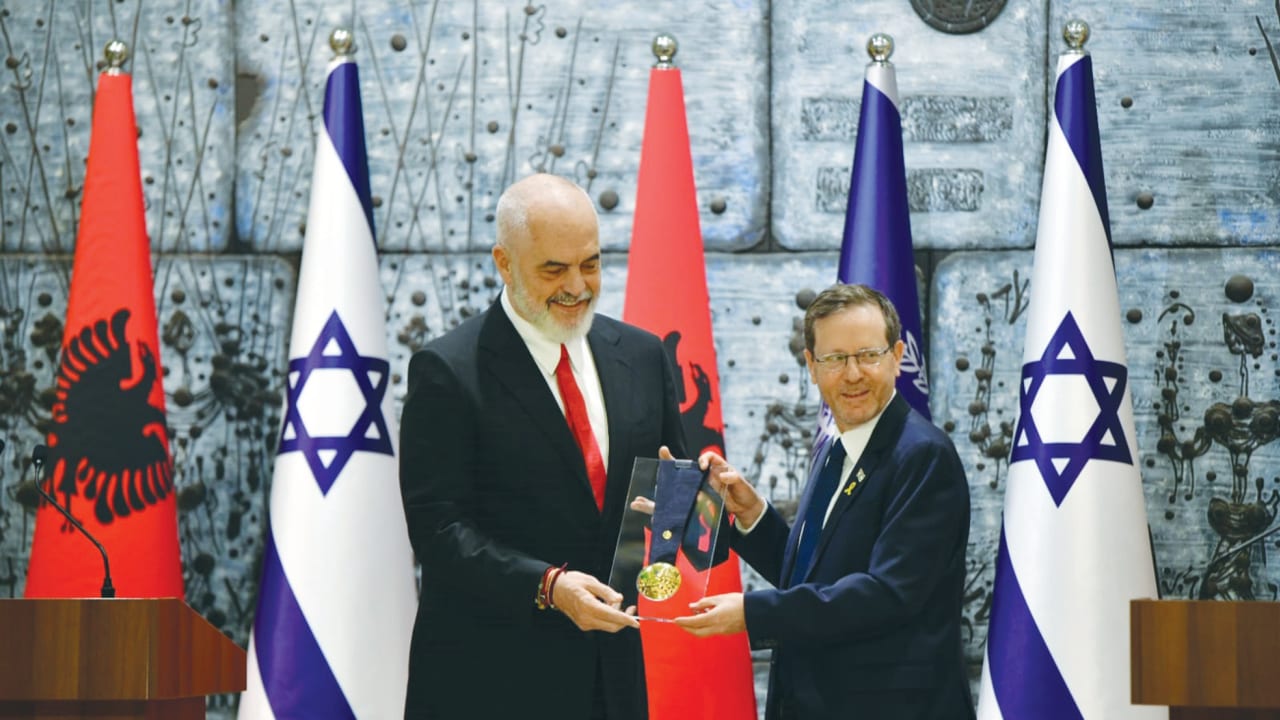
For most Israelis, Albania remains almost hidden between Greece and Italy – two popular vacation and business destinations. But few Israelis realize that Albania has more to offer than its perceived backwater status.
Albania and Israel share a bond forged in the Holocaust as the southeast European country was one of a few Nazi-occupied nations where the Jewish population not only survived but grew, thanks to the extraordinary courage of its Muslim-majority citizens who sheltered Jews at great personal risk. Many Albanians saved and gave refuge to thousands of Jews escaping Nazi persecution. This moral legacy has cultivated profound goodwill in Israel, where Albania is remembered as a beacon of humanity amid darkness.
Since Albania opened its Embassy in Tel Aviv in 1988 and Israel inaugurated its embassy in Tirana in August 2012, bilateral relations have grown, and cooperation has deepened, particularly in the fields of economics, culture, agriculture, and cybersecurity.
Today, Albania is a strategic ally, and has vocally condemned Hamas while fostering robust security ties with Israel, including collaboration between Albanian forces and Israeli defense giant Elbit Systems.
The economic potential of Albania
On paper, the economic potential is immense. Direct flights connect Tel Aviv to Tirana, Albania boasts a stunning Mediterranean coastline, and its government under Prime Minister Edi Rama projects a pro-business, innovation-friendly image.

Israeli investors, known for their appetite for emerging markets, should be flocking to Albania. Yet, the reality is starkly different: Investment flows remain modest, stalled not by cultural barriers but by deep-seated structural issues. Israeli capital hesitates, wary of Albania's institutional fragility and rule-of-law deficits.
From the Israeli investor's perspective, this is the "Security Paradox." Israelis are no strangers to risk as they thrive in complex environments from Africa to Asia, but they insist on legal predictability. Albania offers physical safety for Jews seeking business or pleasure, with virtually zero antisemitism, a refreshing contrast to rising threats in Western Europe.
However, the business landscape feels legally precarious. Persistent criminal networks and weak judicial institutions make assets vulnerable, turning diplomatic warmth into economic caution. Major projects grind to a halt amid fears that contracts could unravel in a system plagued by unpredictability.
This hesitation is amplified by the broader geopolitical context in the Balkans. Albania's EU accession process is inching forward, but domestic politics add layers of uncertainty. Prime Minister Rama's relationship with the US administration under President Donald Trump has been described as complicated, with Trump's anti-EU rhetoric casting shadows over Albania's election landscape and integration efforts. For Israeli institutional investors who prioritize long-term stability, such volatility raises red flags.
At the heart of this crisis is Albania's rule-of-law woes, epitomized by its alarming pre-trial detention rates. A staggering 62% of prisoners there are in pre-trial detention, the highest in Europe, highlighting a system reliant on prolonged incarceration without conviction. The Special Structure Against Corruption and Organized Crime (SPAK), meant to root out graft, faces accusations of judicial overreach, morphing into a tool for political maneuvering. For foreign investors, this erodes trust: a legal framework that flouts due process undermines the very foundations of secure business dealings.
The uncertainty impacts Israel
This isn't abstract; it hits close to home for Israel's allies in Albania. Consider Ilir Meta, the former president who visited Israel in January 2020. He warmly embraced IDF rescue teams aiding his country after the devastating 2019 earthquake, awarding them the prestigious "Golden Medal of the Eagle" in gratitude. Meta's pro-Israel credentials are impeccable, rooted in historical ties solidified by declarations of friendship between Rama and Prime Minister Benjamin Netanyahu in 2015.
Yet today, this steadfast friend languishes in pre-trial detention, a victim of the very system meant to ensure justice. If a former head of state can be held indefinitely without a verdict, what protections exist for investors or partners?
The paralysis extends to Tirana's visionary mayor, Erion Veliaj, the architect of Albania-Israel urban synergy. Veliaj explicitly modeled Tirana's revival on Tel Aviv, dubbing it the "Balkan Tel Aviv" – a hub of innovation, youth culture, and tech-driven growth. He cultivated ties with Tel Aviv Mayor Ron Huldai, whom he calls a mentor, meeting him multiple times to exchange ideas on urban transformation.
Veliaj's outreach went further: he invited Israeli companies to the Tirana Economic Development Area (TEDA), Albania's inaugural Free Economic Zone in Kashar. Positioned as a tax-free paradise for tech, automotive, and digital firms, TEDA offers VAT exemptions and streamlined customs to sidestep bureaucracy. During the "Tirana-Tel Aviv Technology Week," Veliaj urged Israeli startups to establish regional headquarters there, promising a seamless gateway to Europe.
But as of December, this vision is frozen. Veliaj had been in pre-trial detention for several months starting in February 2025, amid allegations critics label as political persecution. Although Albania's Constitutional Court overturned his removal in November 2025, reinstating him after what had become a nine-month ordeal, he still remains barred from physically attending municipal meetings. Reports from international law firms like Kasowitz and Mishcon de Reya detail this as a case of targeted political vendetta, undermining democratic processes.
The irony is biting: the mayor who extended the invitation to Israeli firms cannot now sign their permits. For an Israeli CEO eyeing TEDA, this is the ultimate deterrent – governance from a cell, stalling the "Balkan Tel Aviv" dream.
Albania possesses the history, geography, and strategic will to become Israel's key Balkan partner. But goodwill alone won't suffice. The "Start-Up Nation" cannot thrive in a "Lock-Up Nation" where legal uncertainty reigns. To unleash the economic boom, Albania must urgently restore the rule of law: normalize pre-trial practices, ensure due process, and fully reinstate leaders like Veliaj. Only then can potential translate into profit, turning the Tirana trap into a thriving bridge between two resilient nations.
Israel Kasnett is the senior content writer at B.C. Strategy.