
In the last five years, millions of words have been written about Israel, its wars and policies, Zionism, Jews, Judaism, and surging antisemitism. But with regard to China, with its population of nearly a billion and a half people, little has been written on these topics. Why?
First, there are very few Jews in China, and it denies that it harbors any antisemitism. Second, China is perceived not to matter much in the global discussion about Jews and antisemitism. And third, there are probably no more than five academic experts on antisemitism who speak and read Chinese.
The Jewish People’s Policy Institute’s new publication, Chinese Antisemitism 2021-2025, Its Origins and Purposes, fills an important gap. It contradicts assumptions that antisemitism is not a Chinese issue and that China’s position on this subject does not matter.
Why China's stance on Jews, Israel matters
Since 2020, China has taken a more hostile public stance against Israel and advised Israeli contacts to take a low profile in China. There was no single reason for this; rather, it resulted from the confluence of several factors. Israel, admonished by the United States, made Chinese investments, particularly in hi-tech and infrastructure projects, more difficult. The Chinese expressed their resentment quite openly. Second, China was in the midst of expanding its presence in the Arab Middle East, offering major economic cooperation and long-lasting political ties. A harder attitude against Israel was a cheap sweetener for such offers. And third, Israel’s domestic crisis eroded its “strongman” image in Chinese eyes. A country wracked by mass demonstrations and numerous ineffective elections could no longer be taken as seriously as it had been.
After the short 2021 Gaza war, a Chinese UN delegate accused Israel of war crimes. This was unusual. Antisemitic comments appeared in China’s media. In other words, antisemitism was not an isolated initiative, but part of a larger, coordinated policy trend.
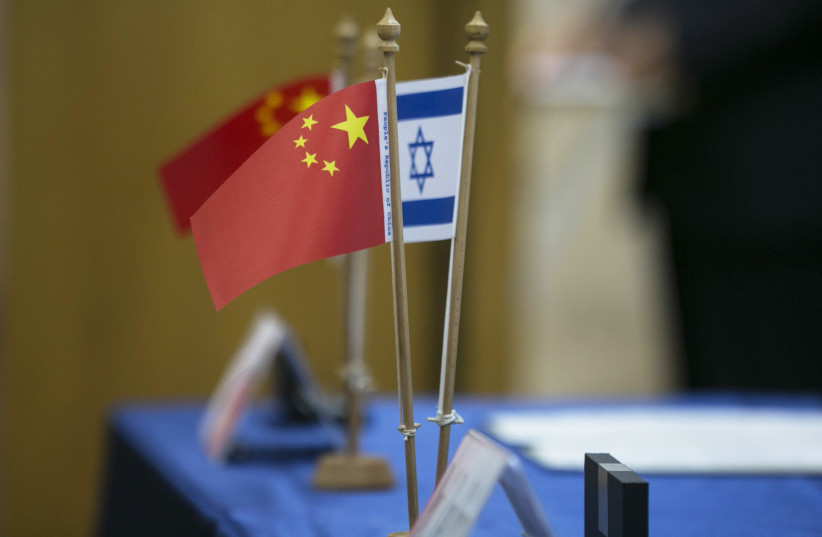
A second, stronger, and still unabated antisemitic wave hit in the wake of October 7. Antisemitism, not just criticism of Israel’s military conduct, surged in the official press and on social media platforms. The rhetoric was particularly vitriolic in China’s universities, which became key transmitters of antisemitic tropes. When a senior political figure pontificated that “political survival in the US” is “parasitically attached to Israel’s powerful Jewish forces,” he was trafficking in traditional antisemitic imagery; he did not lament Gaza’s children.
When a publishing house cancelled planned books on Jewish history, the whiff of Nazi Germany and Stalinist Russia was unmistakable. Still, it did not advance the case for a Palestinian state. Neither did the removal of memorial plaques from a former synagogue in a place where Jews once lived. Some manifestations of Chinese antisemitism looked Orwellian: wiping out the memory of long-dead Jews.
When a professor at Shanghai’s prestigious Fudan University complained that criticism of Israel’s “crimes” was impossible in the West because all public voices were “controlled by financial capitalists… a shadow empire,” he stuck an old antisemitic canard of Jewish media control on a fantasy image of today’s West. And when a well-known blogger who claimed to have 15 million followers quoted Adolf Hitler against the Jews, he closed a circle. In China, the monster returned to its starting point. No Chinese antisemitism originated in China; it was imported from countries with a Christian past, particularly Russia, or from Islam.
The spread of antisemitism in China’s media meant that it had been officially sanctioned. Conflating Israel and Zionism with Jews and Judaism is nothing new, but no other country controls and censors political speech as tightly as China does. It makes little sense for Jews to denounce university professors or managers of social media websites for antisemitism; they are controlled by the Communist Party and hence, the Government. All criticism of Russia’s Putin or of Muslim leaders was blocked, while denunciation of Israel was perfectly permissible, perhaps even encouraged. No constraints were placed on blaming Jewish money for its stranglehold on America. Anti-Israeli Qatar was granted financial control over some university faculties, and Al Jazeera inside China was unimpeded in partisan, one-sided reporting on the Middle East.
What does China hope to achieve by jettisoning links with Israel and the Jewish people? One explanation is linked to the less discussed Cold War between the United States and China. Whether Israel wants it or not – and it does not – it is inextricably tied to this confrontation. “We use Israel as a stick to beat the Americans,” said a Chinese official who was unexpectedly overheard.
Another explanation is China’s even more unmentionable fear of Islam. Muslim minorities – not just the Uyghurs – have revolted against Chinese rule more than once over the last two hundred years. China’s longest borders are with the Central Asian Muslim countries. China seeks to control them, but other candidates are waiting at the gates: Turkey, Russia, the United States, and even Israel. Moreover, 57 Muslim UN member states and their one hundred willing and unwilling supporters are seeking to dominate the international system.
Some point to China’s dependence on Middle Eastern oil, but this dependence is double-edged, and China has the stronger hand. Oil producers depend more on the Chinese market than China does on them.
The sea lanes from the Middle East to China are what are most critical for Beijing, and so we return to the first of China’s concerns, the United States, more precisely, the US Navy.
Arguably, the most salient driver of China’s newfound antisemitism is its discovery of “Palestinianism,” the global revolutionary movement trying to focus Western energies on the destruction of Israel.
What can Israel do to cope with its unenviable situation?
It can perform a few tasks and must not perform a few others. Israel must remember Ben-Gurion’s exhortation to forge Israeli ties with China in the early 1960s when Beijing had even more contempt for the Jewish state.
Israel must be firm in its rejection of China’s official denials that it has become a breeding ground of antisemitism. Israel should build an alliance with the Jewish Diaspora against Chinese antisemitism and a Western political alliance to combat it. Jews across the world worry – and rightly so – about the reemergence of antisemitism, but know little about China’s contribution. Many countries important to China have Jewish communities that can and should make their voices heard in Beijing.
Western countries that have promised to fight antisemitism haven’t a clue about the scourge of the Chinese variant. This has to change. When a Chinese blogger recommends the bile of Adolf Hitler, Germany should act without equivocation. From lodging formal diplomatic protests to blacklisting them from entering Germany or the entire EU zone, it must act.
Finally, when it comes to Taiwan, Israel should have no illusion that it can play “carrot and stick” with China. Israel is too small, and the danger of getting dragged into the East Asian powder keg is too big. Israel must maintain its “One China” policy as it has always done. This means ignoring the urges and opportunities to help Taiwan improve its political situation, while strengthening non-political economic, cultural, and academic relations with Taiwan, including research on Chinese antisemitism.
As the world inaugurates 2026 with hopes of peace and prosperity, the antisemitism virus continues its international spread. China will have to choose. Is it wise to swim in a toxic river that has no genuine Chinese source? Will this truly advance China's national and geopolitical interests?
The writer is a senior fellow at JPPI – the Jewish People Policy Institute.