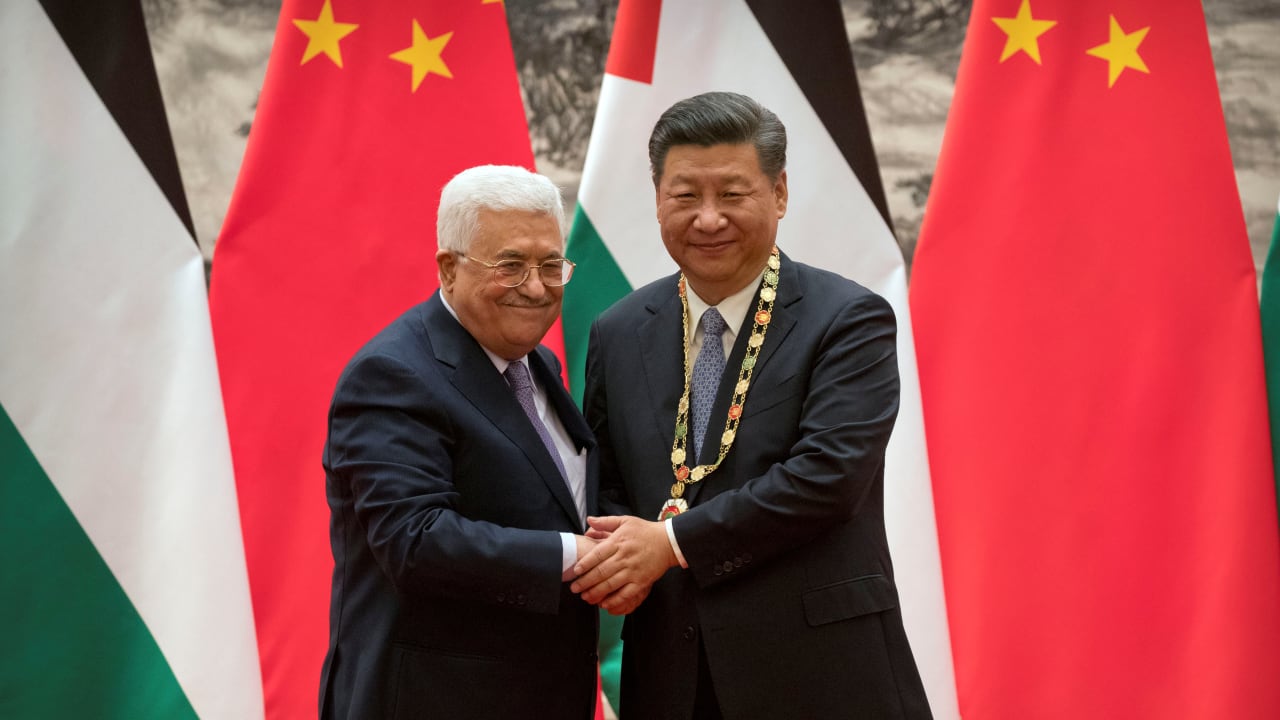
Since the beginning of the 21st century, China has increased its military supplies to Middle Eastern countries, primarily to Iran. Allegedly contrary to Beijing’s will, Tehran transferred some of these arms to regional terrorist organizations, mainly to Hamas in Gaza, pro-Iran militias in Iraq, and Hezbollah in Lebanon.
In 2006, one of Hezbollah’s surface-to-sea missiles, made or designed in China, hit an Israeli Navy corvette-type ship. Following Iran’s defeat in its war with Israel (and the US), Beijing has begun to supplement Iran for its losses while Tehran has never concealed its intentions to destroy Israel.
The question is, what has Israel done to deserve this growing Chinese hostility, not to mention the well-orchestrated wave of antisemitism all over China’s media, given what Israel has contributed to promoting Chinese interests from the very beginning?
Israeli recognition of China
Today, 76 years ago, on January 9, 1950, Israel became the first country in the Middle East – and the seventh in the non-communist world – to recognize the People’s Republic of China. Despite its international isolation, Beijing rejected diplomatic relations with Israel. In July 1951, Zhou Enlai, PRC prime minister and foreign minister, told the Soviet ambassador that China will not establish relations with Israel. Such relations, he said “will not bring anything substantial – and besides, this can lead to a worsening of relations with the countries of the Arab League which, in a number of cases, have supported the PRC.”
In fact, it was only in July 1956 that the first Arab country (Egypt) recognized China, the last being Saudi Arabia in July 1990. Until then, Saudi Arabia, and a few other Arab countries, had still maintained full diplomatic relations with Taiwan (the Republic of China), which Israel has never recognized – a precondition for establishing diplomatic relations with the PRC.

Also, with one exception – described as a “mistake” – Israel has never rejected the PRC’s admission to the United Nations despite continuous American pressure. Disregarding Israel’s goodwill, in 1965 China was not only the first non-Arab country to recognize the Palestine Liberation Organization (PLO) but also provided its members not just with ideological and military training but also with arms – targeting Israel.
In addition, Beijing systematically condemned Israel as an aggressive country, a lackey of “American imperialism.” At the same time, China’s People’s Liberation Army (PLA) was drawing lessons from Israel’s crushing Soviet weapons – now targeting China. By the late 1960s, Chinese and Soviet forces clashed.
Supporting China's security
Since the late 1960s, as the Soviet Union became the main threat to China’s security, relations between Beijing and Washington had begun to improve, leading in October 1971 to the admission of the PRC to the UN and its Security Council, a step that Israel supported. Sharing a common interest, America now wanted to strengthen China’s crippled PLA to withstand Soviet aggression and expansion.
Unable to do it, the US realized that Israel was the only country in the world that could provide China with Soviet-made and upgraded weapons. In early 1979, a high-level Israeli defense delegation flew to China. Following the secret visit, Israel supplied the Chinese with a variety of weapons and military technology, including air-to-air missiles, tanks, guns, and aircraft blueprints that became a basis for the PLA resurrection.
China’s high leaders must have known everything about it, primarily the defense minister – and, obviously, his personal secretary who, at that time, was Xi Jiping who has been running China since 2013. Israel’s military role was the main reason for Beijing’s final agreement to establish diplomatic relations with Jerusalem in January 1992 – the last in the Middle East, ironically 42 years after Israel had been the first in the region to recognize the PRC.
By that time, the world situation had changed following the disintegration of the Soviet Union. Now, Washington has singled out China as its main enemy and began to apply pressure on Israel to dilute its relations with it, primarily military.
Relations between Israel and China
Actually, from the very beginning, Israel’s relations with China (or lack thereof) have always been trilateral rather than bilateral. In the 1950s and 60s, Washington had reservations about Jerusalem’s favorable attitude toward Beijing, blocking any attempt for diplomatic relations between the two countries. So, whereas the US managed to establish diplomatic relations with China in 1979, Israel had to wait until early 1992.
Forced by the US to stop all military relations with Beijing and despite Washington’s reservations, Israel and China have developed extensive economic, cultural, technological, and scientific relations out of all proportion compared to other Middle Eastern countries that are substantially bigger and richer – while still officially and politically identifying with the Arabs and the Palestinians.
Yet, unlike the transliteration of the term “Zionism” in all other languages, the term in Chinese (youtai fuguo zhuyi) is an interpretation, reflecting the essence of the term, namely “Jews Return to the[ir] Country,” a sense that does not exist even in Hebrew.
Nevertheless, China continued, and even increased its public hostility toward Israel, leading a wave of antisemitism previously unknown there. More disturbing, Beijing has accelerated its military sales to Middle Eastern countries, notably Iran, including chemicals and technologies essential for ballistic missiles production. In fact, China has become Iran’s partner in targeting Israel and thus, and against its own interests, is pushing Israel further to US sponsorship.
There is practically nothing that Israel can do directly to change Beijing’s ungracious policy, but it can do it indirectly by providing Taiwan with state-of-the-art weapons, which would prevent a prospective Chinese invasion of the island, or make it highly costly to China. Israel has done nothing wrong to China – on the contrary – so why it deserves such Chinese hostility is a mystery.
The author is professor emeritus in the departments of political science and Asian studies at the Hebrew University of Jerusalem.