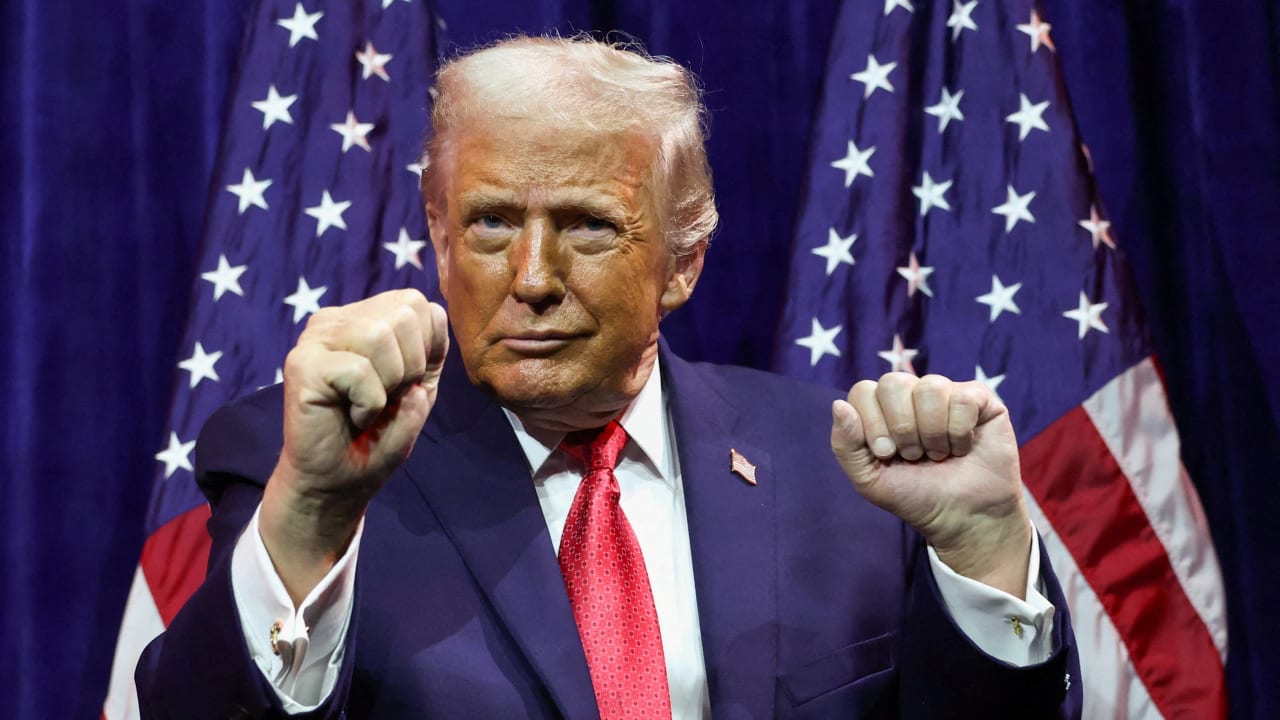
Before our eyes, the vision once sung by the socialist Internationale (the workers’ anthem that calls to tear down the old world to its foundations) is taking shape, and it is happening at the hands of the other pole, the capitalist West, or more precisely, under US President Donald Trump.
In its new configuration, the US is producing and encouraging a new world order, tectonic political shifts, more aggressive power, lighter trigger on military force, and burial of political correctness”.
It starts at the global level and spills into our Middle East at a pace and intensity that sparks astonishment, panic, growing pains, and maybe a sliver of hope.
Let’s begin with the question of questions: Is the US still the largest and strongest democracy in the world? The answer has become complicated and no longer clear-cut.
It is possible that even Israel, struggling over its democracy, may currently lead compared to a superpower turning extreme and increasingly unfamiliar.

One thing is clear: President Trump is pulling the world back, in a very direct way, to a unipolar world, led by a single superpower, with all due respect to China and Russia.
Right now, the world has one king who wields tariffs and economic power with one hand, and military power with the other, in Iran, in Venezuela, soon in Greenland, and so on. The ambitions are big. Cuba is also on the radar.
In the military operation, impressive, it must be said, to seize dictator Nicolás Maduro and his wife and bring them to stand trial in New York, Trump presented the world with resolve, capability, and deterrence that put leaders and states on notice.
Does this step grant legitimacy to other countries to act the same way? Probably yes. Will they dare? Not sure. Still, this is an unusual and dangerous move that can hand a green light to a Chinese invasion of Taiwan, a Russian push into additional parts of Ukraine, and perhaps even “samples” here in our region.
Middle East faces problems stemming from American power
The Middle East has its own problems, shaped by American power and missteps. Israel is focused right now on Iran: the regime’s pressure, and the steps the ayatollah regime might take when it feels its back against the wall and tries to divert attention toward a war with Israel.
Inside Iran, the rebuilding of capabilities in missiles and air defense is moving fast. There is also a desire for revenge, a sense of mission to eliminate the Zionist project, and a drive to reset the region’s agenda.
Lebanon and Hezbollah are also on the agenda. The agreement under which the terrorist organization was supposed to disarm has failed. The air force has returned to activity there against rehabilitation and rearmament targets, and a broader operation is waiting for the right moment and a decision.
And maybe the next front will be somewhere else: on the Jordan border, in the West Bank, or through an incursion by Iranian-backed militias from the south or the north.
In the meantime, Israel is trying to settle matters with Syria, focusing on Somaliland (the self-declared republic in the Horn of Africa) across from Houthi Yemen, trying to slow Trump’s dash toward a Nobel Peace Prize at our expense, and tempting him with an “Israel Prize for Peace” floated by Education Minister Yoav Kisch.
This is a new world, without any doubt, in governing culture, in language, in technology, and in brute force. Trump, Erdogan, Putin, Kim Jong-un, Netanyahu, Xi Jinping, and even Zohran Mamdani in New York, these are the leaders of our new world. Good luck.
The writer is a former IDF spokesperson.